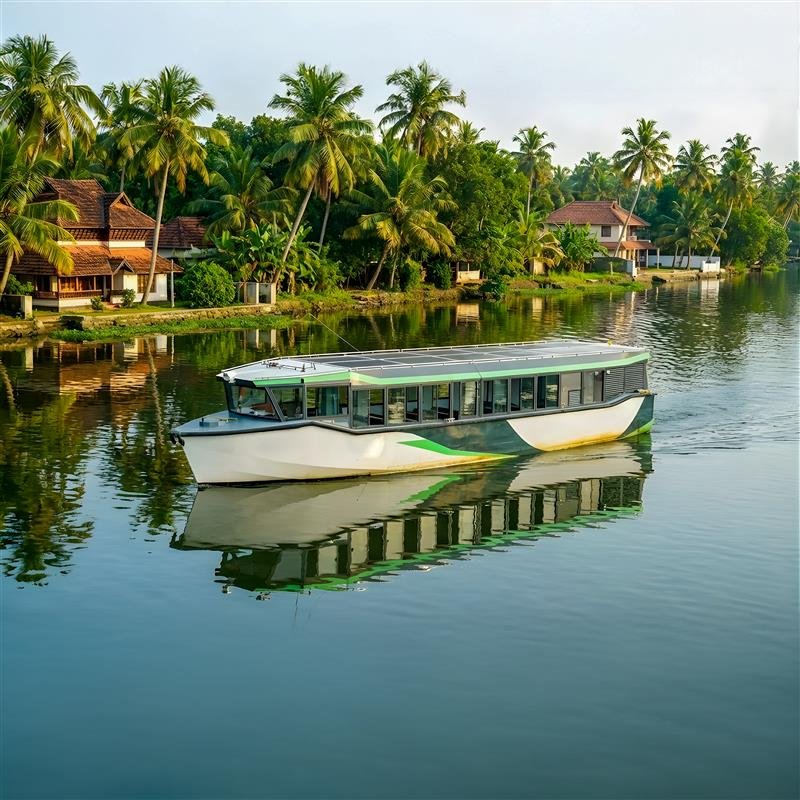
In 2017, a ferry began crossing Kerala’s Vembanad lake carrying 75 passengers — silently, with no diesel engine and no fuel bill. The Aditya, built by Kochi startup Navalt, went on to ferry roughly half a million passengers a year and save an estimated 225,000 litres of diesel annually. Nearly a decade later, the company says it has built more than 80 solar-electric vessels — ferries, workboats and water taxis — and its latest, Barracuda, is billed as India’s fastest solar-electric boat.
Navigation by alternative energy
Navalt Solar & Electric Boats Private Limited was founded in Kochi in 2013 by Sandith Thandasherry — a naval architect from IIT Madras who had worked in shipyards in South Korea and Japan before an MBA in France. The name is a contraction of “Navigation by Alternative Energy,” and the company began as a joint venture between Navgathi India, France’s AltEn and EVE Systems. It is the kind of cross-border, deep-domain founding story that explains how a Kerala startup ended up the subject of a Harvard Business Review case study (via IIM Bangalore, 2026).
The thesis was simple and contrarian: waterways are the ideal first market for electric propulsion. Boats run fixed routes at steady speeds, solar panels love open water, and diesel ferries are ruinously expensive to operate. While the auto industry argued about charging infrastructure, Navalt built boats where the fuel falls from the sky.
Aditya: the ferry that proved it
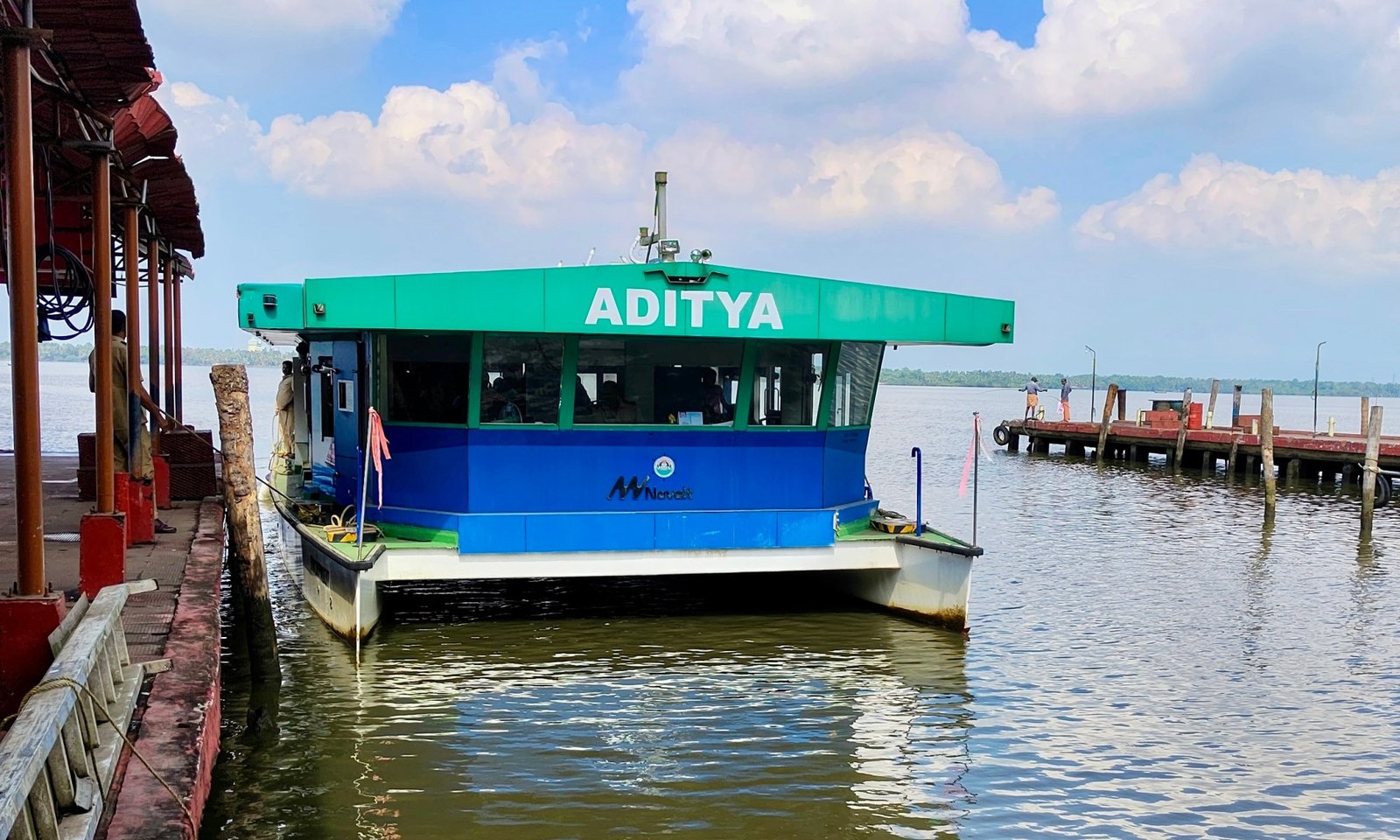
The Aditya, launched in 2017 on the Vaikom–Thavanakkadavu route, was India’s first solar ferry — and it became the company’s proof of concept at scale. The numbers, widely reported: around 500,000 passengers a year, roughly 225,000 litres of diesel avoided, and about 500,000 kg of CO₂ not emitted. It won the first Gustave Trouvé Electric Boat Award in 2020 — the electric boating world’s international prize — and Navalt repeated the win in 2024 with its Srav workboat. An earlier boat, Sunrider, entered the Limca Book of Records as India’s fastest solar boat, per the company’s account via Plugboats.
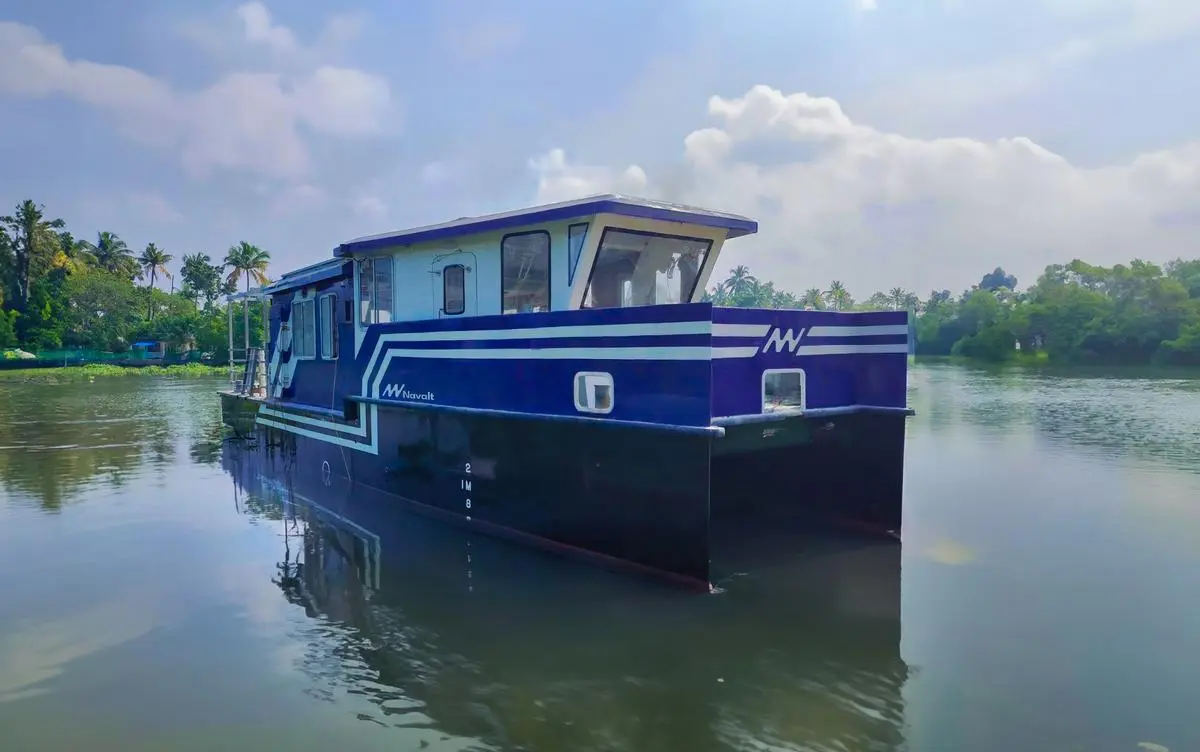
Then came Barracuda, the current flagship: a 14-metre, 12-knot solar-electric boat with twin 50 kW motors, a marine-grade LFP battery, 6 kW of solar and 12-passenger capacity. Built with Mazagon Dock Shipbuilders and launched in Alappuzha, it is described as India’s fastest *solar-electric* boat — attributed to the company and the Kerala government, with Minister P. Rajeev at the launch. A 12-knot solar boat is not India’s fastest boat overall, and this post won’t imply otherwise.
Half a million passengers a year on sunlight — the Aditya proved that solar ferries aren’t a demonstration project but a working transport business.
Scale, exports and the RoRo bet
The fleet numbers need careful reading. Down to Earth (October 2026) cited “around 80 vessels deployed across 11 states”; the CEO told Saur Energy the same month about 87 boat projects with roughly 46 operating; ETV Bharat (August 2026) split it as 45 delivered plus 40 under construction. The honest summary: the company says 80-plus vessels built, about 46 in active operation — attribute the figures and don’t imply all 80 are in service.
The order book is going bigger. In March 2026 the company announced two 100-tonne solar RoRo vessels for the Kerala State Water Transport Department, each able to carry four 40-foot container trucks or around 30 cars. Exports are real too: vessels for Halifax Harbour Tours in Canada, plus orders across Israel, the Maldives (a US$650,000 ferry order), Seychelles and Cyprus. The catalogue spans 18 models, and in 2023 Barracuda won the Berlin Start-up Energy Transition Award in mobility.
Key takeaway
The takeaway: Navalt turned a contrarian thesis — waterways first, roads later — into 80-plus solar-electric vessels and genuine exports. The “fastest” claims are category-specific and attributed; the diesel savings are the real story — the same sun-to-value logic Solavio applies to solar-panel cleaning.
The economics of sun-powered ferries
The business case writes itself wherever ferries run daily: diesel is a ferry operator’s largest cost, sunlight is free, and electric drivetrains need a fraction of the maintenance. The Aditya’s reported 225,000 litres of annual diesel savings is the number that sells the next boat. The open questions are industrial — can Navalt scale production for the RoRo and export pipeline while holding quality? With a decade of operating history and an HBR case study, it has earned the benefit of the doubt most marine-EV startups never get. Maritime autonomy is advancing on the defence side too — see Sagar Defence’s crewless vessels.
What is Navalt?
Navalt Solar & Electric Boats Private Limited is a Kochi-based company founded in 2013 by naval architect Sandith Thandasherry (IIT Madras). The name contracts “Navigation by Alternative Energy.” It builds solar-electric ferries, workboats, water taxis and patrol craft, and says none of its vessels will ever burn fossil fuel.
What was the Aditya?
Launched in 2017 on Kerala’s Vaikom–Thavanakkadavu route, the Aditya was India’s first solar ferry. It reportedly carries around 500,000 passengers a year, saving roughly 225,000 litres of diesel annually, and won the first Gustave Trouvé Electric Boat Award in 2020.
Is Barracuda really India’s fastest solar-electric boat?
That description comes from the company and the Kerala government (Minister P. Rajeev attended the launch). The qualifier matters: Barracuda, at 12 knots, is described as India’s fastest solar-electric boat — not India’s fastest boat overall. It is a 14-metre vessel with twin 50 kW motors, built with Mazagon Dock Shipbuilders.
How many boats has Navalt built?
The company says 80-plus vessels. Reports split this as 45 delivered plus 40 under construction (August 2026), with the CEO citing about 46 currently operating (October 2026). Use attributed ranges rather than a single hard number.
Does Navalt export?
Yes — vessels for Halifax Harbour Tours in Canada, plus orders in Israel, the Maldives (a US$650,000 ferry order), Seychelles and Cyprus, per company statements and press coverage.
More Read
Sources & further reading
- Down to Earth: Kerala’s electric waterways — Fleet scale, RoRo vessels and the economics of solar ferries
- Navalt — official site — Vessel range, company background and the “never burn fossil fuel” positioning
- Navalt Apollo — official channel video — 75-passenger solar-electric ferry walkthrough on the company’s official YouTube channel