An ordinary camera sees the world in three colours. The satellites flying over your head right now can see it in more than 135. One of them can tell, from 550 kilometres up, whether a patch of farmland is just stressed enough to fail in a week, or whether a plume of methane is leaking from a pipeline nobody has inspected in months. And the company that built it works out of Bengaluru.
The company is Pixxel (Pixxel Space Technologies), founded in 2019 by Awais Ahmed (co-founder and CEO) and Kshitij Khandelwal (co-founder and CTO). Its bet is that the next leap in Earth observation is not sharper pictures but richer ones: hyperspectral imaging, which splits reflected sunlight into hundreds of narrow bands, turns every pixel into a chemical fingerprint of whatever is below.
Seeing in 135 colours
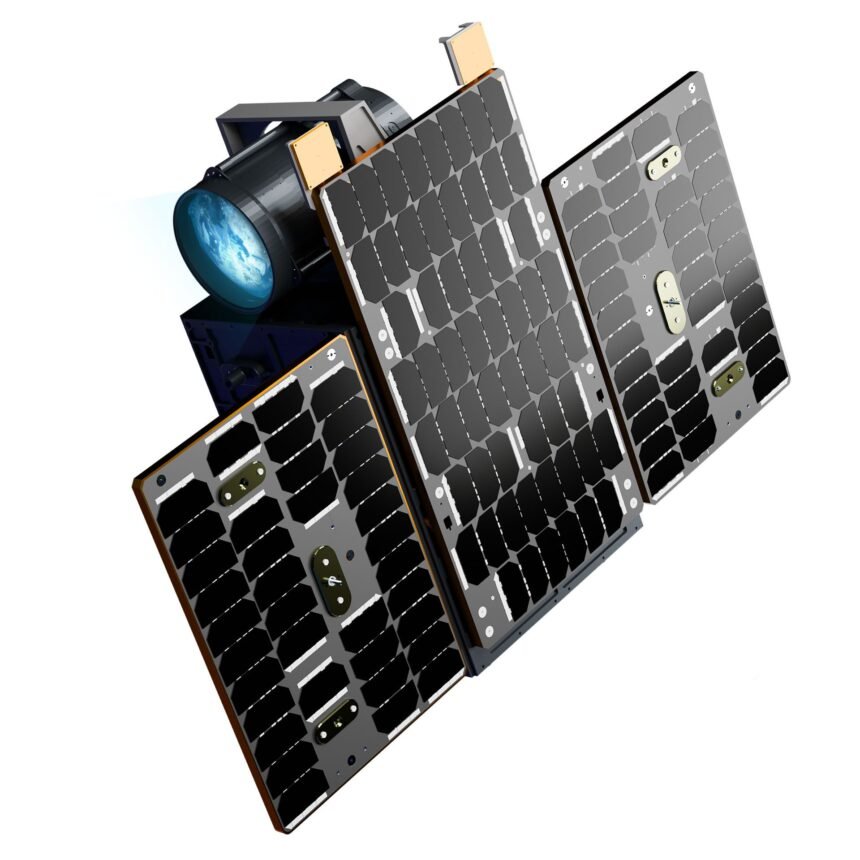
Each of Pixxel’s Firefly satellites is a roughly 50-kg spacecraft carrying a sensor that captures more than 135 spectral bands at five-metre resolution across a 40-km swath. The first three Fireflies went up in January 2026 on a SpaceX rideshare; a second set of three followed in August, completing the first phase of the constellation. With six satellites in a sun-synchronous orbit at about 550 km, the company says the Fireflies form the most advanced commercial hyperspectral imaging system ever deployed — a claim worth treating as the company’s own characterisation, but backed by a real hardware fact: no other commercial operator has six hyperspectral satellites imaging at this resolution today.
The physics is what makes it interesting. A panchromatic camera can show you a field. A multispectral sensor can show you a sick field. A hyperspectral sensor can show you why the field is sick — nitrogen deficiency, water stress, fungal infection — because each condition absorbs light at slightly different wavelengths. The same trick works on oil and gas infrastructure, mining tailings, forest canopies and ocean algae blooms. Crop stress before it is visible, pollution near real time: that is the pitch, and the satellite data is real.
From pixels to decisions
Raw hyperspectral data is enormous and unreadable, so Pixxel has built a second business around interpreting it. Aurora, its Earth-intelligence platform, combines multiple satellite datasets and converts them into what the company calls decision-ready insights for governments, infrastructure operators and industry. Ahmed has said the Fireflies are already generating revenue from data and analytics — and that Pixxel also sells satellites themselves, giving it three revenue streams: data, intelligence, and spacecraft manufacturing.
The next hardware generation is Honeybee. Where Firefly covers visible and near-infrared light, Honeybee extends into shortwave infrared (SWIR), and the constellation will add synthetic aperture radar (SAR) and ultra-high-resolution optical imaging. A technology demonstrator, Honeybee-0, is expected to fly in 2027, carrying a sensor spanning roughly 400 to 2,550 nanometres across about 450 bands.
More Read

The $100 million bet
In September 2026 Pixxel closed a $100 million Series C round co-led by Temasek and Seraphim, with 360 ONE Asset, IMM Investment and existing investors including Radical Ventures and growX participating. That takes total funding to $195 million — reported as the largest single funding round raised by an Indian space-technology company. A major share of the money goes into the Honeybee constellation and into manufacturing capacity in India and the United States for higher-rate satellite production.
Ahmed has been unusually direct about why investors wrote the cheque: “Since the last round we had raised, we had launched these six satellites successfully. So the technical risk was almost zero now because the satellites are up there and working,” he told ET. The commercial risk, he argued, had fallen too, because the satellites were generating revenue. Whether that revenue is enough to justify the valuation is a question for the next raise — but the hardware-first derisking argument is the right one for this kind of company.
Building India’s sovereign eye
Pixxel’s biggest institutional validation is not the funding. In January 2026, IN-SPACe signed an agreement with Allied Orbits, a consortium led by Pixxel and including Dhruva Space, PierSight and SatSure, to build India’s first fully indigenous, privately-led commercial Earth-observation constellation under a public-private partnership. The plan: 12 advanced EO satellites with panchromatic, multispectral, hyperspectral and SAR sensors, more than Rs 1,200 crore of investment over five years, operational by 2029. It sits inside a larger national push — the government’s Phase III space-based surveillance programme envisages 52 satellites by 2029, of which 31 are to be built by private companies.
That is the real significance of Pixxel. A decade ago, Indian Earth observation meant ISRO building satellites and selling data. Now a seven-year-old Bengaluru startup is contracted to build and operate part of the country’s own orbital infrastructure — and flying its commercial constellation on SpaceX rockets in the meantime.
Caveats, honestly stated
The “most advanced commercial hyperspectral system ever deployed” line is Pixxel’s own claim, and it rests on a fair but specific definition: six satellites at five-metre resolution in 135+ bands. Competitors fly fewer hyperspectral satellites or at coarser resolution, but the field is moving fast and the crown is contestable.
Honeybee is still a roadmap. The first satellite is expected in 2027, and constellation schedules in this industry slip regularly — Pixxel’s own demonstrator timeline has already moved once. The Rs 1,200-crore Allied Orbits constellation is a five-year programme whose hardest years are ahead of it, and sovereign EO contracts can reshape a startup’s priorities as easily as they fund them.
Pixxel also does not disclose revenue, so the “commercial risk has fallen” argument is an assertion from the founder, not an audited number. And its manufacturing expansion spans India and the US, which is good business but dilutes the pure Make-in-India story the site otherwise celebrates.
Still: a Bengaluru startup that went from two college-age founders to six satellites in orbit, a nine-figure raise, and a contract to help build India’s sovereign Earth-observation network — that is exceptional engineering with receipts, and exactly what this site exists to showcase.