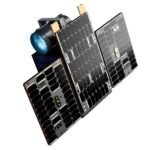
At one in the morning on 2 October 2026, a SpaceX Falcon 9 dropped 130 payloads into orbit over California, and one of the smallest packages on board may have been the most quietly ambitious. It was a satellite from Hyderabad called LEAP-2 — and its job was not to take pictures or process data. Its job was to carry other companies’ technology to space and look after it once it got there.
The company behind it is Dhruva Space, founded in 2012 by Sanjay Nekkanti (co-founder and CEO) together with Chaitanya Dora Surapureddy, Abhay Egoor and Krishna Teja Penamakuru. While most space startups pick one job — build the satellite, or the sensor, or the data product — Dhruva Space decided to build the whole road system: satellites, launch integration, and the ground stations that talk to them. Fourteen years in, that bet has put Indian-built infrastructure in orbit carrying French and Indian payloads, on an American rocket.
The bus company of orbit
LEAP-2 — “Launching Expeditions for Aspiring Payloads” — is the second commercial mission of Dhruva Space’s hosted-payload programme. It rides on the company’s P-30 satellite platform, a nanosatellite bus in the 20-to-50-kg class with three-axis attitude control, deployable power systems and modular payload interfaces. The idea is simple and powerful: a startup or research group with an instrument to validate in orbit should not have to build an entire spacecraft, arrange a launch and run a ground station. Dhruva Space sells the ride, the bus and the ground segment as one package, or individually.
This mission carries two passengers. One is TAPAS-1 from Ahmedabad’s SatLeo Labs, described by the company as India’s first dedicated commercial thermal-imaging payload — a CubeSat-category sensor meant to validate thermal sensing, calibration and processing in orbit. The other is a next-generation star tracker from Sodern, an ArianeGroup company in France, the kind of precision attitude sensor satellites need to know where they are pointing. Two countries’ hardware, one Indian platform, integrated end to end in India.
That last part matters. Dhruva Space says it carried out the complete launch integration of LEAP-2 with the Falcon 9 itself — the satellite and deployer assembly, the mission preparation, the deployment operations — and with LEAP-1 it became the first private Indian company to undertake launch-vehicle integration of its satellite in-house. For a country whose private space industry is barely a decade old, doing your own integration with SpaceX’s vehicle is not a procurement detail; it is the difference between being a customer and being a capability.
A stack that goes beyond the satellite
The P-30 did not go to orbit cold. In January 2024, Dhruva Space flew a technology demonstrator, LEAP-TD, on ISRO’s PSLV-C58 POEM-3 platform to validate the bus’s core subsystems: the onboard computer, UHF telemetry and command, the beacon, reaction-wheel attitude control and the power distribution electronics. LEAP-1 followed in August 2025 on a Falcon 9, the company’s first commercial mission on the P-30, hosting an AI compute module from Australia’s Akula Tech and a hyperspectral imager from Esper Satellites. LEAP-2 is the same playbook with Indian and French customers — the business model is the mission.
More Read
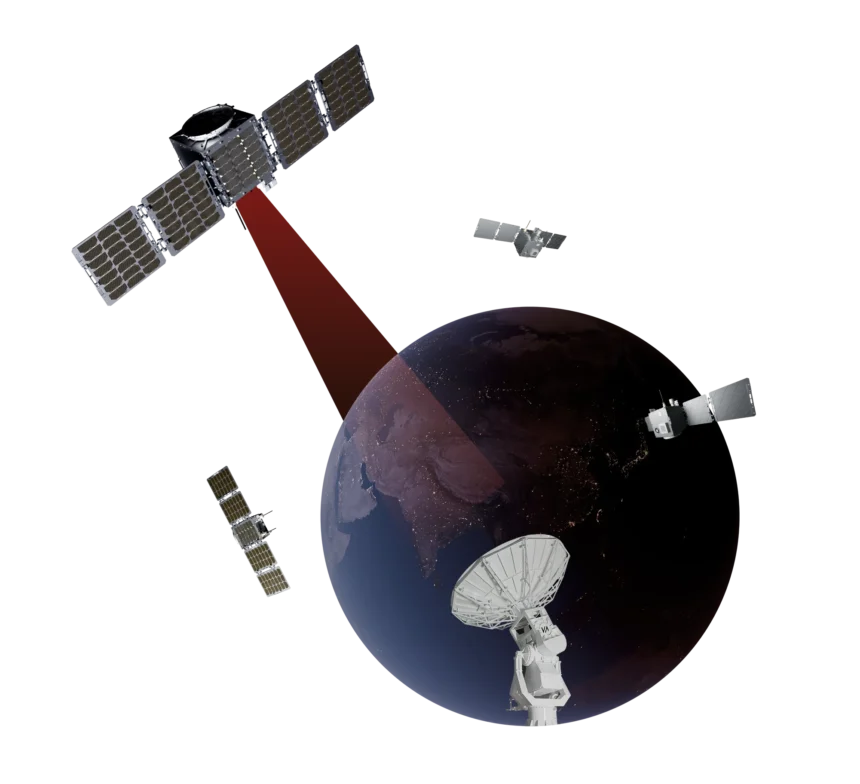
What makes Dhruva Space unusual is how far the stack extends on both sides of the spacecraft. Below it: the DSOD family of orbital deployers and a portfolio of satellite buses — the P-DoT CubeSat platform (at Technology Readiness Level 9), the P-30, and the upcoming P-Nu microsatellite platform for spacecraft up to 500 kg. Above it, quite literally: ground stations. The company operates a growing global ground network including an owned-and-operated station in Luleå, Sweden — which Dhruva Space says is the first ground station outside India owned and operated by a non-governmental Indian entity, authorised by the Government of India to provide Ground-Station-as-a-Service. LEAP-2 is now in its launch-and-early-orbit phase, and it will be supported by that network.
Building the factory for a thousand satellites
Nekkanti has been explicit about the thesis. As the world moves from building tens of satellites to thousands, he argues, someone has to build the infrastructure that makes missions routine — and India should own a piece of it. The company is building a 280,000 sq ft satellite mass-production facility to match that ambition, and says its order book across satellite platforms, infrastructure, mission services and national programmes exceeds Rs 500 crore.
The institutional validation is following the hardware. This week Dhruva Space became the first company to receive investment from the Antariksh Venture Capital Fund — Rs 60 crore from the Rs 1,600-crore government-backed fund managed by SIDBI Venture Capital, announced at the IN-SPACe Industry Connect event in Ahmedabad. Its ongoing pre-Series B round now stands at Rs 275 crore, combining Rs 150 crore in equity with Rs 125 crore in debt financing. And in January 2026, IN-SPACe signed the company up as part of Allied Orbits, the Pixxel-led consortium that will build India’s first fully indigenous, privately-led commercial Earth-observation constellation: 12 satellites, more than Rs 1,200 crore of investment over five years, operational by 2029.
Founder Nekkanti has a favourite analogy for what the company does: think of the iPhone — Apple does not make the camera, but somebody has to put the whole system together. Dhruva Space, he says, does not build the payloads on its satellites. It builds the building blocks and the integration that makes them work.
Caveats, honestly stated
Not every mission has worked. In January 2026, Dhruva Space’s Polar Access-1 programme — four satellites and five separation systems meant to fly on ISRO’s PSLV-C62 — was lost when the launch vehicle itself failed. That is the shared risk of the space business, and it is worth remembering when counting achievements: Dhruva Space’s hardware was lost through no fault of its own, but the loss is still real.
There is also a distinction the company itself observes: TAPAS-1 reaching orbit is a mission milestone, not a validated service. The payload is in its commissioning phase, and orbital validation of its sensing and calibration is still ahead of it. Similarly, the synthetic-aperture-radar constellation the company has discussed for late 2026 and the P-Nu microsatellite platform remain plans, and satellite timelines slip. And while the “first private Indian company” integration claim is the company’s own characterisation, it is at least anchored in a verifiable fact: Dhruva Space did the Falcon 9 integration work in-house for LEAP-1 and LEAP-2.
Still: a Hyderabad company that designs the satellite bus, builds the deployer, integrates the mission with SpaceX, operates the ground stations in Sweden and India that will talk to it, and now carries the first government space-fund investment as validation — that is exceptional engineering with the receipts to prove it, and exactly what this site exists to showcase.