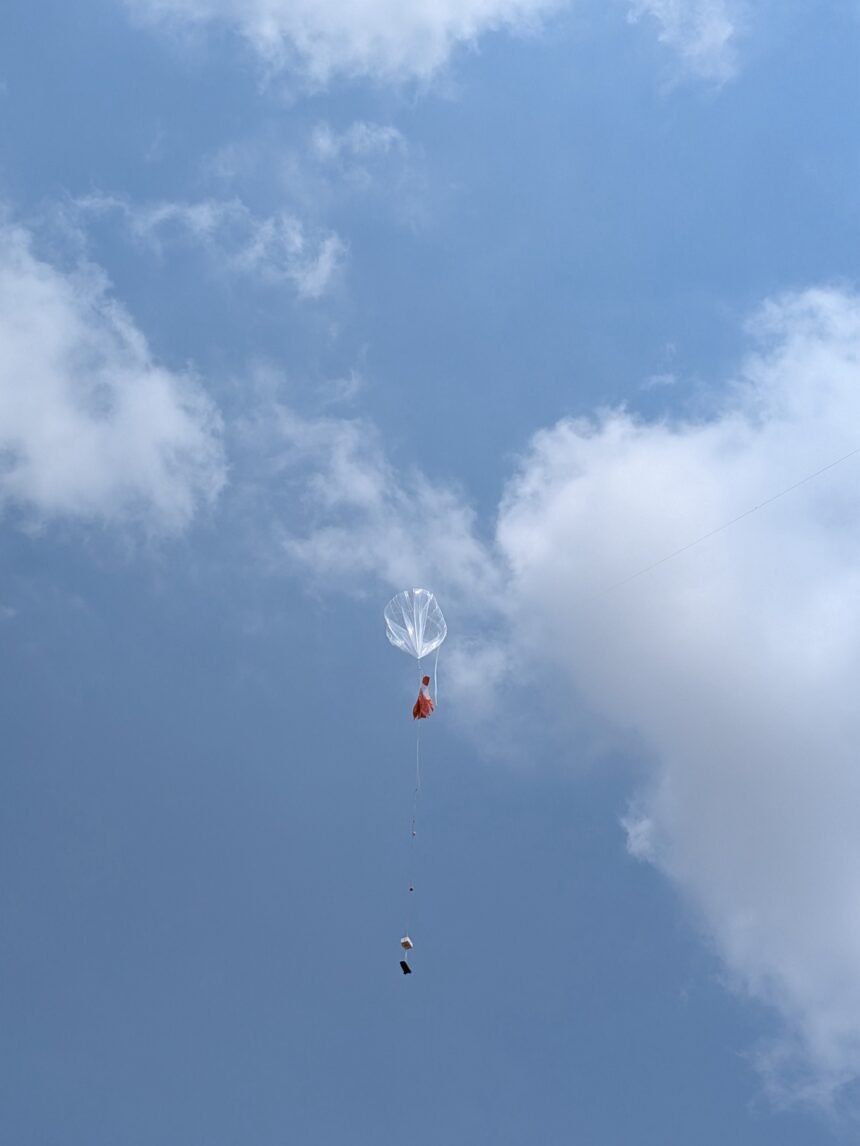
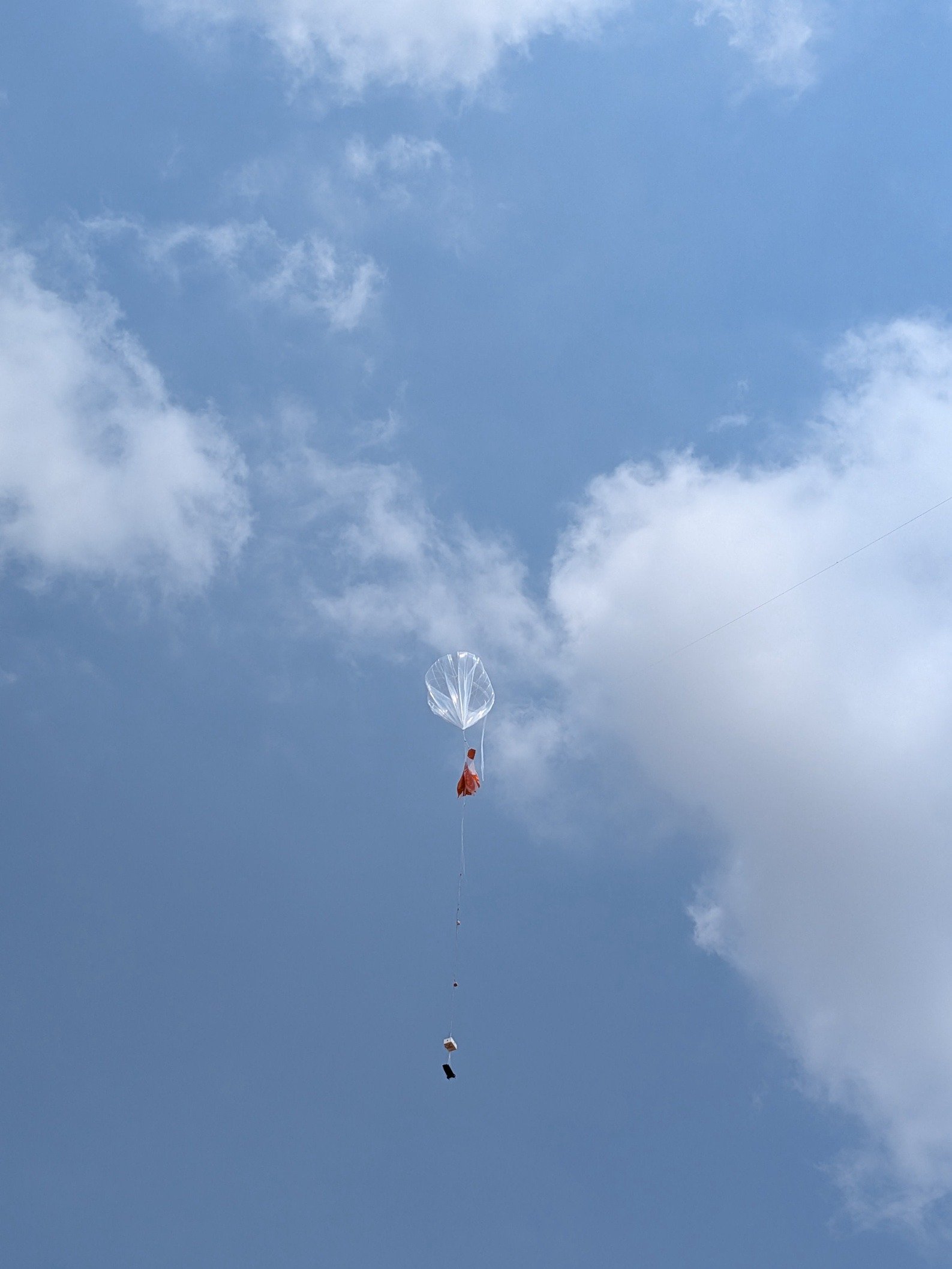
On 27 May 2026, a small crowd gathered at the Indira Gandhi Stadium in Vijayawada and watched a translucent envelope of engineered film rise silently into the blue. It kept climbing until it settled nearly 25 kilometres above the Earth — higher than any airliner flies, far below where any satellite orbits. The mission was called SANA, and it made India only the fifth nation, after the United States, France, Japan and China, with an indigenous super-pressure stratospheric balloon capability. The company behind it, Red Balloon Aerospace, was barely a year old.
The startup is betting on a slice of sky that aerospace has largely ignored. Conventional aircraft operate below 10 kilometres; satellites orbit above 160 kilometres. The stratosphere between 20 and 50 kilometres — what Red Balloon calls near-space — offers satellite-like persistence at a fraction of orbital cost: high-resolution imaging, longer dwell times than satellites, and deployment in days or weeks rather than years.
Eight months to first flight
Red Balloon Aerospace was incorporated in May 2025 by Dr Chakravadhanula Venkata Sai Kiran and Sireesh Pallikonda. Kiran is a former scientist at ISRO’s Vikram Sarabhai Space Centre who spent years on near-space technologies and later served as a vice-president at Skyroot Aerospace; Pallikonda worked on unmanned aerial vehicles at Hindustan Aeronautics and in the commercial satellite business at SES in Luxembourg. The two met at Skyroot, where they noticed a recurring problem: satellite customers wanted to validate payloads in near-space conditions before an orbital launch, but India offered few viable avenues for it.
That bottleneck became the entry point for a larger plan. Instead of buying balloon technology, the company designed nearly everything itself. The critical piece is the envelope: a multi-layer nanocomposite film, just 30–65 microns thick, engineered to survive the stratosphere’s thin air and punishing day-night temperature swings. The company says it designed its envelope film and reinforcing structure entirely in-house, built much of its own manufacturing equipment because suitable machines were not available off the shelf, and now keeps 75–80% of the value chain domestic. From starting operations to the first flight took about eight months — which the company describes as among the fastest development timelines the global near-space sector has recorded.
Mission SANA
The May 2026 mission began with a tethered trial at the Indira Gandhi Stadium on 13 May, followed by the free flight two weeks later. VISTA — the company’s super-pressure balloon platform — carried payloads from seven national and international partners, including biological experiment systems, propulsion technology demonstrations, onboard computing platforms, earth-observation sensors and navigation validation systems. The company says all payload missions were completed successfully.
Unlike conventional zero-pressure weather balloons that rise and descend within hours, super-pressure balloons hold a stable altitude through day-night temperature cycles without venting gas. The company’s long-term target is endurance measured in weeks or months, turning VISTA into a persistent “tower in the sky” for communications, earth observation, disaster monitoring and surveillance.
More Read
VISTA, ALTIS, HELIX — and Dive
VISTA is only the first of three modular platforms that share a common technology stack — materials, avionics, navigation, payload interfaces, communication systems and mission software. ALTIS, a tethered aerostat, is being developed as a testbed for systems that will feed into the flagship platform, HELIX: an autonomous, solar-powered stratospheric airship designed to hover at around 20 kilometres for extended periods.
HELIX is the company’s commercial endgame — flying cell towers for rural connectivity and disaster communications. A single platform at 20 kilometres could, the company says, cover a radius of nearly 500 kilometres and replace hundreds of conventional towers, which typically cost ₹2–3 crore each to erect. The initial HELIX platform is targeted for completion by December 2026, with flight trials expected in early 2027. Sitting above the hardware is Dive, an AI-powered analytics platform meant to turn raw aerial imagery into actionable intelligence — for instance, helping authorities identify flood- or earthquake-affected areas within hours instead of days.
The business model is rideshare: a single VISTA mission can carry multiple payloads for multiple industries at once, and the company says eight of its planned launches are already commercially booked to a certain extent. It has so far raised a pre-seed round and is preparing to raise more as it scales to larger airships; globally, it benchmarks itself against near-space companies such as Sceye and World View.
The company’s name comes from the Oscar-winning French film The Red Balloon — a story of persistence and determination that, its founders say, reflects the philosophy of building platforms meant to stay aloft for a long time. India’s balloon heritage is decades old — institutions like TIFR and the Indian Institute of Astrophysics have flown high-altitude science balloons for years. What Red Balloon did was turn that legacy into commercial infrastructure: an indigenous near-space capability, built from the envelope film up, that now sells rides to customers in India and abroad.