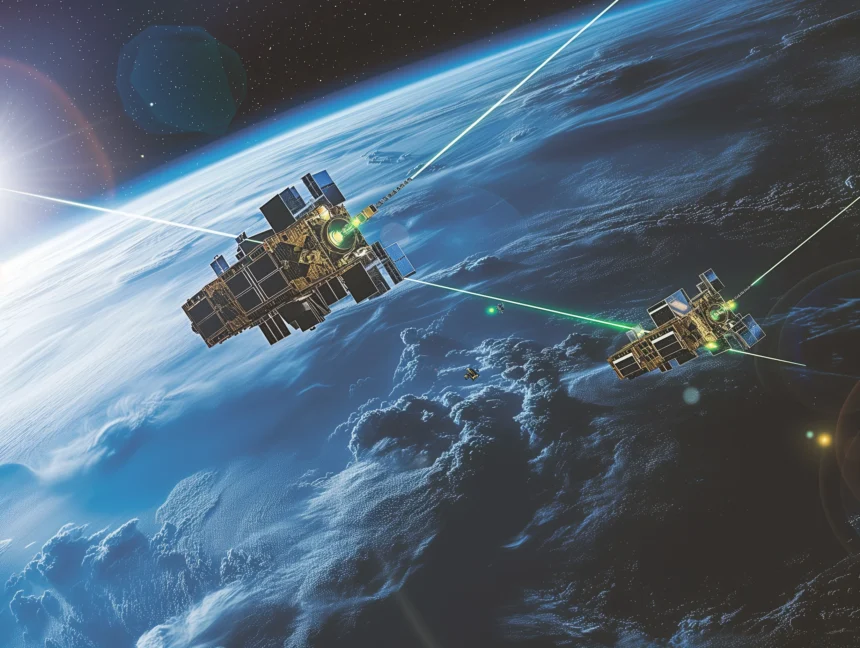
Much of the world’s digital security rests on a single mathematical bet: that factoring very large numbers will stay hard. A sufficiently powerful quantum computer would win that bet overnight — the scenario the cybersecurity world calls Q-Day, the day RSA encryption stops working. A Bengaluru startup has spent the last three years building an answer that sidesteps the mathematics entirely. Pramatra Space is developing quantum key distribution (QKD) on an integrated-photonics chip, designed to ride on satellites and beam unbreakable encryption keys down to earth.
A chip instead of an optical bench
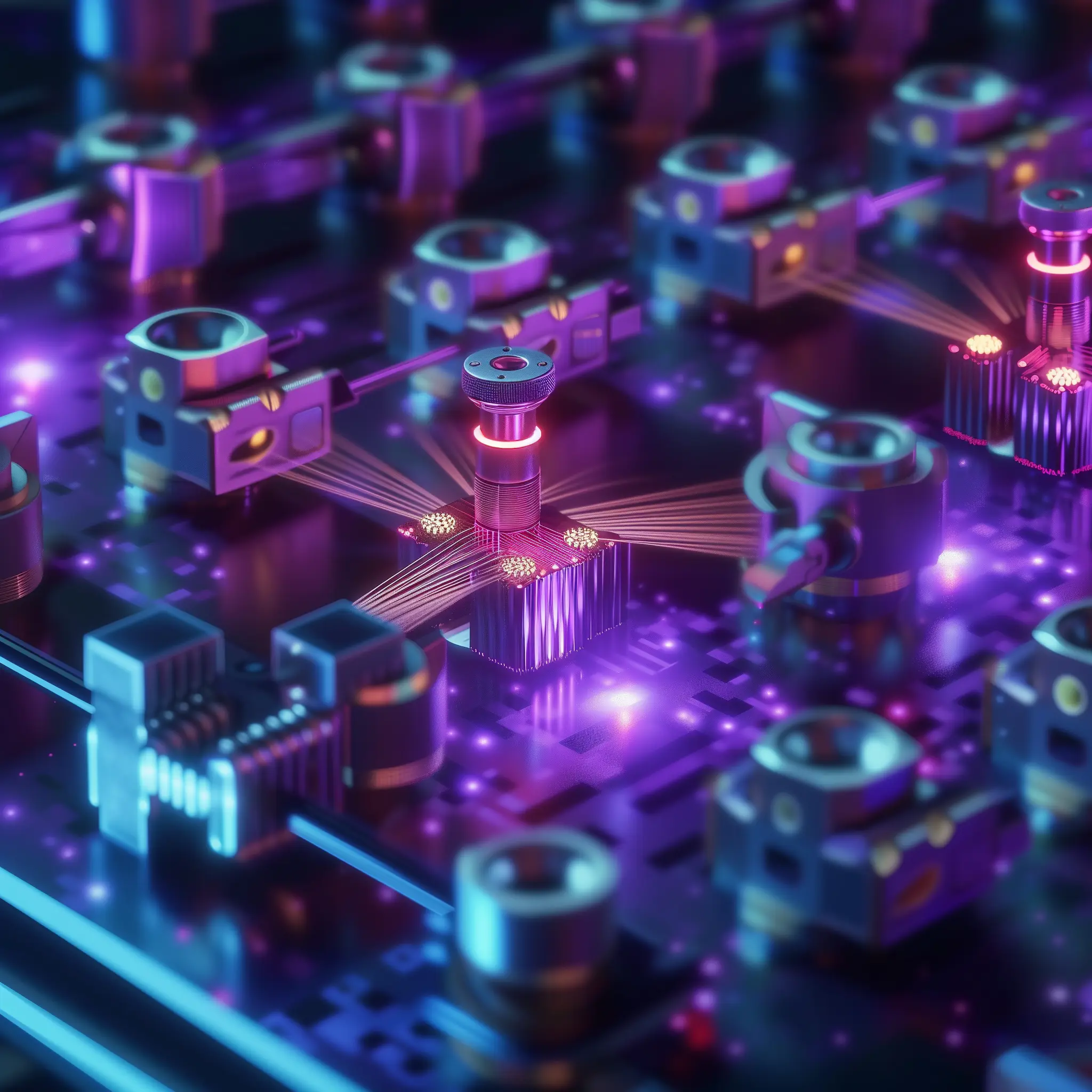
Quantum key distribution is physics-as-security: keys are encoded in quantum states of photons, and any eavesdropper trying to intercept them disturbs those states and reveals themselves. The problem has always been hardware — QKD setups are typically benches full of precisely aligned optics. Pramatra’s approach compresses the quantum light sources, beam splitters and phase modulators onto a single photonic integrated circuit (PIC) the size of a fingernail, generating pairs of polarisation-entangled photons on silicon.
The chip is not a sketch. The company has completed three tape-outs of its QKD chip, and founder and CEO Richa Hukumchand told YourStory in October 2026 that the latest silicon is under test with results expected within 15 to 20 days. On intellectual property, Pramatra has moved from a provisional patent to a filed final patent whose specification is complete and under examination. The Indian Institute of Technology Madras has validated the company’s results and its hypothesis around chip-based technology for space-based QKD, and the startup has been selected for Bharat Innovates, a government-backed programme spanning 120 deeptech companies.
Why space — and why hybrid
Photons do not travel well in fibre: quantum signals attenuate so fast that ground-based QKD is limited to roughly a hundred kilometres before it needs trusted relay stations that reintroduce vulnerability. Low-earth-orbit satellites erase that constraint, giving a single transmitter line-of-sight coverage across continents. That is why Pramatra is working with about three satellite companies on payloads, with a first in-space demonstration planned for 2027 and a first mission targeted for 2028; it is also working with Japanese ground-station operator Infostellar to define optical ground-station and last-mile requirements.
The product strategy is deliberately hybrid. Defence-sector feedback pushed Pramatra to combine QKD with post-quantum cryptography (PQC): as Hukumchand puts it, QKD handles the encryption while an added layer of PQC handles authentication — “for holistic security”. A software orchestration layer ties the different security hardware together. The company is also eyeing terrestrial use: pilot discussions are underway for securing links between telecom towers and between drones and ground stations, and a data-centre product remains in development.
The company behind the chip
Pramatra Space Technology Private Limited was incorporated in November 2022 and is led by founder and CEO Richa Hukumchand, with an 11-member team in Bengaluru. It raised pre-seed capital in 2026 earmarked for flight-qualification of its hardware, and is preparing a fresh funding round. The startup was part of Techstars’ Fall 2024 cohort, was named among the top 10 deeptech startups at Nasscom Emerge50 in 2026, and sits on YourStory’s Tech30 2026 list; Hukumchand was honoured with the ‘Emerging Woman Founder’ award at HDFC Tech Innovators 2025.
Q-Day has no announced date, but the direction of travel is one-way: quantum hardware keeps improving, and every year of encrypted data captured today becomes retroactively readable the day it arrives. Pramatra’s bet is that the defence against that day should be physical, not mathematical — and small enough to launch. The two tests to watch: whether the third tape-out’s results hold up, and whether the 2027 in-space demonstration hits its window.