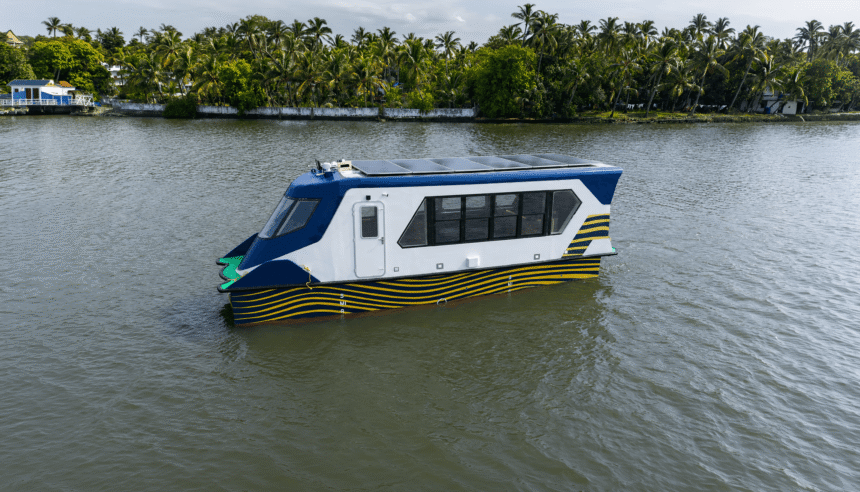
Ferries are a footnote in the global vessel count but an outsized slice of marine pollution — European monitoring data puts them at roughly 3 percent of vessels and about 10 percent of shipping CO₂ emissions. A Kochi company has spent more than a decade proving the fix is not a cleaner diesel engine but no fuel at all. Navalt Solar & Electric Boats designs and builds solar-electric vessels that, the company says, undercut diesel on running costs by an order of magnitude — and its first ferry has nine years of passenger numbers to back the claim.
A ferry that runs on daylight
In January 2017, Navalt’s 75-seater Aditya entered service for the Kerala State Water Transport Department on the Vaikom–Thavanakkadavu route: India’s first solar ferry. The specification was modest on paper — 20 kW of rooftop solar, a 40 kW motor, a 50 kWh lithium battery. The operating record is what matters. Aditya runs 22 trips a day covering 66 km, and has since carried more than four million passengers, saving an estimated 225,000 litres of diesel and over 500,000 kg of CO₂. It was named the world’s best electric ferry at the 2020 Gustave Trouvé Electric Boat Awards. Convinced by the ledger, KSWTD has planned conversions of its diesel fleet to solar-electric.
Why the economics work
The trick is weight. A conventional 75-seater steel ferry displaces around 75 tonnes; Aditya, built from glass-reinforced plastic and aluminium with a computational-fluid-dynamics-optimised catamaran hull, weighs 17. Navalt says its boats need just 17 kW of propulsive power where a conventional hull needs 45, and the sun covers about 70 percent of a day’s energy needs. The purchase price is higher — roughly ₹3.5 crore against ₹1.5 crore for a diesel equivalent — but the company says running costs fall around 35-fold.
Founder and naval architect Sandith Thandassery, an IIT Madras graduate, frames the pitch around the buyer rather than the planet: in his words, Indian operators don’t buy green, they buy cheaper — the greener boat arrives as a bonus. That discipline shows up in the engineering: every kilogram and every kilowatt is fought over in the design, because on a solar boat there is no cheap energy to waste.
From ferries to the fastest boat in the country
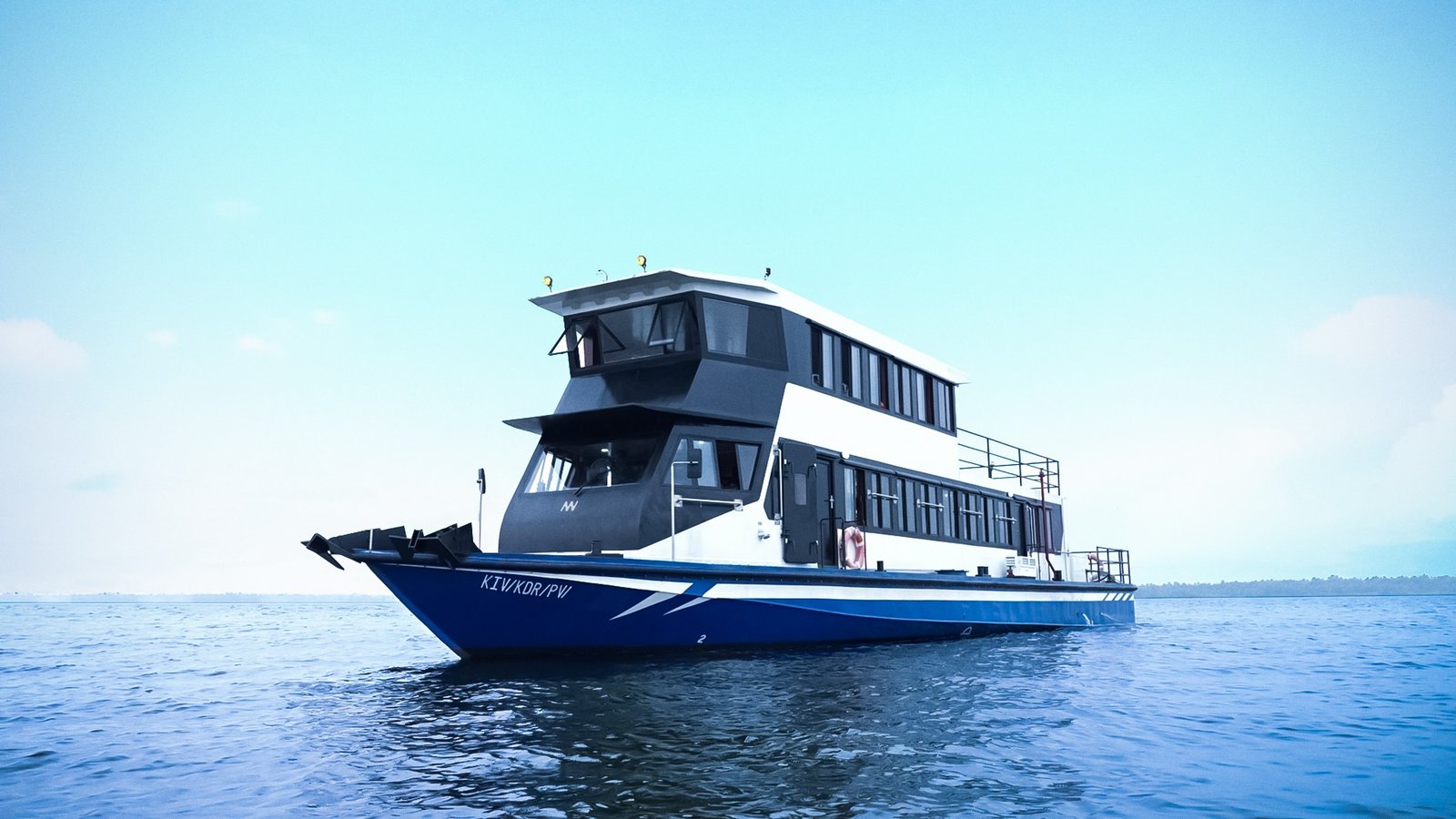
The fleet has grown well past the commuter niche. Barracuda, developed with Mazagon Dock Shipbuilders, is India’s fastest solar-electric boat: a 14-metre workboat with twin 50 kW motors, a marine-grade LFP battery and 6 kW of solar, good for 12 knots and seven hours on a charge, certified by the Indian Register of Shipping to handle four-metre waves. It now serves Mazagon Dock’s Mumbai operations as Saur Sakthi and took the mobility prize at Berlin’s 2023 Start-up Energy Transition Awards. Indra, launched in 2023, is India’s largest solar-electric ferry; Srav, described by the company as the world’s first solar-electric fishing boat, won best workboat at the 2024 Gustave Trouvé awards.
More Read
The company behind the boats
Navalt was founded in 2013 by Thandassery inside the Navgathi marine group, and the count now stands at 73 projects worldwide — 35 in operation, 38 under construction — across India, Canada, Israel, the Maldives and Seychelles. The export story is accelerating: a luxury boat shipped to Halifax, Canada, and in August 2026 a memorandum with the Cyprus Marine and Maritime Institute to put Cyprus’ first solar-electric passenger boats on the water by April 2027, with autonomous defence vessels under discussion. The test to watch is the same one as every industrial bet — whether the unit economics that won Kerala can win the world’s ferry operators too.