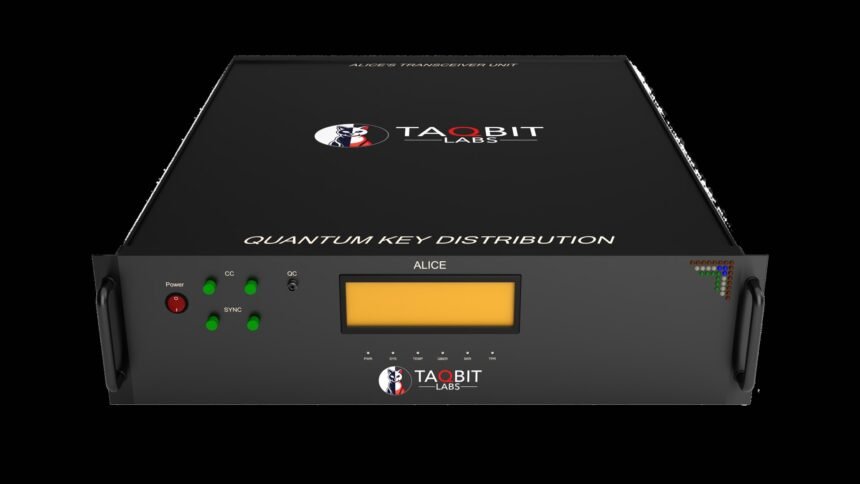
Most of the world’s encryption is a mathematics race: hard problems that computers may crack someday. Quantum key distribution plays a different game entirely. It hides nothing in mathematics — it encodes secrets in the fragile quantum states of photons, and physics itself does the guarding. Touch the signal and the states collapse; measure the photons and the eavesdropper’s attempt announces itself. DRDO calls this “unconditional security” — not a marketing phrase, but a property of the universe.
The company carrying that idea from the laboratory onto a live military network is Taqbit Labs, a Bengaluru startup founded in 2018 by Animesh Aaryan (CEO), Sugata Sarkar and Sreeram Sreekrishna. Aaryan is a physicist by training — a five-year integrated MSc in Photonics from the Cochin University of Science and Technology, research at the Raman Research Institute, and a stint at Singapore’s Nanyang Technological University, where, he told the New Indian Express in 2025, he watched quantum technologies cross from pure research into real-world applications and decided India should build its own.
Taqbit’s product line is a full quantum-security stack, developed and manufactured in India. Its QKD systems implement two complementary protocols — Coherent One-Way (COW) and Differential Phase Shift (DPS) — over standard fibre-optic networks, which the company says makes them deployable on existing infrastructure rather than demanding a new one. Alongside QKD sits post-quantum cryptography built on the NIST-selected Kyber, Dilithium and Falcon algorithms, and a quantum random number generator that extracts true entropy from photon-level quantum fluctuations at multi-gigabit throughput.
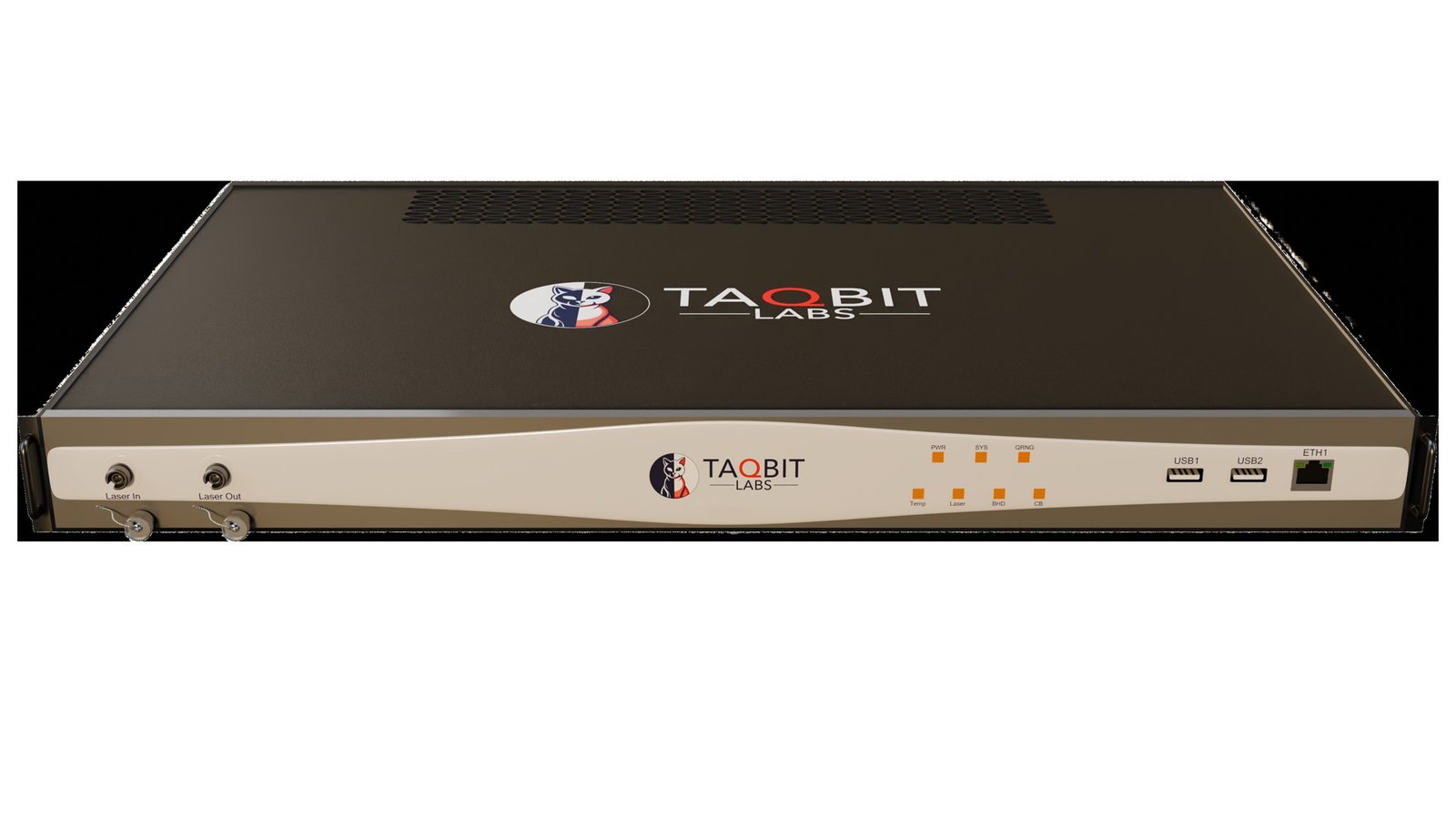
The validation that matters most is not on a specification sheet. Taqbit has been collaborating with DRDO since 2020 to develop QKD systems for the Indian Armed Forces. In July 2026 the two completed military field trials of a scalable, fibre-based QKD system — the step reported to pave the way for large-scale, multi-hop quantum networks. Then, on 14 October 2026, DRDO announced it had configured and tested the QKD platform on the live network of the dynamic test ranges at the Proof and Experimental Establishment (PXE), Chandipur. The purpose: securing real-time critical observations and telemetry from artillery and armoured weapon tests and evaluations — data sensitive enough, and valuable enough to an adversary, to be worth “harvest now, decrypt later” storage. Taqbit Labs is named as DRDO’s production partner, and the platform was developed under DRDO’s Microelectronic Devices, Computational Systems and Cyber Security (MCC) cluster.
The caveats, stated plainly: “unconditional security” is DRDO’s characterisation, reported in coverage rather than independently verified, and QKD key rates are modest — Taqbit’s own published figures are around one to two kilobits per second at 22 dB loss — because QKD exists to exchange keys, not to carry bulk traffic. What the Chandipur test demonstrates is narrower and more important: that an indigenous quantum system works on a live, operational military network, carrying the live telemetry of weapons trials, in the exact environment it is meant to protect. That is the step quantum security has to take before anyone can take it for granted.
Eight years on from its founding, a Bengaluru startup built on photonics is giving India’s defence network a shield made of physics. If the programme scales into the multi-hop quantum networks DRDO describes, the keys guarding India’s most sensitive military data will be laws of nature — and they will be Indian-made.