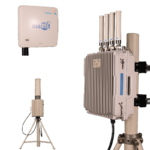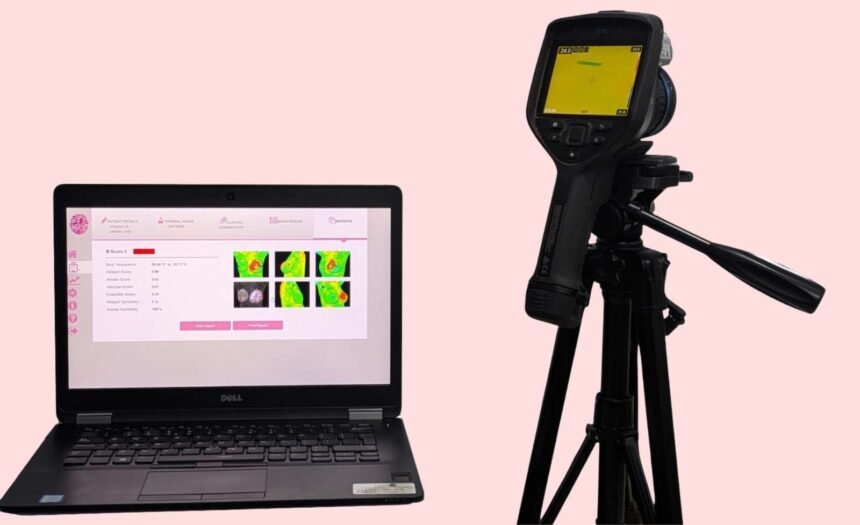
Breast cancer is one of the leading causes of cancer death among women in India — and a new global analysis published in The Lancet Oncology in March 2026 found that new cases in the country have risen nearly fivefold since 1990, to over two lakh a year. Most are still found late, when treatment is hardest. A Bengaluru company believes the answer is not a bigger machine, but a smarter one: an AI-powered thermal camera that can spot the earliest signs of cancer in about fifteen minutes, without radiation, without touch, and without anyone even seeing the patient.
Niramai Health Analytix calls its solution Thermalytix. It combines a high-resolution thermal sensing device with cloud-hosted analytics that read 400,000 temperature points on the chest and produce a quantitative breast health report. The company says its AI looks for subtle temperature abnormalities — abnormal blood-vessel patterns and unusual heat signatures — that human interpretation might miss, reducing the subjectivity and error that come with manual reading of thermal images.
Image: Niramai (official company image).
The 15-minute screening
The procedure is deliberately simple. The equipment sits about three feet from the patient; nobody sees or touches her. A thermal camera captures the temperature map of the chest, and Niramai’s machine-learning models — trained on large datasets of thermal images matched against mammography, ultrasound and histopathology reports — generate a risk score and assist doctors in identifying abnormal lesions. Every report is also reviewed by an expert radiologist trained in thermal interpretation.
The physics behind it: cancerous tissue can exhibit changes in metabolic activity and blood flow that create heat patterns distinct from surrounding tissue. Niramai says Thermalytix works on temperature maps rather than thermal images, giving it 50 times greater thermal sensitivity — 0.02°C on a temperature map versus about 1°C in a conventional thermal image — which it says enables detection of abnormal patterns before they become visible in imaging. The company says the system can detect tumours as small as 4 millimetres, against roughly 25 millimetres for a physical examination.
More Read
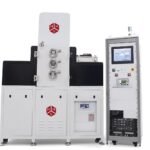
Image: Niramai (official company illustration).
Built for the women mammography misses
Mammography remains the standard of care, and Thermalytix is positioned as an adjunct — a first-line screen whose high-risk or positive cases get referred for mammography, ultrasound or MRI. Where Niramai says it shines is precisely where conventional screening struggles: younger women and dense breasts. The company’s clinical studies, it says, show accuracy non-inferior to X-ray mammography in general, and 25% better sensitivity than mammography in women with dense breasts. Results have been published in peer-reviewed journals including BMJ Open, the ASCO Journal of Clinical Oncology Global Oncology, Frontiers and The Lancet Oncology, and presented at the San Antonio Breast Cancer Symposium.
The design choices all point at access. The test is radiation-free, painless and private — a combination that matters deeply in communities where cultural stigma and modesty concerns keep women from being screened at all. The hardware fits in an ordinary backpack, so screening camps can go to villages, offices and schools. It works for women of any age — including those under 40, for whom mammography is not recommended — and of any breast density. India averages just 1.3% screening uptake, against 2.2% across low- and middle-income countries; Niramai’s aim is to make the test affordable, accessible and accurate enough to change that.
Scale and a patent wall
The company’s numbers tell a story of steady traction. Niramai says more than 400,000 women have been screened across 250-plus locations in India, with more than 2,000 cancers detected. Thermalytix is commercially available in 22 countries — including the Philippines, Zambia, Sweden, Bulgaria and the UK — and carries a CE Mark for all of Europe alongside clearances in India (CDSCO) and many African and Asian countries. A related device, SMILE-100 (marketed as BreastHealth-100, with a subset of Thermalytix functionality), has US FDA 510(k) clearance for adjunctive use. The company’s quality systems are certified to ISO 13485 and ISO 27001.
Behind the product sits a formidable patent portfolio: 41 granted patents, including 16 in the US, 15 in India, and two each in Canada, Singapore, Japan, Europe and China. For the last mile, Niramai built Mythri — a compact, mobile-based screening solution running the same Thermalytix engine, designed so health workers can carry early detection into rural homes and primary health centres. In a Zambia study, the company reports, Thermalytix demonstrated 83.3% positive agreement with radiologist-reported mammography.
A founder who made it personal
Niramai was founded in 2016 by Dr Geetha Manjunath, a PhD computer scientist from IISc who spent 17 years at Hewlett-Packard Laboratories as a principal research scientist and then led data-analytics research at Xerox Research Centre India, together with Dr Nidhi Mathur. The name stands for “Non-Invasive Risk Assessment with Machine Intelligence”. The mission grew out of personal loss: two of Manjunath’s relatives, aged just 42 and 38, were diagnosed with late-stage breast cancer and died within months. As she put it in a 2018 TED talk, breast cancer does not have to be a killer — with early detection, it is very treatable.
That conviction has earned the company a growing global stage — from a Bill & Melinda Gates Foundation grant exploring the same thermal-AI approach for river blindness, to deployments across four continents. Thermalytix’s promise is disarmingly simple: a camera, some AI, and fifteen quiet minutes — and a disease that is still usually found too late, found in time.
Video: Niramai Analytix (official company channel).