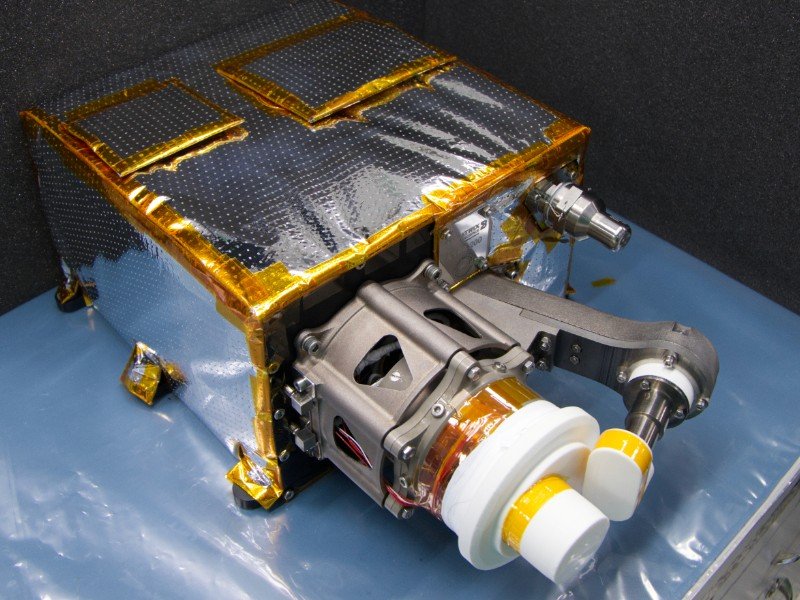
Getting to space is only half the journey. Once a satellite arrives in orbit, it still has to get to work — nudging itself into exactly the right slot, holding formation against the whisper of atmospheric drag, dodging debris, and stretching its station-keeping fuel across a decade or more of service. The tiny engines that do all of this are among the most sophisticated machines flying today, and a growing share of them are being built in Bengaluru. Bellatrix Aerospace has spent a decade perfecting satellite propulsion — electric and green engines that are already flying in space — and the world has started placing its orders.
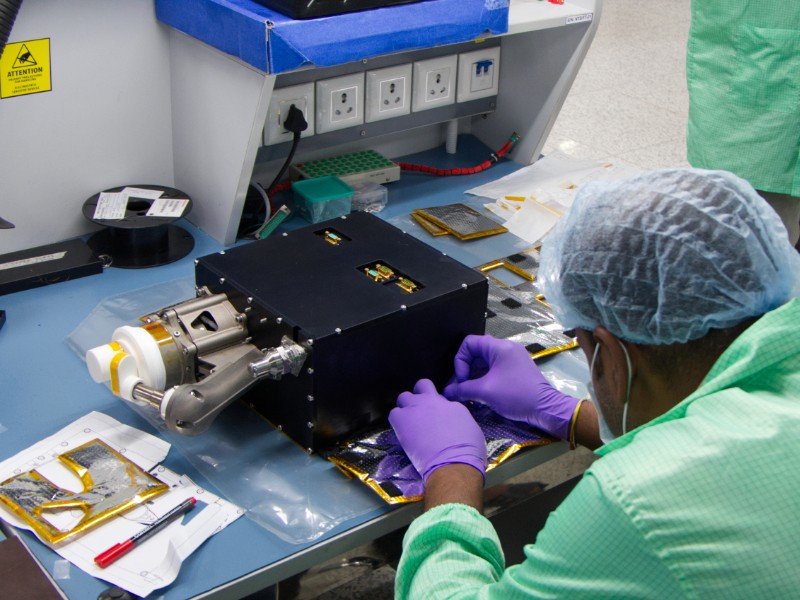
Image: Bellatrix Aerospace (official company image) — inside the company’s cleanroom, where propulsion systems bound for orbit are assembled by hand.
The propulsion specialists
Founded in 2015 by Rohan M. Ganapathy and Yashas Karanam, Bellatrix Aerospace is a private space technology company that has made one thing its entire mission: making satellites move. Where most spacetech startups chase rockets or cameras, Bellatrix went after the engine in the middle — the propulsion systems that steer satellites once they leave the launch vehicle. The company says its philosophy is simple: own the technology end to end, qualify it in the unforgiving environment of space, and then build it at a scale the world can buy.
That focus has produced a full family of propulsion products. Rudra is the company’s green monopropellant thruster line, designed to replace the toxic hydrazine that has powered satellite manoeuvring for decades. Arka is its series of Hall-effect electric thrusters — the efficient, plasma-driven engines increasingly favoured for long-duration missions. Jal uses water as propellant, and Rudra Nano shrinks the green-propulsion concept down for the smallest satellites. The portfolio spans low Earth orbit and geostationary missions alike, the company says, covering the full range of satellites going up today.
Green fire, flight-proven
Propulsion is one of those technologies where a ground test is never quite enough — the only proof that counts is firing in space. Bellatrix’s green propulsion has exactly that proof. Under the Defence Research and Development Organisation’s Technology Development Fund, the company developed a 1N-class green monopropellant thruster for microsatellite attitude control and orbit keeping, and it was flown on ISRO’s PSLV-C58 mission aboard the PSLV Orbital Experimental Module (POEM). In a statement in February 2024, the Defence Ministry said the in-orbit demonstration had succeeded, with telemetry data validated at ISRO’s tracking network in Bengaluru and found to have exceeded all performance parameters.
More Read
The significance is easy to miss and worth stating. Hydrazine, the industry’s long-standing workhorse propellant, is toxic and carcinogenic — handling it demands elaborate safety procedures and protective equipment. Bellatrix’s green propellant is non-toxic and environmentally benign, the company says, while cutting handling costs by more than 60 per cent and offering over 35 per cent higher density than hydrazine. Demonstrating pulsed and steady-state firing in vacuum, with every key component — propellant, valves, catalyst bed, drive electronics — developed indigenously, was India’s green-propulsion coming-of-age moment, and Bellatrix wrote it.
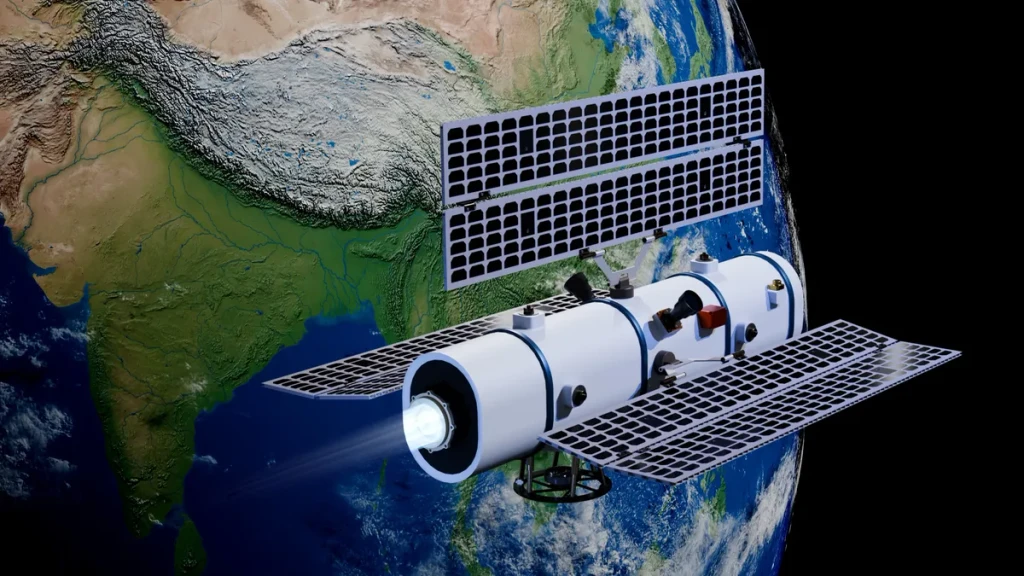
Image: Bellatrix Aerospace (official company image) — a concept render of the company’s orbital transfer vehicle, an in-space “taxi” for delivering satellites to their operational orbits.
A ₹700 crore vote of confidence
The market has noticed. The company told Outlook Business in October 2026 that it has signed orders worth around ₹700 crore across its propulsion systems and satellite businesses, with the order book expected to be realised during FY27. Nearly 80 per cent of that comes from propulsion, and — in a telling detail for India’s space ambitions — it is largely backed by international customers across the United States, Europe, Japan and Korea, serving communication and Earth-observation satellite makers. Deliveries to an overseas customer began in March 2026, the company says, and the trajectory is steepening: Bellatrix has raised around $40 million so far, including a $20 million pre-Series B round led by Cactus Partners earlier in 2026, and is in talks to raise a $50–100 million Series B to scale manufacturing.
The manufacturing story is where Bengaluru’s engineering muscle shows. The company’s existing facilities can already produce nearly 200 propulsion systems a year, and it is building a $76 million factory on a five-acre site at the KIADB Aerospace Park near Bengaluru airport — designed, the company says, for a capacity of 250 to 300 systems annually through high-throughput production lines. Satellite propulsion is becoming an industrial product, made in India, bought by the world.
Breathing air in orbit
Bellatrix’s next act may be its boldest. Very Low Earth Orbit — altitudes of just 180 to 200 km, far below conventional satellite orbits — promises dramatically sharper imaging and lower-latency communication, but atmospheric drag there is fierce enough to drag an ordinary satellite out of the sky in weeks. Bellatrix’s answer is an air-breathing propulsion system that collects the thin atmospheric nitrogen at those altitudes, converts it into plasma, and generates thrust continuously to fight the drag. The company plans to launch three VLEO satellites by the end of 2026 to demonstrate the concept — a mission its co-founder calls the biggest validation milestone for the business. If it works, the company says, satellites could operate for years in an orbit that has so far remained commercially out of reach.
From a green thruster firing above India on a repurposed rocket stage, to Hall-effect engines whispering plasma across the vacuum, to a factory that will turn out hundreds of propulsion systems a year — Bellatrix Aerospace has spent eleven years doing the unglamorous, brutally hard work of making satellites move. Now the world’s satellite builders are queuing up. Propelling dreams, as the company’s tagline goes, was always going to take real engines. Bengaluru is building them.
Keep reading: India’s First Near-Space Balloon: Inside Red Balloon’s 25-km Mission SANA · Catching lasers from space: inside QOSMIC’s ARGUS and India’s optical ground-station bet · More Aerospace & Defense stories
Like stories like this? Add Exceptional Technology as a preferred source on Google to see more of our reporting in your search results and Discover feed.