A warehouse floor is a game of millimeters and minutes: pallets weighing over a tonne must move from one end of the building to the other, on time, every time, without denting a rack or stopping the line. For years, factories had to choose between two kinds of machines for that job — the old automated guided vehicles that followed magnetic tapes and moved anything, and the new autonomous mobile robots that could think but couldn't always lift. A Bengaluru company decided to stop choosing, and built robots that do both.
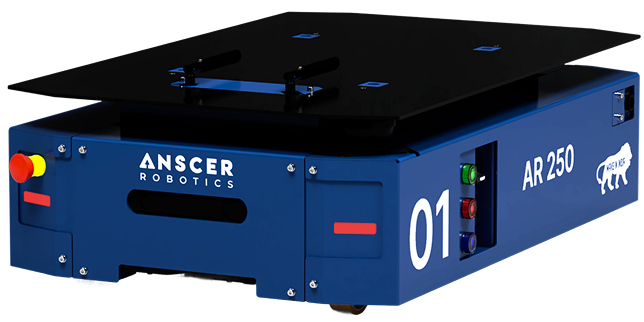
The company is ANSCER Robotics. Founded in 2020 in Bengaluru by Ribin Mathew, Ebin Sunny, Raj Mohan and Raghu Venkatesh, it designs and builds autonomous mobile robots and the fleet software to run them, right at its Bommasandra facility in Bengaluru. Its hybrid robots combine the carrying muscle of an AGV with the intelligent navigation of an AMR — and that engineering has now carried the company across an ocean: in September 2026, three of its platforms became some of the first robots anywhere to receive the US Federal Communications Commission's Conditional Approval for foreign-produced advanced robotic devices.
The approval, effective 18 September 2026, covers the company's AR250, AR650 and AR1250 platforms. It exempts them from the FCC's Covered List restrictions for foreign-produced advanced robotic devices — a national-security eligibility gateway that governs which robotic systems can be authorized for sale and deployment in the United States. ANSCER now stands alongside Sweden's Husqvarna among the first robotics companies to be listed in the FCC's robotic-device conditional approvals, with its US subsidiary in Plano, Texas handling sales and field service across North America.
What the robots can do
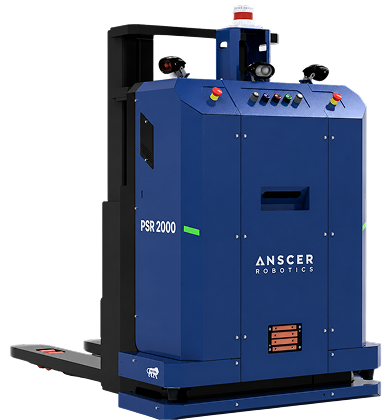
ANSCER's catalogue is built on a simple idea: one modular mobile base, many jobs. The AR series — the platforms that won the FCC approval — automate lifting, tunneling and tugging, with the AR 1250 carrying up to 1,250 kg. The PSR series handles pallet stacking, transport and trolley movement, while the AGV series runs compact, QR-guided point-to-point transport for lifting and sorting. Interchangeable top modules let a single platform take on different material-handling applications, and the company's Fleet Manager software coordinates the robots so they never argue over the same aisle.
The robots are designed for rough, real-world floors — not just tidy warehouses but manufacturing plants, dock areas and machine-tending cells, where they integrate with robotic arms for CNC operations. The company also sells its robots as a service: customers can rent rather than buy, turning a capital expense into a monthly subscription that scales up or down with demand.
The engineering is matched by scale. At its Bengaluru facility, with around 60 engineers on site, the company says it can manufacture more than 1,000 robots a year on a three-shift operation. Its client list spans Schneider Electric, Samsung, Tata, Mahindra Logistics and Trelleborg Engineering Systems — and its PSR 2000 recently featured in Schneider Electric's Hub Asia transformation in Singapore, the S$25 million warehouse modernisation at Tuas. The company also runs on an ecosystem philosophy: it supports robotics labs at seven Indian universities, and its BEST Robotics Lab, funded by the Bajaj Foundation, has trained more than 700 people in industrial automation and robotics deployment.
More Read
From Bengaluru floors to American factories
The FCC milestone sits on top of a year of momentum. The company closed a Series A round led by the IAN Group with participation from Info Edge Ventures, and it says it is deploying robots not only across India but in Thailand, Malaysia, Singapore and Indonesia — with new customers in North America, including leading parcel-delivery companies, now entering deployment.
That an Indian startup is among the very first to clear America's new robotic-device regulatory bar says something about how far the country's industrial robotics has come. ANSCER's bet was that automation should be practical, affordable and human-centric — a subscription robot that carries like a forklift and navigates like a scout, built in Bengaluru and now cleared to roll across factory floors in Plano, Pittsburgh and beyond.
From Bommasandra to Texas, ANSCER Robotics is showing what Indian industrial automation looks like when it ships as world-class engineering — robots that lift tonnes, think for themselves, and are now officially welcome on American soil.
Keep reading: Built, Not Bought: Inside General Autonomy, the Bengaluru Startup Walking Its Own Robot Dog · Beyond Silicon: Inside Spintronics AI, the Hyderabad Startup Building India's GaN Future · More Industrial Automation & Technology stories
Like stories like this? Add Exceptional Technology as a preferred source on Google to see more of our reporting in your search results and Discover feed.