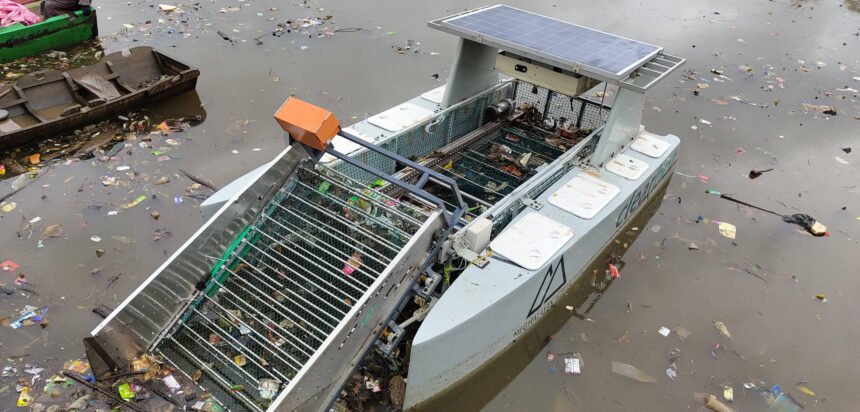
India’s rivers, lakes and harbours swallow an enormous amount of floating waste every year — plastic bottles, wrappers, water hyacinth — and cleaning it up has long meant diesel boats, manual labour and endless repetition. A Bengaluru company thinks the answer is to take the people out of the boat entirely. Its autonomous vessels now patrol some of India’s busiest waterways, collecting tonnes of waste without burning a drop of fuel.
The company is Clear Robotics. Founded in 2019 by Sidhant Gupta and Utkarsh Goel, it runs its India operations through Clear Robotics India Pvt. Ltd. from Bengaluru, and operates a fleet of 26 all-electric, AI-optimised unmanned surface vessels. In June 2026, the company closed a $1.75 million pre-Series A round led by Shipsfocus Ventures, with participation from Katapult Ocean, SGInnovate, M7 Holdings and MGS Ventures, to scale the fleet across India, Southeast Asia and the Middle East.
What the Clearbots can do
The workhorse of the fleet is the Class 3: a 4.04-metre vessel carrying a 3-kWh battery pack good for up to eight hours of operation — extendable by about four hours via rooftop solar panels — with a range of 5 kilometres and an average speed of 3 to 10 knots. A conveyor at the bow gathers floating debris into an onboard hold that carries 500 kg per mission, while a specialised cutter shreds invasive weeds like water hyacinth and duckweed. A 1080p camera, LiDAR and optional anti-collision systems enable full autonomous operation, and self-docking stations let the vessels top up their charge without human help.
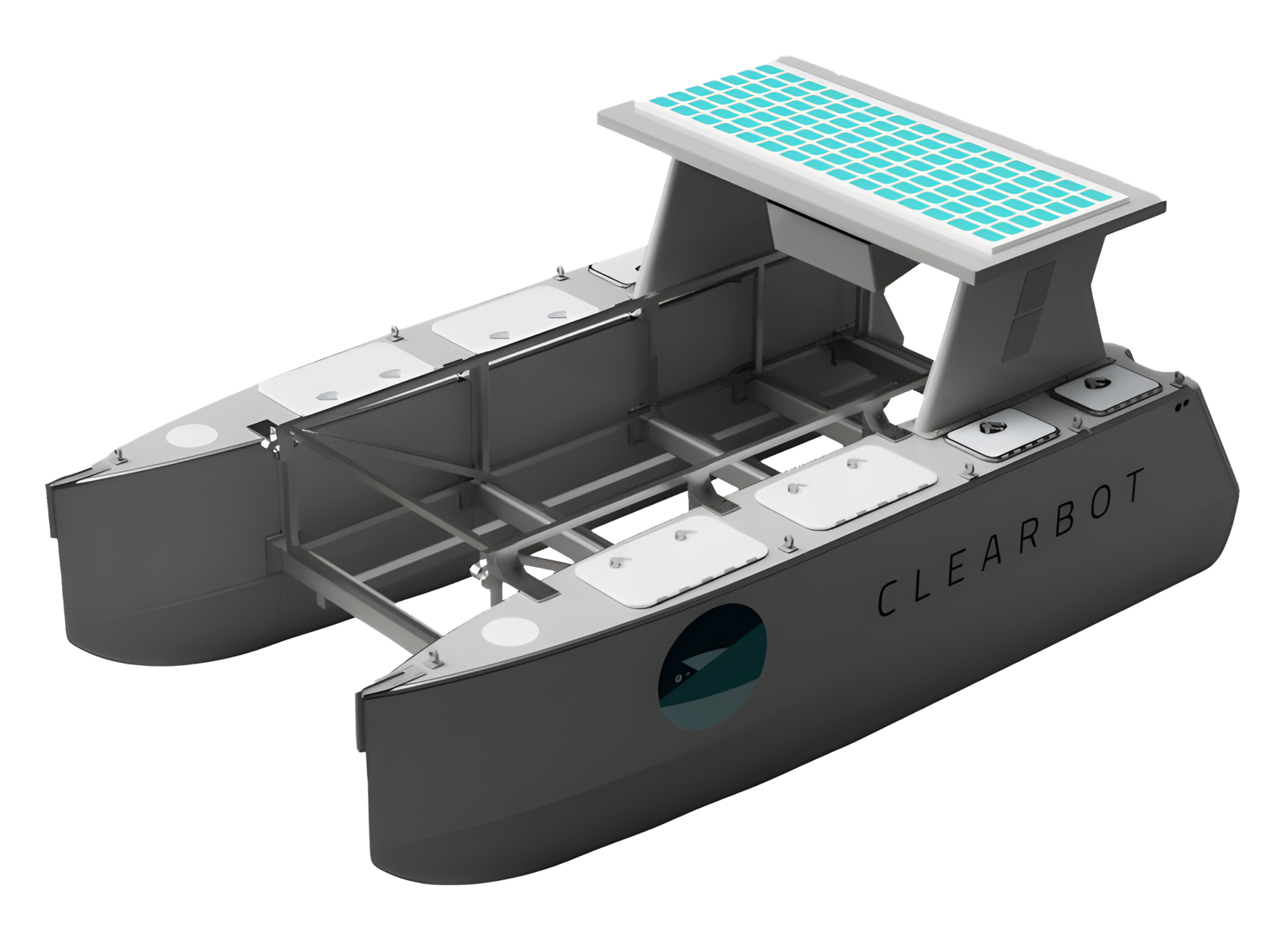
The intelligence sits in the machine vision. On the Clearbot Neo, two cameras work in tandem: one surveys the water surface, identifying rubbish while avoiding marine life, navigational hazards and other vessels; the second photographs every piece of waste that lands on the conveyor belt and transmits its image and GPS location to the company’s data compliance system. The company says every collected item becomes a data point — location, size, type, material and weight — giving ports and municipalities automated ESG reporting along with a cleaner waterway.
The numbers the company reports are striking: on trash duty a Class 3 covers up to 10,000 square metres a day, falling to about 2,500 square metres a day when cutting weeds — against the roughly 10 square metres a day a manual worker clears, per the company’s estimates. And the vessels run fully electric, so there is no fuel bill and no exhaust over the water they are trying to clean.
Where the fleet is working
In India, the company has launched a fleet of 25 autonomous Clearbots, aligned with the Harit Sagar and AMRUT missions. At the Jawaharlal Nehru Port Authority in Mumbai — one of India’s largest and busiest ports — the company says a Clearbot Class 3 has removed over 7,000 kg of floating waste, proving the platform in a high-traffic port environment. Deployments span the Brihanmumbai Municipal Corporation, ONGC, Gaya Nagar Nigam, Adoor Municipality and the Meghalayan Age enterprise at Umiam Lake in Meghalaya, where the company reports tens of tonnes of waste recovered. At Lohagarh Fort in Bharatpur, a deployment removed 4,691 kg of trash for the Rajasthan municipal authorities.
More Read
Beyond India, the fleet has cleared around 20,400 units of water hyacinth from the Ilugin River in the Philippines in partnership with the Asian Development Bank, and 260 tonnes of thick hyacinth in two weeks at Hong Kong’s SENTX landfill with Veolia. In September 2026, the company partnered with ReSustainability to deploy a 100% electric, semi-autonomous Clearbot Class 2 on Singapore’s Pandan River — replacing diesel workboats and turning a four-person manual crew into a single upskilled operator on the dock, with AI post-processing classifying the collected waste for ESG reporting.
The company also sells the vessels as a service: its robots-as-a-service model offers ports, municipalities and waterway authorities pollution recovery, port security, bathymetric and draft surveys, inspections and water-quality monitoring from the same autonomous platform.
From the JNPA’s docks to Singapore’s rivers, Clear Robotics’ electric fleet is showing what India’s marine robotics can look like when it ships as a commercial service — cleaner waters, measured in tonnes and square metres, and zero diesel burned in the process.
Keep reading: EyeROV: The Kochi Startup Putting India’s First Military-Grade Underwater Robot in Navy Service · Sunlight, not diesel: inside Navalt, the Kochi company building India’s solar-electric boats · More Shipbuilding & Maritime stories
Like stories like this? Add Exceptional Technology as a preferred source on Google to see more of our reporting in your search results and Discover feed.