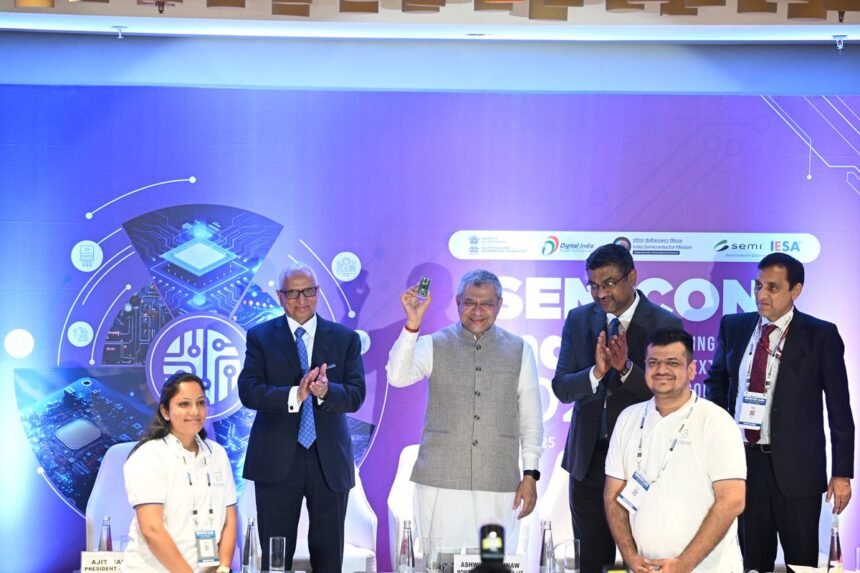
In September 2026, at SEMICON India 2026 in Yashobhoomi, New Delhi, Union Minister Ashwini Vaishnaw held up a small module for the cameras. It looked unremarkable — a palm-sized board — but what was on it was a genuine first. The ISC-VEGA-SOM, built by Ahmedabad-based fabless startup IndieSemiC, is what the company describes as India’s first indigenous System-on-Module integrating a VEGA-based processor with LoRa wireless technology: C-DAC’s VEGA Thejas32 processor and IndieSemiC’s FCC- and CE-certified LoRa RF module, on a single board.
A System-on-Module is the part an industrial product designer actually buys. A processor can exist as working silicon inside a research institute, but it only becomes sovereign technology when somebody builds a product around it. The VEGA-SOM is that bridge: a ready-to-use building block that a device maker can plug directly into a product — a smart meter, a city sensor, an industrial controller — instead of sourcing and integrating the processor and the wireless module separately. Compute and long-range wireless, designed together, on one Indian-made board.
Plug-and-play, made in India
IndieSemiC has also built a pluggable version, the ISC-VEGA-SOM-NIC, as a LoRaWAN network card. It works with the single-phase and three-phase versions of C-DAC’s Smart Energy Meters, and the company says it can slot into gas meters, water meters and Smart City projects that need dependable long-range wireless connectivity. The module was designed and developed under the Industry Support Centre, a MeitY-funded initiative of C-DAC that pairs the national R&D institution’s processor IP with startup engineering.
The launch landed on exactly the theme SEMICON India 2026 chose for itself: “Silicon to Systems.” As Jinal Shah, the company’s Founder and CMO, put it at the launch, the conversation around India’s semiconductor progress has stayed focused on the chip itself — but the real impact comes when that chip is turned into something ready to be used, a complete module a meter or a city project can simply plug in and run.
The company behind the module
IndieSemiC is an Ahmedabad fabless semiconductor company working on chipsets, RF modules and system-level solutions. Its technology spans BLE, Wi-Fi, LoRa, GPS and Zigbee, with clients across Europe, the USA and India, and the company says it serves more than 60 customers with over 10 WPC-ETA certified RF modules. April 2026 brought a partnership with Nordic Semiconductor to design and commercialise wireless modules for connected devices, plus an MoU with Kaynes Semicon covering qualification, assembly and testing pathways for its SiP modules and SoC roadmap. It also signed an MoU with Prizor Viztech to develop and commercially deploy a CCTV-focused SoC, the ISC-S2-PZ. A year earlier, at Semicon India 2025, IndieSemiC had already launched its IoT Evolution Board developed with C-DAC, pairing the indigenous VEGA processor with Bluetooth and LoRa connectivity for faster prototyping.
The road from processor to platform
The deeper story is the VEGA line itself: India’s own family of indigenously designed processors from C-DAC. In December 2025, IndieSemiC and C-DAC Thiruvananthapuram signed an MoU to jointly develop an AI chip based on the 64-bit VEGA processor with an on-chip Neural Processing Unit, alongside building an indigenous hardware and software ecosystem around the THEJAS-32 microcontroller as a domestic alternative to widely used imported microcontrollers. The company is also developing two indigenous System-on-Chips — the S1, a single-core SoC aimed at agritech, healthcare wearables, consumer electronics, drones, robotics and motor controllers, and the S2, a dual-core SoC with integrated AI capabilities for surveillance, vehicle clusters, displays and automation — with a stated target of rolling out 5–10 million units over two years, starting with applications like surveillance systems and drones. From a module a meter-maker can plug in today to an AI-capable chip family for tomorrow, the company is walking the whole ladder from silicon to systems — in India, for India.
More Read

Keep reading: From Idea to Silicon in 10 Minutes: Inside InCore, the Chennai Startup Automating India’s Chip Design · From Bengaluru to America: Inside ANSCER Robotics, the Warehouse Robots That Cleared the US Market · More Industrial Automation & Technology stories
Like stories like this? Add Exceptional Technology as a preferred source on Google to see more of our reporting in your search results and Discover feed.