


Behind every CT scan in India sits a quiet economic fact: the country imports between 75% and 85% of its advanced medical equipment, according to the Association of Indian Medical Device Industry. The high-end scanners that image trauma, stroke and tumours arrive with foreign price tags, customs duties and expensive overseas service contracts — which is why advanced diagnostic hubs cluster in the big metros while district hospitals hundreds of kilometres away must refer patients onward for a scan that takes seconds. On 15 October 2026, the Technology Development Board (TDB), a statutory body under the Department of Science & Technology, signed a commercialisation agreement that points a new way forward: it is backing Karnataka-based Panacea Medical Technologies to develop and commercialise an indigenous 32-slice CT scanner.
For a country building out its healthcare infrastructure at a furious pace, a domestically designed, manufactured and serviced CT scanner is a genuine engineering milestone. A 32-slice system captures 32 anatomical cross-sections in a single gantry rotation — sub-millimetre detail delivered in seconds. In the emergency department it can flag an intracranial bleed or skull fracture inside the golden hour; in the chest clinic it resolves tuberculosis lesions, severe pneumonia and early pulmonary masses; in abdominal care it maps kidney stones, appendicitis and localised growths. The 32-slice configuration is the clinical workhorse of district and secondary-care hospitals worldwide — exactly the tier the Panacea project is aimed at, from district hospitals to tier-2 and tier-3 healthcare facilities and semi-urban centres.
A quarter-century of building precision machines in India
Panacea is not starting from zero — it is starting from twenty-five years of precision engineering. Founded in 1999 and headquartered in Bengaluru under managing director G. V. Subrahmanyam, Panacea Medical Technologies designs and manufactures radiotherapy and radiology equipment for the diagnosis and treatment of cancer. Its machines are installed in 55 Indian hospitals, are CE certified and IEC compliant, and the company says each unit can treat 70 to 100 patients a day at a lifetime cost 50 to 60 percent lower than foreign competitors.
The company’s engineering lineage reads like a catalogue of firsts for Indian medtech. Its Bhabhatron II telecobalt unit, developed in collaboration with the Bhabha Atomic Research Centre, was gifted by the Government of India to Malawi, Kyrgyzstan, Kenya and Madagascar — machines that have helped treat over 100,000 cancer patients. The Siddharth-II linear accelerator is CE certified, US FDA 510(k) cleared, CDSCO and AERB type approved, with a patented in-gantry dual kV imaging system integrated for the first time on a linac. The Bhabhatron-3i brought image-guided gamma therapy onto a cobalt platform, and the LILAC full-field digital mammography system carries CDSCO approval and AERB type approval. Panacea’s precision credentials run deep: its experience spans high-precision gantry engineering and digital detector integration — precisely the disciplines a CT scanner demands.
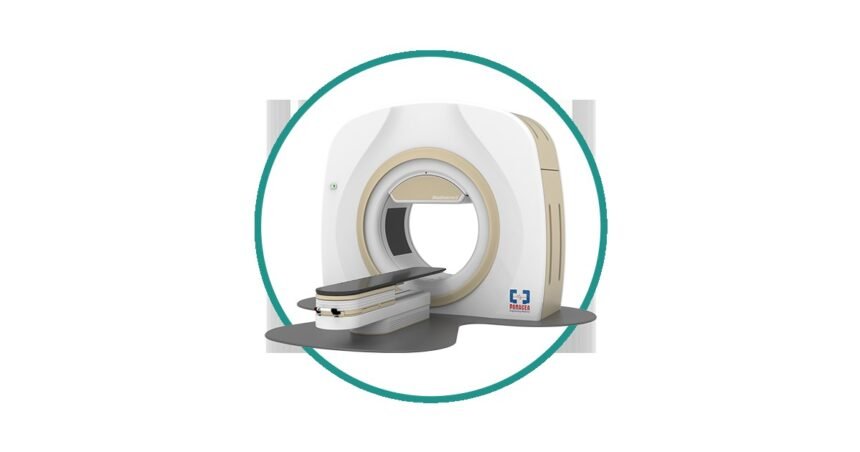
Panacea’s Bhabhatron-3i precision radiotherapy gantry — the ring-gantry engineering the company is now channeling into its indigenous 32-slice CT scanner. Image: Panacea Medical Technologies.
From gantry to scanner: the engineering at stake
A CT scanner is among the most demanding machines in medical engineering: an X-ray tube and a multi-channel detector array spinning at speed around the patient, converting X-ray attenuation through bone, tissue and vessels into millimetre-thin cross-sections via reconstruction algorithms. It demands precision alignment, high-voltage power handling, detector electronics and calibration exact enough to keep imaging safe and true. Panacea’s representative confirmed that TDB’s backing will expedite the commercialisation cycle, with engineering focused on system reliability, electrical efficiency suited to regional power grids, and local availability of replacement parts — the details that decide whether a scanner keeps running in a district hospital rather than waiting weeks for a foreign service engineer.
More Read

The government’s intent is explicit. “The development of an indigenous CT scanner aligns with the Government of India’s vision of strengthening domestic manufacturing of high-end medical devices under the Make in India initiative,” said Shri Rajesh Kumar Pathak, Secretary of the TDB, adding that the support aims to encourage Indian medtech companies to build innovative indigenous solutions for the country’s healthcare needs while opening doors to global markets. This is not Panacea’s first collaboration with TDB either: the board previously supported the company’s work on an S-band tunable magnetron for particle accelerators, developed indigenously by CSIR-CEERI and transferred to Panacea for mass production — a project the government has framed as a step toward making cancer treatment more affordable for the common person.
Why this scanner matters
When a district hospital can image on site, the whole care pathway changes. Acute trauma and stroke patients get diagnosed in minutes instead of after a long referral journey; follow-up scans become affordable enough to repeat; and the domestic supply chain insulates hospitals from shipping bottlenecks, spare-part delays and currency swings. Domestic assembly, regional servicing and local component sourcing are all projected to bring scan costs down — the same playbook that made Panacea’s radiotherapy machines a fraction of the cost of imported ones.
India already proved it can build world-class radiotherapy hardware at Indian prices. Now the same engineering muscle — gantries, detectors, imaging chains, precision manufacturing at Malur, Karnataka — is turning to diagnostic imaging. If Panacea delivers, the scanner that sees inside the Indian patient will, at last, be built by Indian hands.
Keep reading: The Backpack That Keeps Vaccines Alive: Inside Blackfrog, the Manipal Startup Cooling India’s Last Mile · Named for Kalam: Inside Makers Hive, the Hyderabad Startup Building India’s First Bionic Hand · More Chemicals, Materials & Life Sciences stories
Like stories like this? Add Exceptional Technology as a preferred source on Google to see more of our reporting in your search results and Discover feed.







