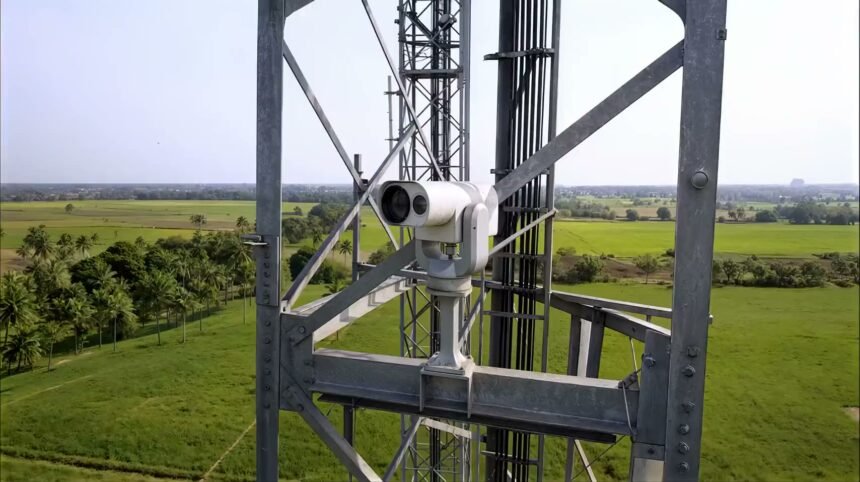
A beam leaves one tower and, twenty kilometres away, another lens catches it — carrying ten gigabits of data every second through open air. No fibre to trench, no spectrum licence to buy, no radio signal for an adversary to intercept. That is free-space optical communication, and a young Pune company called olee.space has demonstrated it end to end, reporting around 85 per cent indigenous content in the hardware.
olee.space was founded in 2023 by James Solomon, an IIT Bombay alumnus who serves as the company’s chief executive, and engineer Suman Hiremath, its chief operating officer. Solomon’s route to light was indirect: his first attempts at long-range wireless used television white space and then LoRa, both stalled by spectrum licensing. The breakthrough, as he tells it, was realising that light operates outside every regulated band — so in 2019 he built a ten-foot experimental rig to push data through the air on a laser beam, and set about solving the hard problems of smoke, dust, rain and wobble.
The showcase result came in January 2026, when the company demonstrated a 20 km, 10 Gbps wireless laser link — designed, manufactured and tested in India, and built, the company says, within four months of project funding. The platform pairs a high-accuracy Indian-made gimbal with arc-second-level pointing precision and an internally integrated fast steering mirror driven by voice-coil and piezo actuators; the two stages hold the beam on target even as the atmosphere churns. The company reported carrier-grade link availability of 99.9999 per cent during performance validation. “Achieving a 20 km, 10 Gbps optical link with carrier-grade availability under Indian operating conditions is a significant milestone,” Solomon said at the time. “This demonstration establishes India’s ability to design, manufacture, and validate advanced wireless laser communication systems using predominantly indigenous technologies.”

What makes olee.space unusual is that the laser link is only one of three applications the company has engineered from the same photonics core — what it calls putting controlled photons to work. On the DATA side, free-space optical links, with quantum key distribution on the roadmap, move 10 Gbps across 20 km — faster than laying fibre, immune to jamming, invisible to spectrum congestion — and the company is working towards optical payloads on satellites across low, medium and geostationary orbits. On the POWER side, the same beam technology delivers electricity without a wire: the company lists wireless power transfer of 600 W across 400 m, a photovoltaic cell at the far end turning light back into current. And on the PROTECT side, directed energy: laser systems the company says can secure critical assets at up to a five-kilometre class — in the company’s own words, a hostile drone makes it an interceptor. Eleven patents have been filed across photonics, optical control and beam delivery.
The directed-energy line is already taking physical form. The company describes laser configurations from 2 kW to 50 kW for counter-drone and short-range air-defence roles, engaging targets in under three seconds and integrating with radar as well as electro-optical and infrared sensors. One system puts a 2 kW AI-driven laser on a compact unmanned ground vehicle — about 1.5 by 0.9 metres, under 250 kg, with a reported range of roughly 130 km on a full tank and the ability to operate in coordinated swarms. International defence coverage has described it as among the most compact ground-based laser weapon systems of its kind.
The Indian state has noticed. On 31 August 2026, the Government of India nominated olee.space as the development-cum-production partner for a Rs 70 crore (about US$7.4 million) Advanced Photonics Development Programme — a 24-month structured pathway spanning research, technology development, engineering, fabrication, system integration, testing, validation and production readiness, judged milestone by milestone. “We believe the core photonics is far more exciting and to be discovered. We have struck the first rock, we would be the one mining it economically,” Solomon said. “The applications are endless, we have presented 15 already and we would build further in shared photonics architecture.” The company, which raised US$3 million in seed funding in August 2025, says it aims to supply its systems to Indian and international markets over the next 12 to 24 months, with ground-to-drone communication links among the capabilities on its roadmap.
More Read
A startup that began with a ten-foot laser rig in 2019 now works across the full arc of photonic engineering — data, power and protection, all carried by light. If olee.space’s roadmap holds, the invisible infrastructure of India’s battlefields, backhaul networks and forward bases may soon run on beams built in Pune.
Keep reading: The 120-Year-Old Efficiency Ceiling Just Broke: Inside Spacerolls, the Bengaluru Startup Rebuilding the Jet Engine’s Heart · Nine Months to a Jet Engine: Inside Nabhdrishti, the Bengaluru Startup Building India’s Own Gas Turbines · More Aerospace & Defense stories
Like stories like this? Add Exceptional Technology as a preferred source on Google to see more of our reporting in your search results and Discover feed.