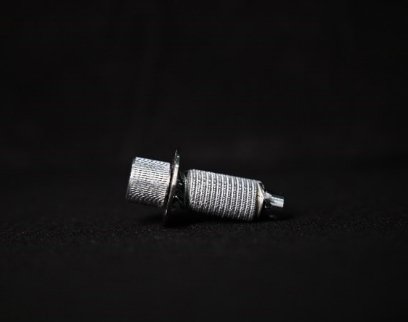
The infrared seeker is the eye of a missile — and, like any eye that works by detecting heat, it has a maddening flaw. At room temperature the sensor generates so much of its own heat that the signal it is hunting disappears into the noise. Trying to pick out a distant heat source with a warm detector, as one report puts it, is like trying to see a candle while standing next to a bonfire.
The fix is to make the detector brutally cold — around −196°C — almost instantly, in a package so small it barely registers on a scale. For decades the device that does this, the miniature Joule-Thomson cryocooler, was a monopoly guarded by the United States, France and Israel, and controlled under the Missile Technology Control Regime. India had to import it. Now a small team in Mumbai, led by a 75-year-old IIT Bombay alumnus and former DRDO laboratory director, has cracked it on home soil. The cooler weighs about ten grams. The country that builds it is India.
That team is Techno Defence Private Limited. Established in 2016, the company is a joint venture between Technocraft Industries India Limited — led by Sharad Kumar Saraf and Sudarshan Kumar Saraf — and Dr Pravin Salinkar, all of them IIT Bombay alumni. From a design office and laboratory in Thane, some 20 km from Mumbai, Techno Defence has spent years turning cryogenics into indigenous defence capability, with a stated vision of becoming a leading manufacturer of smart ammunition seekers.
The flagship achievement is the Dual Flow Miniature Cryocooler: a fast-cooldown, low-flow, dual-flow, self-regulating JT cooler developed in collaboration with DRDO’s Solid State Physics Laboratory (SSPL), Delhi, under the Technology Development Fund (TDF) scheme. It cools the infrared sensors and focal plane arrays inside missile seekers to cryogenic temperatures — the way high-performance cooled infrared detectors demand — while staying compact, lightweight and vibration-free.
The physics behind it is the Joule-Thomson effect: let a high-pressure gas expand through a restriction and its temperature drops sharply. Doing that inside a device that must be tiny, feather-light and ready on demand is, in the words of the Hindu BusinessLine, a complex engineering project — and Techno Defence’s design is distinct from those of the foreign players. It developed its own specialised production techniques and equipment, drawing on local small-scale and cottage industries. Assembly demands skilled hands working under a microscope, pure materials and clean environments, backed by stringent quality controls to meet defence-grade reliability. It is the kind of precision work usually associated with far larger, better-funded defence contractors — done here by a small team of engineers and technicians, mostly women.
The journey began, almost improbably, with a chance meeting sometime between 2017 and 2018 between Dr Salinkar and a DRDO laboratory director. That conversation led him to accept a critical defence manufacturing challenge. In 2020 the project received funding under DRDO’s Technology Development Fund scheme for the indigenous design and development of the JT cooler. By 2023–24 the team had completed the project and handed it over to DRDO for trials — trials the company says were successful.
More Read

Recognition has followed. Economic Times, in collaboration with DRDO, felicitated Technocraft Industries India Limited with an appreciation award for developing the Joule-Thomson cryo-cooler at the India Defence Conclave 2023 in Delhi. The company’s lab has drawn visits from the country’s senior defence figures, including DRDO chairman Dr Samir V. Kamat, and Padma Bhushan A. Sivathanu Pillai, the founder of BrahMos Aerospace, who visited the JT Cooler lab in February 2024. Industrialist Anand Mahindra hailed the achievement publicly, writing: “A 10-gram cooler just broke a monopoly the US, France & Israel guarded for decades. With only a small Mumbai team, a DRDO fund willing to bet early, & 5 years of someone refusing to look away from a hard problem.”
For indigenous production, the company says missile manufacturers will have to reach out to it — it is the sole producer of the JT cooler in India. And the world has noticed: Techno Defence says it is in talks with a foreign country for the product’s export, though as a strategic component governed by the MTCR, that will need a special export permit.
The cryocooler is not Techno Defence’s only precision work. The company has also built a 3-axis test setup for measuring the centre of gravity and moment of inertia of payloads and vehicles ranging from 1,200 kg to 15,000 kg, a swivel table for calibrating the gyro sensors of the Su-30 MKI across speeds from 0.03 deg/sec to 150 deg/sec in both directions, and the canister system for Akash-NG missiles.
What makes the JT cooler story exceptional is not just the ten grams of metal — it is what those ten grams unlocked. A seeker that sees clearly is a missile that tracks truly, and the cooling system behind it was one of the last quiet monopolies India depended on. A handful of people in Thane spent five years refusing to look away from that hard problem, and now the country makes its own.
Keep reading: Light as Infrastructure: Inside Olee.space, the Pune Startup Building Laser Communication, Power Beaming and Directed Energy · The 120-Year-Old Efficiency Ceiling Just Broke: Inside Spacerolls, the Bengaluru Startup Rebuilding the Jet Engine’s Heart · More Aerospace & Defense stories
Like stories like this? Add Exceptional Technology as a preferred source on Google to see more of our reporting in your search results and Discover feed.