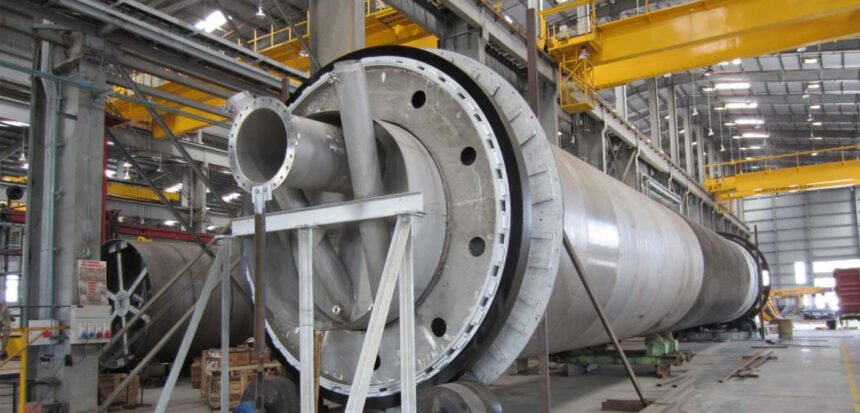
Every cup of tea, every bag of cement and every granule of fertiliser passes through a step most people never think about: drying. Wet material must be dried evenly, gently and at scale before it can become a product the world can use. For nearly four decades, the machines that do that job for plants across the world have often carried one Indian name: Kilburn Engineering.
Founded in 1987, Kilburn Engineering Limited designs, manufactures, installs and commissions custom-built process equipment from its registered office in Kolkata and its works at Saravali in Thane, Maharashtra. The company says it delivers projects from concept to commissioning, covering detailed engineering, manufacturing, site construction, installation, commissioning and training.
The full range of drying, under one roof
Kilburn’s catalogue reads like a complete vocabulary of industrial drying. Rotary dryers, paddle dryers, fluid bed dryers, spray dryers, flash dryers, band dryers and vibrating fluid bed dryers sit alongside rotary coolers, calciners and kilns, heat exchangers, pressure vessels, silos and material handling systems. Around them, the company builds air, gas and liquid drying systems, solvent and vapour recovery systems, pneumatic conveyors and packaged skid systems for offshore and industrial duty.
That breadth is the point. A tea factory, a soda ash plant, a cement works and a fertiliser complex all need to remove moisture, but each material behaves differently, and each process demands its own machine. Kilburn builds each system to the customer’s material, capacity and site, rather than selling a standard box.
The tea dryer the world keeps buying
Nowhere is that reputation clearer than in tea. The company says it continues to be the market leader in the manufacture of tea dryers, and its vibro fluid bed tea dryers have passed 1,200 installations, supplied to almost all tea-producing countries in the world. It is a quiet kind of global leadership: a machine perfected in India, running in tea factories on several continents, turning fresh leaf into the tea the world drinks.
The same engineering travels far beyond tea. Kilburn’s steam tube calciners have served soda ash producers including Nirma, Tata Chemicals and GHCL; its instrument and utility gas drying systems have gone to offshore platforms through builders including Mazagon Dock, Larsen & Toubro, Hyundai and Samsung, with more than 100 systems delivered for ONGC installations; and its air handling and heavy water recovery systems have served Nuclear Power Corporation projects.
More Read
Scale that keeps compounding
The company reported revenue from operations of ₹424.46 crore in FY2024-25, with operating EBITDA of ₹100.99 crore and profit after tax of ₹62.39 crore, and an order backlog of ₹483 crore at the end of March 2025. Growth has come with new muscle: the acquisition of M.E. Energy, a specialist in waste heat recovery and waste heat reutilisation systems, and of Monga Strayfield, broadening Kilburn’s product portfolio and customer base, alongside a new facility at Ambernath that adds execution capacity.
Recent wins show where that momentum is heading. In 2025 Kilburn signed a master agreement with Komline-Sanderson Corporation of the United States, under which it manufactures turbo dryers and paddle dryers for global customers and provides engineering services for the American company’s projects. In June 2026 it secured its first orders from Casale SA of Switzerland, valued at ₹70.2 crore, for specialised process equipment for fertiliser applications, qualifying Kilburn as a supplier within the global vendor network of one of the world’s leading fertiliser technology licensors.
Indian engineering, built for the world’s hardest jobs
What ties the story together is a discipline honed over 38 years: design it yourself, build it yourself, prove it on the customer’s site, and stand behind it. From tea dryers in hillside factories to calciners in soda ash plants, gas skids on offshore platforms and fertiliser equipment for global licensors, Kilburn’s machines work where heat, dust, moisture and scale leave no room for error.
It is the kind of Indian engineering story that rarely makes headlines and quietly makes everything else possible: the dryers, coolers and calciners behind the tea in the cup, the cement in the wall and the fertiliser in the field, designed and built in India for plants around the world.
Keep reading: The Solan Precision House Behind the Switches, Meters and EVs of 38 Countries and The Noida Pumpmaker Quietly Powering 50+ Countries: Inside Roto Pumps’ 57-Year Engineering Story — and explore more stories in the Industry Leaders series, celebrating established Indian companies building world-class engineering.
Like stories like this? Add Exceptional Technology as a preferred source on Google to see more of our reporting in your search results and Discover feed.