On a small farm, the hardest problems are the most ordinary ones: nobody available to spray, nobody available to weed, and a tractor that costs more than the land earns in a season. In February 2025, at the World FIRA farm-robotics event in Auzeville-Tolosane, near Toulouse, France, the judges of the world’s farm-robot prize looked past machines costing half a million dollars and picked a small orange robot from Hyderabad.
That robot is the iMog, built by FarmRobo Technologies. Founder and CEO Sreekanth Reddy Vajrala, an agricultural engineer, started from a gap he kept seeing on small and mid-sized farms: labour that arrives late, costs more every year, or does not arrive at all — while the machines that could help are built for large farms, large budgets and specialist operators. The iMog, in development since 2019, is his answer: a robot sized, priced and simplified for the farms that need it most.
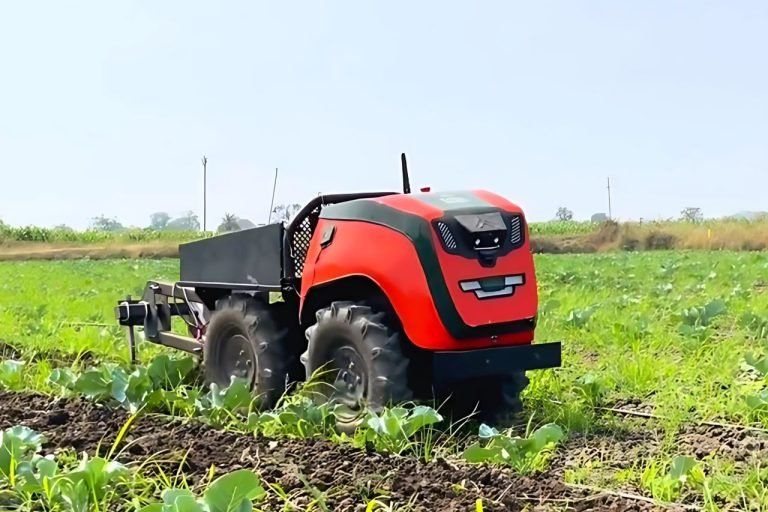 FarmRobo’s R1, the current generation of its autonomous field robot, working a crop row. (Image: FarmRobo)
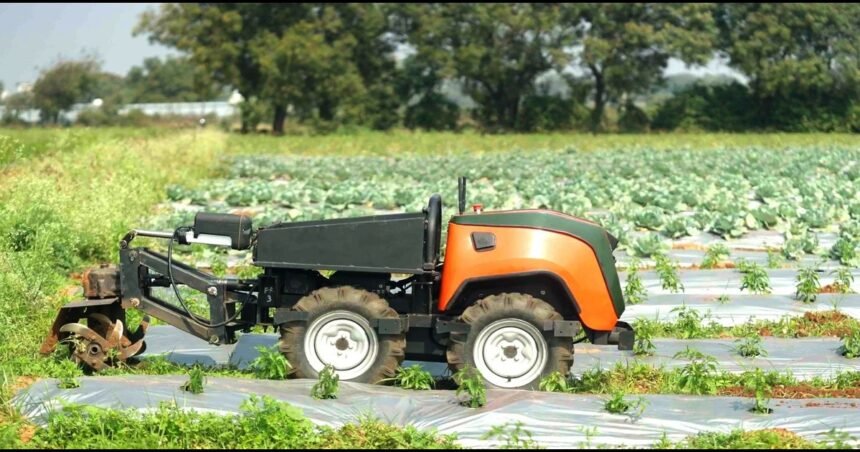
The machine itself is deliberately modest. The iMog weighs about 550 pounds (roughly 250 kg) and measures just two feet wide by four feet long — small enough to slip between tightly packed crop rows without damaging plants. An 8 HP-equivalent electric motor drives it, fed by a 90 Ah lithium-iron-phosphate battery that the company says runs for four to five hours on a charge and recharges in two and a half to three hours. There is no diesel, no exhaust in the field, and very little noise.
What makes it autonomous is a combination the company tuned for Indian fields: RTK-enabled GPS for what it describes as centimetre-level positioning, camera-based row guidance that steers the robot down the crop line, and the ability to follow a route programmed by the farmer. When a farmer wants control, the robot can also be driven remotely through its onboard cameras, or manually by radio control. Its own power take-off (PTO) lets it run conventional implements — a rotary tiller, furrow blade, cultivator, high-pressure sprayer or mulcher — so one small machine covers spraying, mechanical weeding, transport, field logistics and precision crop work.
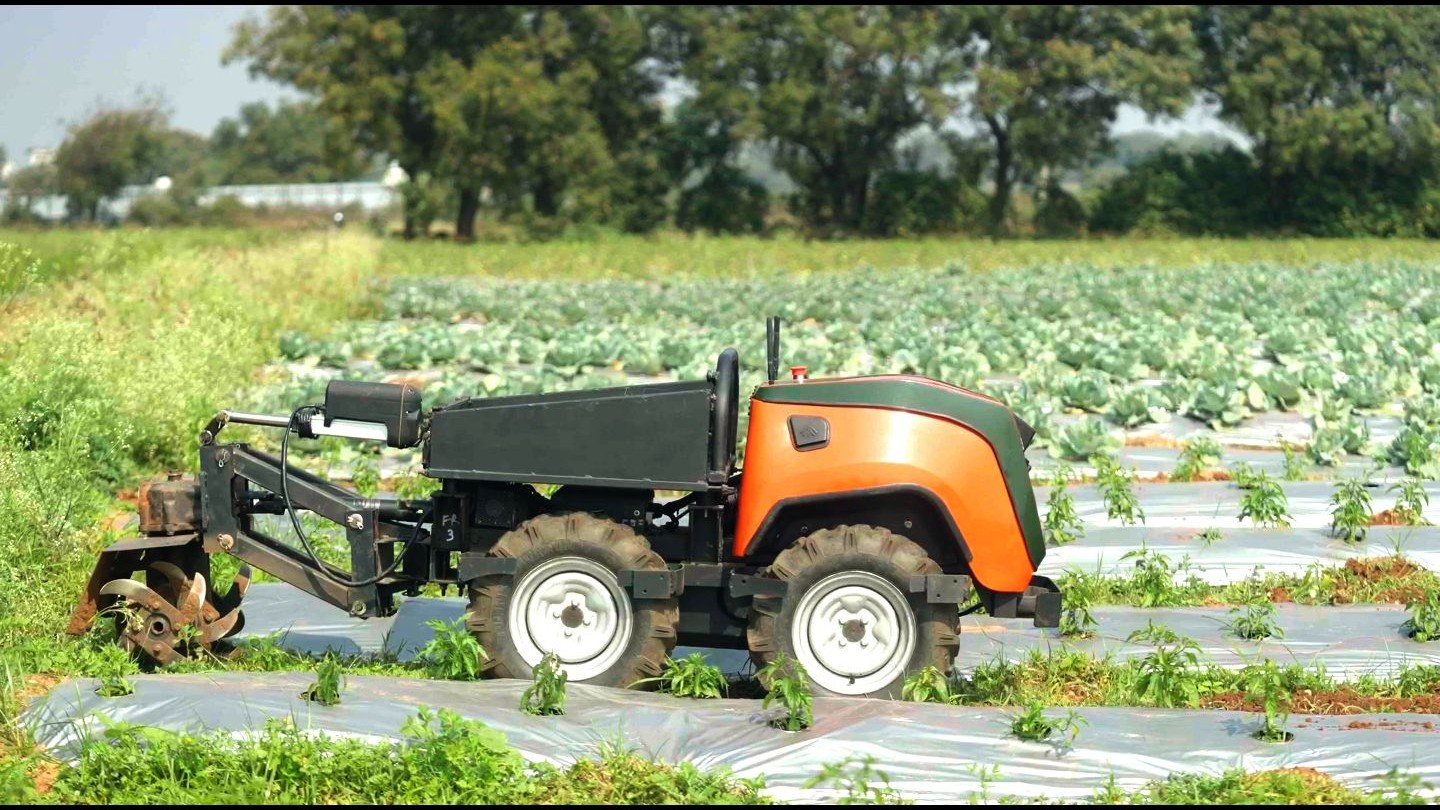 The iMog with a tiller attachment, working between mulched crop rows. (Image: FarmRobo)
More Read

The award that put FarmRobo on the world map is the Ag Robot of the Year 2025, announced at World FIRA on 6 February 2025 by René Koerhuis, editor of Future Farming. An expert jury of Future Farming editors, a Wageningen University robotics researcher and farmers from around the world judged five finalists — drawn from eleven candidates — on originality, market readiness, potential impact on farmers’ lives, ease of uptake and sustainability. The iMog won on all of it: twenty units were already operational by the end of 2024, the jury praised its vision steering, its PTO and its versatility, and its base price of €12,000 (about $12,840) made it by far the most affordable finalist. The public agreed — in a vote open from 14 January to 2 February, readers also chose the iMog as their favourite, giving FarmRobo the jury prize and the people’s prize in the same week.
The economics are the point. FarmRobo’s own comparison puts traditional spraying and weeding at five to ten workers per operation, or one to two days per acre for a ten-person crew, with chemical waste from uneven spraying and health risks from direct exposure. The company’s site reports labour-cost reductions of up to 90% for farms using its robots, and lists more than 50 farmers now running them across challenging terrain, with over 7,000 operating hours logged on real Indian farms. The current generation, the R1v2, carries the same platform forward with camera row guidance, RTK support, safety failsafes and fleet monitoring, and is listed on the company’s site from ₹8.5 lakh.
FarmRobo’s R1 at work in the field. (Video: FarmRobo)
FarmRobo’s bet is a simple one: that autonomy will reach Indian agriculture not through the biggest machine, but through the smallest one a small farmer can actually buy, run and maintain. A world title for a €12,000 robot from Hyderabad suggests the rest of the industry is starting to agree.
Keep reading: From Notebook to Network: Inside KhetiBuddy, the Pune Company Digitising India’s Farms Acre by Acre · Frozen in Winter, Flowing in Spring: Inside Acres of Ice, the Leh Startup Building Artificial Glaciers · More Food Processing & Agri-Tech stories
Like stories like this? Add Exceptional Technology as a preferred source on Google to see more of our reporting in your search results and Discover feed.