Every AI breakthrough has a physical shadow: heat. The chips training today’s models pack more power into every rack than the air conditioning of a conventional data centre was ever designed to remove, and as racks grow denser, simply blowing more air at the problem stops working. An Ahmedabad startup decided the answer should be built in India, for Indian conditions, as one complete system — from the chip to the chiller.
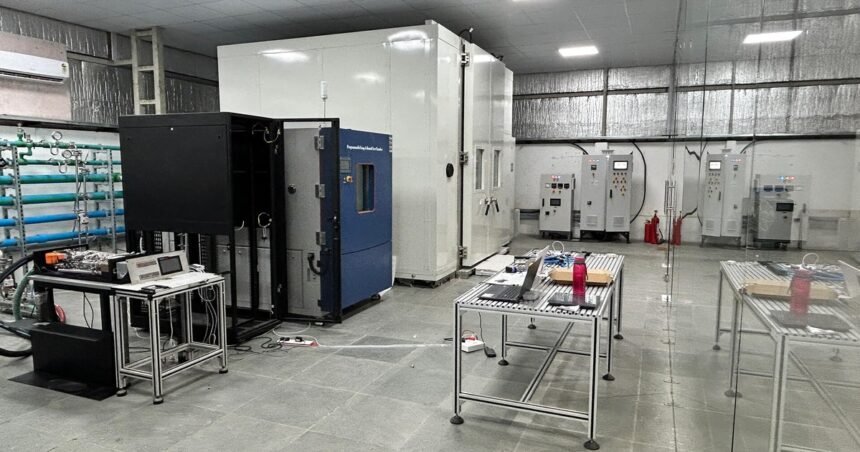
That startup is KühlTherm, founded in 2025 by Shailesh Bishnoi and co-founders Vishant Gandhi, Kamish Kachhadia, Jasvipul Chawla and Kishan Baravaliya, several of whom previously worked at Ola Electric. On 7 August 2026, the company unveiled its made-in-India liquid cooling range for AI data centres: a Rear Door Heat Exchanger (RDHx) and a Cooling Distribution Unit (CDU), alongside what the company describes as India’s first integrated liquid cooling validation laboratory, in Ahmedabad.
The RDHx ProSeries is the workhorse at the rack itself. It captures heat directly at the rear of the rack, before it ever enters the data centre environment, so the facility’s existing air systems no longer have to fight it. Built on a modular architecture that scales from 20 kW to 100 kW per door in 20 kW blocks, it uses variable-speed fans and built-in redundancy to adapt to real-time thermal load — letting operators run higher rack densities without major facility changes.
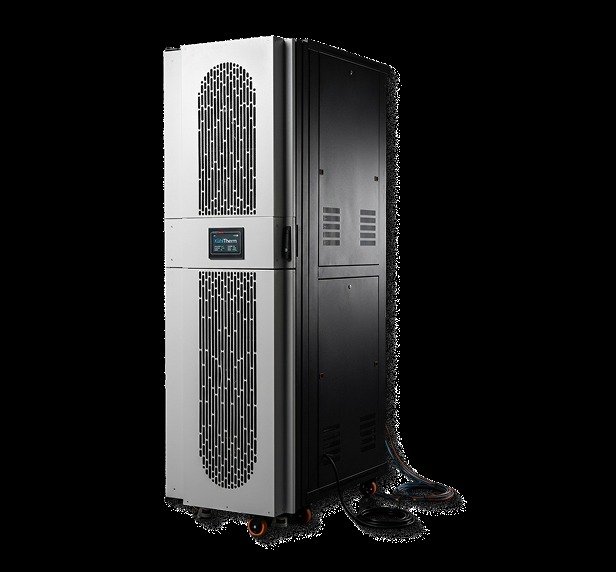 KühlTherm’s Rear Door Heat Exchanger (RDHx) ProSeries, which captures heat at the rear of the rack before it enters the data centre. (Image: KühlTherm)
Behind the rack doors sits the CDU, the unit that sits between facility water and the liquid cooling infrastructure and keeps the whole loop honest. It delivers precise coolant flow, temperature control and pressure management, engineered in modular blocks scaling from 250 kW to 1.5 MW per row, with N+1 redundant pumps and fans, automated leak isolation and toolless service at every stage. The company says the combination supports both current infrastructure and future capacity growth without interruption.
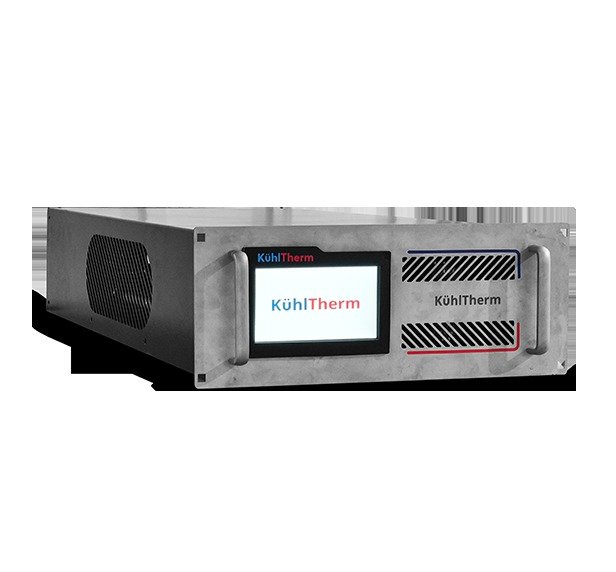 KühlTherm’s Cooling Distribution Unit (CDU), which manages coolant flow, temperature and pressure across the liquid cooling loop. (Image: KühlTherm)
More Read

The loop starts even closer to the heat. KühlTherm’s direct liquid cooling system removes heat directly from CPUs and GPUs using a patented Mesh Cold Plate technology, co-engineered around the thermal profile of modern processors, delivering 300 W to 2,500 W of cooling capacity per plate for accelerator racks pushing past 100 kW. Tying it all together is NexusFlow OS, the company’s proprietary AI-powered thermal intelligence platform, which runs the journey from chip to chiller and from grid to rack as one live loop, learning each facility and getting sharper the longer it operates.
What makes the stack distinctly Indian is the conditions it is designed for. The company says its systems are engineered for high ambient temperatures, grid fluctuations and local infrastructure realities — the everyday operating environment of an Indian data centre — and that the complete thermal loop, from chip to chiller, is designed and manufactured in India. Every product is tested against real-world conditions in the company’s Ahmedabad validation laboratory before deployment, which the company says is how it establishes reliability and trust with operators adopting liquid cooling for the first time.
The timing matches a national buildout. India is entering a major data centre expansion cycle, and cooling decisions made now will define the efficiency of that infrastructure for years. KühlTherm says its current manufacturing capacity stands at 300 MW, with a vision of reaching 2 GW by 2027, and the company raised $1.1 million in a seed round led by Arkam Ventures earlier in 2026 to scale its modular cooling systems.
AI’s future will be decided as much by thermodynamics as by algorithms — by whether the machines doing the thinking can shed their own heat, hour after hour, without wasting power on the cooling itself. KühlTherm is betting that India should not have to import that answer, and that a full liquid cooling loop designed in Ahmedabad can keep the country’s fastest computers running cool, efficient and ready for whatever comes next.
Keep reading: The Software Between the Model and the GPU: Inside Simplismart, the Bengaluru Startup Making AI Cheaper to Run · Seven Minutes From Sky to Doorstep: Inside Skye Air Mobility, India’s Drone Delivery Pioneer · More Industrial Automation & Technology stories
Like stories like this? Add Exceptional Technology as a preferred source on Google to see more of our reporting in your search results and Discover feed.