Under every Indian city runs a second city — thousands of kilometres of sewers and drains that nobody sees until something goes wrong. When a blockage defeats the jetting machines and suction equipment, the job has too often fallen to a worker climbing down into a manhole, into darkness, toxic gas and fast-moving water. A Hyderabad robotics company decided that no job in a modern city should ever ask a human being to do that.
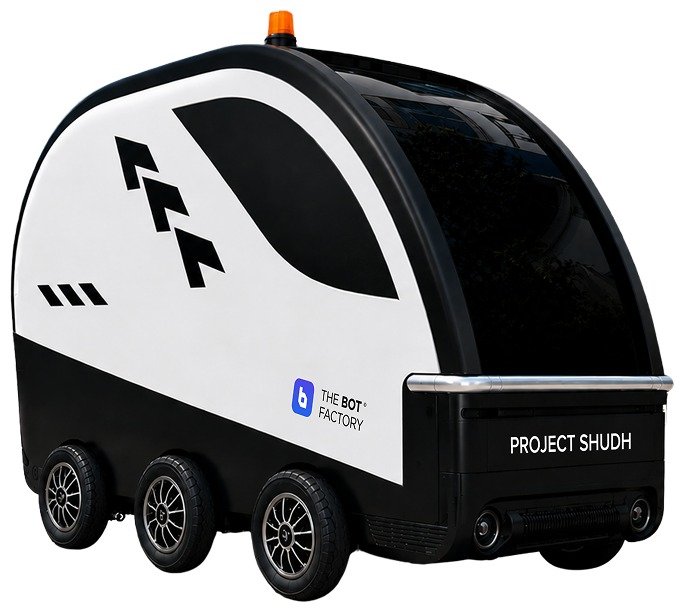
That company is The Bot Factory, a deep-tech robotics startup incubated at T-Works, Telangana’s state-run prototyping hub. Its answer is Project SHUDH, an AI-powered sewer governance platform built around autonomous robots — and on 11 July 2026, Telangana’s IT and Industries Minister D. Sridhar Babu formally launched it at T-Works, in front of the very civic agencies it is built to serve.
SHUDH starts from a different idea than most sewer machines. The Bot Factory calls it a shift from sewer cleaning to sewer governance: instead of simply mechanising one job, the platform turns the whole underground network into something a city can see, measure and manage. Autonomous robots travel through vertical manholes and horizontal pipelines, including the corner manholes that conventional equipment struggles to reach, inspecting and cleaning as they go. Every intervention is digitally tracked, recorded and analysed, and the data flows into live dashboards for civic officials.
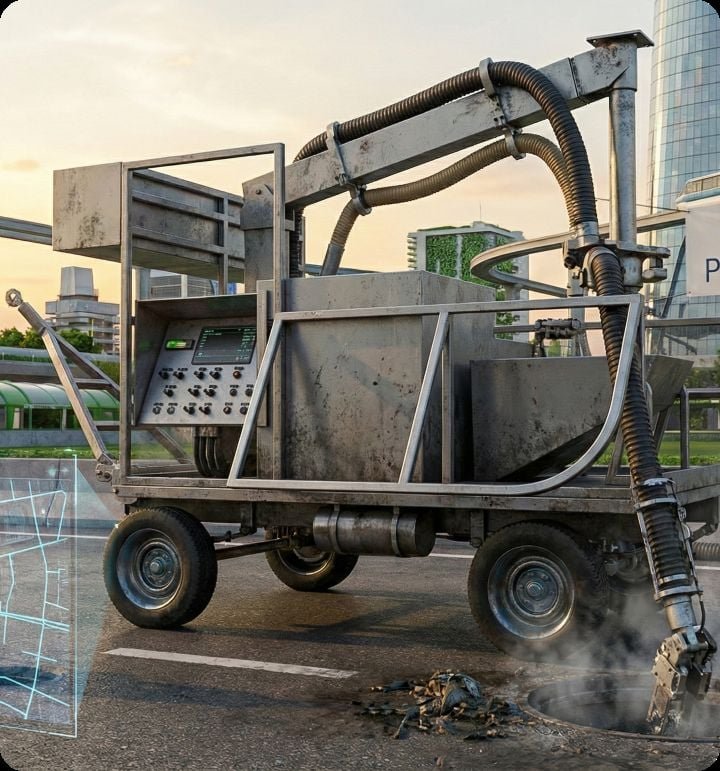 A Project SHUDH machine at work at a manhole, cleaning and inspecting the sewer below. (Image: The Bot Factory)
The intelligence sits above the robots as much as on them. SHUDH combines artificial intelligence with GIS and satellite-based monitoring and predictive analytics, building a live digital map of the drainage network. The company says the system forecasts blockages before they happen, so maintenance crews can act on a warning rather than a crisis — and so a city can spot recurring trouble spots instead of clearing the same drain again and again.
The platform was put through its paces with Hyderabad’s own water board before launch. Trials conducted with the Hyderabad Metropolitan Water Supply and Sewerage Board showed encouraging results in identifying drain blockages, generating alerts and feeding data into predictive analytics, and the board’s managing director, Ashok Reddy, said at the launch that a pilot deployment in a selected area would come next, ahead of scaling up across the network. An earlier live demonstration at Yakutpura in January 2026 had already shown the system cleaning sewers and manholes with minimal human intervention, in front of water board officials.
More Read

The goal the company states for SHUDH is simple and absolute: zero manual sewer entry. The Bot Factory says its robots are built for exactly the high-risk environments where human safety cannot be compromised, and that the same disaster-management robotics work extends to protecting rivers, lakes and other urban infrastructure. The platform is designed to serve the full sweep of urban India — the company points to more than 4,500 statutory towns, municipal corporations, Smart Cities, water boards and industrial townships that all manage underground networks of their own.
The backdrop makes the mission urgent. Data presented in Parliament records 377 deaths while cleaning sewers and septic tanks between 2019 and 2023, and the company estimates that nearly 800,000 sanitation and sewer workers maintain India’s drains, sewers and septic tanks today. Every robot that goes down a manhole instead of a person is a risk removed from someone’s working day — and every digital map it brings back is a city learning, for the first time, exactly what lies beneath its streets.
Project SHUDH was developed under the guidance of the All India Robotics Association, and its launch drew the city’s civic leadership together — the water board, the Greater Hyderabad Municipal Corporation and the state government — around one idea: that the most invisible infrastructure in a city deserves the most modern technology India can build. Hyderabad’s sewers may stay out of sight, but with robots, AI and a live map watching over them, they will never again be out of mind.
Keep reading: The Heat Beneath the AI Boom: Inside KühlTherm, the Ahmedabad Startup Cooling India’s Data Centres With Liquid · The Software Between the Model and the GPU: Inside Simplismart, the Bengaluru Startup Making AI Cheaper to Run · More Industrial Automation & Technology stories
Like stories like this? Add Exceptional Technology as a preferred source on Google to see more of our reporting in your search results and Discover feed.