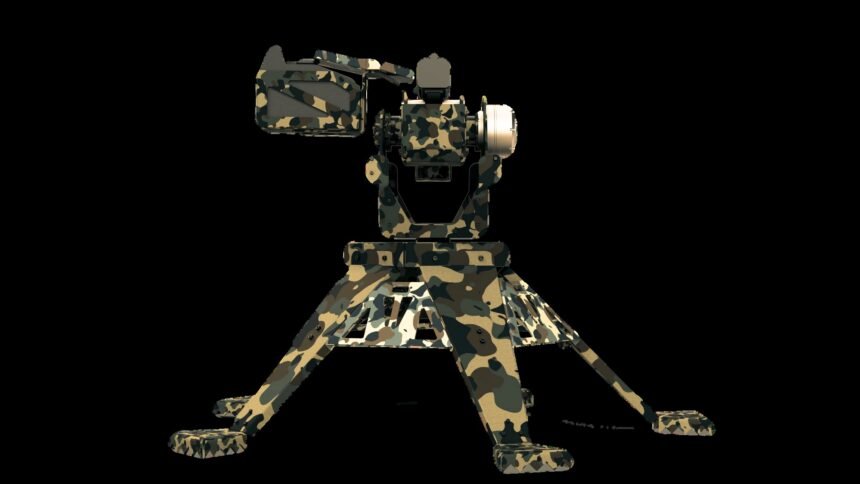
Modern battlefields have a maths problem. A hostile drone can cost a few lakh rupees; the missile sent to stop it can cost crores. And when drones arrive not one by one but as a swarm, every second of delay — and every rupee of overkill — matters. An Indian defence-technology company has answered with a machine built to change that equation: a compact, AI-driven turret that watches the sky on its own, picks out the threat, and answers it with gunfire instead of missiles.
It is called TRIYAM-3D — “Detect | Decide | Destroy” — and it comes from BSS Materiel Limited, part of the BSS Alliance. The system, unveiled in April 2026, is an autonomous weapon platform designed for one job above all: stopping drones and drone swarms before they reach the soldiers, bases and infrastructure they are hunting.
An AI brain watching the sky
At the heart of TRIYAM-3D is what the company calls its Detection Engine: AI-driven target detection, recognition and tracking, fused with a sensor suite the company lists as a 1080p day camera, an electro-optical thermal night camera and a 30× optical zoom. The turret turns a full 360 degrees, so there is no blind direction for a swarm to slip through.
The system also carries LookOut, a passive, optical-based drone-detection layer that spots unmanned aircraft from their own optical emissions — the LiDAR anti-collision pulses, range-finding and targeting lasers and near-infrared illumination that drones give off. Working together, the sensors and the AI compress the whole chain — detect, classify, prioritise, engage — into a rapid sensor-to-shooter cycle, with minimal human input. The company says the platform is designed for a hit probability of 90% or higher, with an effective engagement range of up to 1,000 metres, and it fires specialised, cost-effective hard-kill ammunition engineered to defeat multi-rotor and fixed-wing drones while keeping collateral risk low.
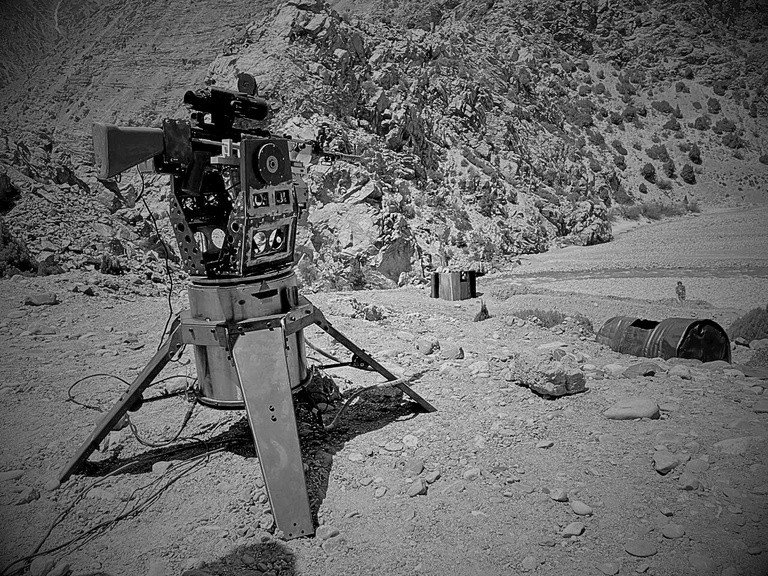
TRIYAM-3D on a high-altitude deployment, from the company’s official catalogue.
More Read
Built for the highest, harshest posts
TRIYAM-3D was not designed for a showroom. The company says the platform is ruggedised for temperatures from –30°C to +50°C, is IP65 dust- and moisture-resistant and built to MIL-STD-810G, with a quick-deploy mounting platform the company describes as tool-less to assemble. In its trial configuration it weighed around 60 kg — a man-portable system that a small team can carry, assemble and run — and the company puts its total weight, excluding weapon and ammunition, at under 100 kg.
Endurance is part of the design too: the company says the system supports continuous autonomous operations for up to 92 hours on battery power, extendable further with integrated solar charging. It can be deployed from strategic bunkers and forward posts, and mounted on tactical combat vehicles, all-terrain vehicles and naval platforms.
Proven with the Army, high in the Himalayas
The system has already been put through its paces with the people it is built for. In field evaluation trials conducted with the Indian Army from 30 May to 8 June 2026, TRIYAM-3D was tested at elevations of approximately 14,000 to 14,500 feet in Uttarakhand’s Hersel Valley and other northern frontier areas, paired with a modified 7.62×51 mm Negev light machine gun. The modular architecture also supports weapons up to .50 calibre and Gatling-style configurations for counter-drone and force-protection missions.
And the programme is moving from trials toward service. In October 2026, India’s Ministry of Defence initiated the process of transitioning TRIYAM-3D from successful field trials towards active procurement under the Buy Indian-IDDM category of the Defence Acquisition Procedure 2020 — the category that prioritises equipment designed, developed and manufactured in India.
Three modes, one operator philosophy
TRIYAM-3D offers three mission modes, giving commanders a choice in how much autonomy to hand over: human-in-the-loop, with manual tracking, acquisition and engagement; human-on-the-loop, with automatic tracking and acquisition and remote manual engagement; and human-out-of-the-loop, with autonomous tracking, acquisition and engagement. The company says the design eliminates human fatigue during prolonged surveillance, removes hesitation from time-critical decisions, improves firing efficiency and reduces ammunition wastage.
TRIYAM-3D is the flagship of a wider indigenous defence push by BSS Materiel Limited, which, through the BSS Alliance and its constituent BSS Advance Technologies, works across small arms, unmanned systems, counter-UAV systems and electro-optic devices, with a stated mission of building a world-class defence manufacturing hub in India. The message on its own pages is simple: “Nation First; Always First.”
Watch the company’s own film on the system’s journey from prototyping to field testing:
Keep reading: Twelve Hours on Sunlight: Inside Maraal Aerospace’s Tejasvaan, the Solar UAV That Refuses to Land · Nine Colours, Half a Kilo: Inside EON Space Labs’ MIRA, the Indian Space Telescope Now in Orbit · More Aerospace & Defense stories
Like stories like this? Add Exceptional Technology as a preferred source on Google to see more of our reporting in your search results and Discover feed.