Indian cities are running out of space long before they run out of emissions. Planting a hundred trees takes land that a crowded campus, metro station or refinery simply does not have. A Kanpur startup called Greengine has answered that squeeze with something that looks like a tree, works like a tree, and fits where trees cannot — an artificial tree powered by living microalgae that eats carbon dioxide straight out of the air.
The machine is called the G-Urban Tree 100x, and it is already standing and working at a real site. In April 2026, Greengine deployed the unit at the Engineers India Limited (EIL) office complex in Gurugram, where it was inaugurated by EIL’s Chairman and Managing Director, Vartika Shukla. The company describes it as the world’s first vertical algal biofilm carbon capture and utilisation unit — a compact, solar-powered installation that turns a patch of campus ground into a working carbon sink.
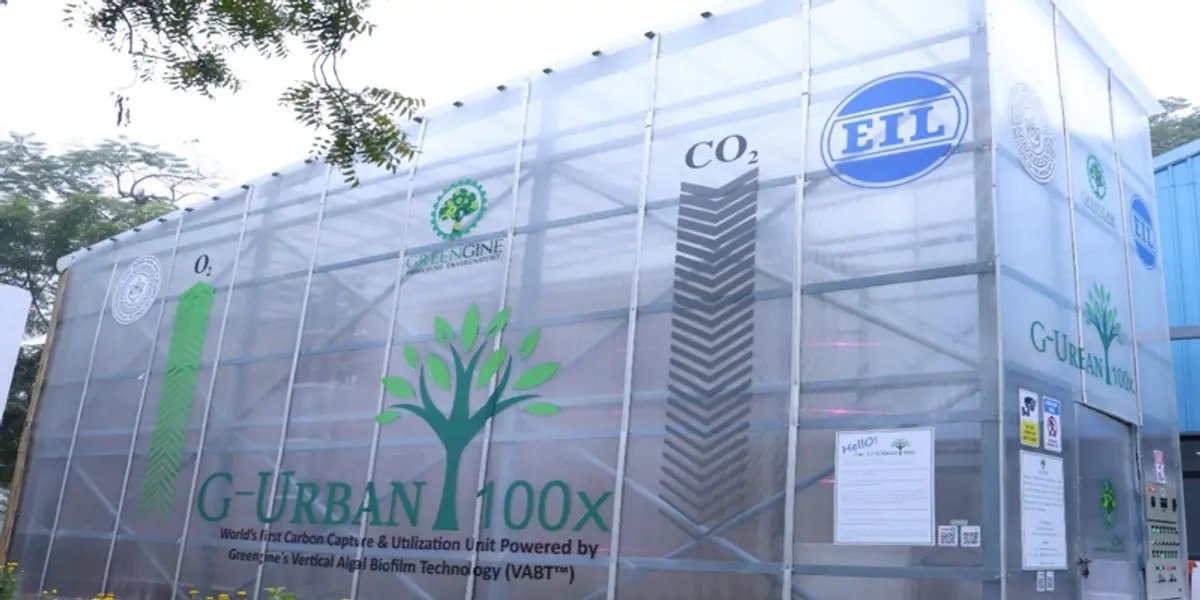
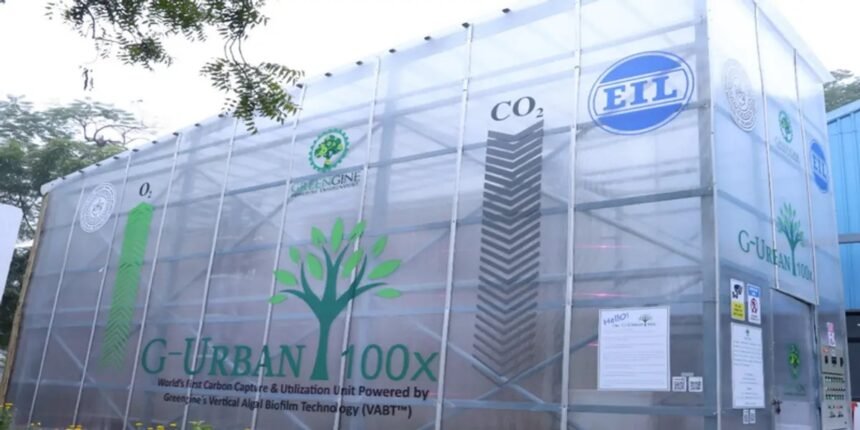
Greengine’s G-Urban Tree 100x unit at Engineers India Limited’s Gurugram campus, capturing carbon dioxide with living microalgae.
A living biofilm that breathes in carbon
At the heart of the G-Urban Tree 100x is Greengine’s patented Vertical Algal Biofilm Technology, or VABT. Instead of growing algae in open ponds, the system grows a thin, engineered biofilm of microalgae on vertical surfaces inside the unit. Air flows past the biofilm, and the algae do what they have done for billions of years — photosynthesis — pulling carbon dioxide out of the air and releasing oxygen, far faster per square metre than a leafy tree.
The company says each G-Urban Tree 100x unit captures approximately 2.25 tonnes of carbon dioxide a year and releases nearly 2 tonnes of oxygen — the environmental impact of 100 mature trees, in a fraction of the footprint. The unit runs on solar power, so it draws no grid electricity, and it is built from upcycled steel. Remote monitoring and automated operation keep manual intervention to a minimum, and the carbon it captures does not simply vanish: it is stored in the algal biomass, which the company channels into sustainable material applications, closing the loop with zero waste.
More Read

From an IIT Kanpur thesis to a Gurugram campus
Greengine’s story starts in a Kanpur laboratory. Founder Nitin Srivastava, a chemical engineering graduate pursuing his M.Tech at IIT Kanpur, built a rudimentary bioreactor for his thesis while exploring whether microalgae could take on carbon emissions at scale. After close to seven years in sustainability roles at companies including Toshiba India and Diageo India, he founded Greengine Environmental Technologies in 2015, and in 2017 returned to his hometown Kanpur to commit to the idea full-time.
The company was incubated at IIT Kanpur’s Startup Incubation and Innovation Centre, and its early work drew in India’s industrial heavyweights: Indian Oil Corporation and Engineers India Limited both became early collaborators, with pilot projects paving the way to the full-scale G-Urban Tree 100x deployment at EIL’s Gurugram campus. Greengine is also backed by Third Derivative, the climate-tech accelerator, and is a member of the Carbon Removal India Alliance and the Alliance for Industry Decarbonization.
One platform, from city squares to smokestacks
The urban tree is only the visible tip of the platform. The same VABT system scales up and plugs into industrial exhaust streams, capturing carbon dioxide from flue gases at refineries, power plants, cement factories, steel mills and other hard-to-abate sectors. Greengine says its modular architecture flexes from 10 tonnes a year to 50,000 tonnes a year and beyond, and its design brings a full stack of engineering choices: a compact modular build, high-flow air intake, maximum elemental exposure for the biofilm, specific-wavelength lighting, solar power, and monitoring and control throughout — with nitrogen and sulphur oxide removal as part of the package.
The biomass the system produces is itself a resource. Greengine’s plan turns captured carbon into biomaterials and bioenergy — fertiliser, animal feed, nutraceutical and cosmetic inputs among them — so a factory’s emissions become feedstock instead of waste. It is a circular, revenue-generating model for clients chasing net-zero targets, and one that fits India’s national carbon capture, utilisation and storage ambitions.
A million tonnes, then a billion
Greengine’s ambitions are deliberately large: the company aims to capture 1 million tonnes of carbon dioxide by 2027–28, and 1 billion tonnes by 2035. The G-Urban Tree 100x shows how that scale begins — not with a sprawling new plant, but with a single elegant unit on a campus, quietly doing the work of a hundred trees while the city carries on around it.
From Kanpur to Gurugram, Greengine is proving that some of India’s most original climate engineering does not come from a giant laboratory. It comes from a small team that looked at a single-celled organism, saw the fastest carbon-capture machine nature ever built, and engineered it into something a city can actually install.
Keep reading: Built for India’s Grid, Not Adapted to It: Inside Zenergize’s Homegrown SiC Power Electronics · No Heat Escapes: Inside Adiabatic, the Ahmednagar Startup Building the Batteries India’s Robots and Drones Run On · More Energy & Power stories
Like stories like this? Add Exceptional Technology as a preferred source on Google to see more of our reporting in your search results and Discover feed.