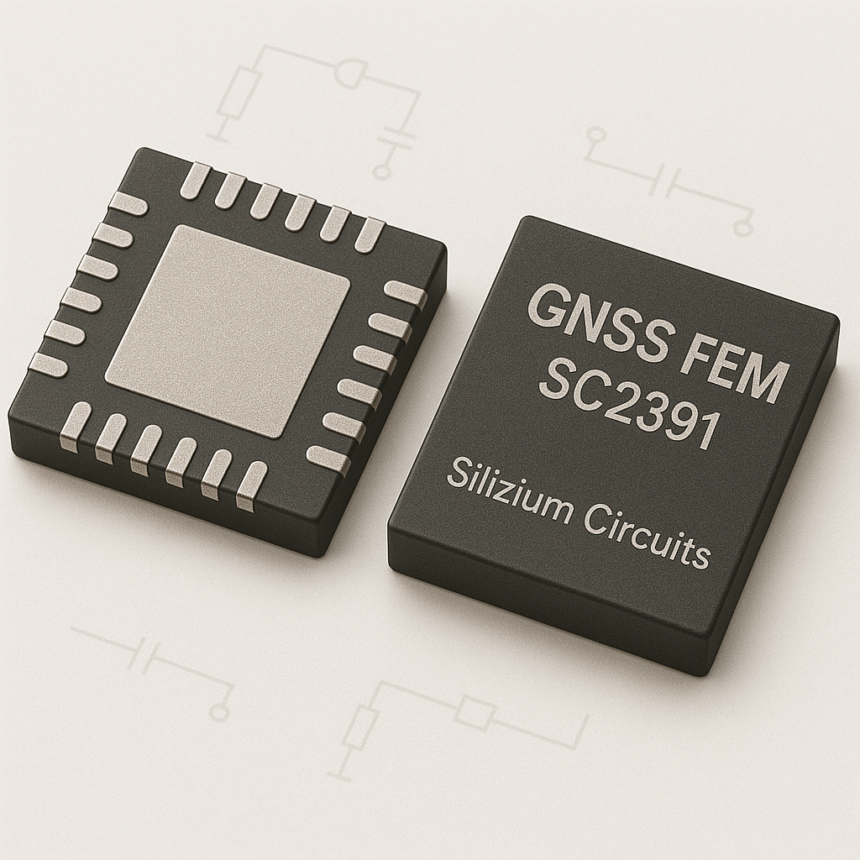
Every time your phone finds you on a map, a tiny chip is listening to satellites thousands of kilometres overhead, pulling whispers of radio signal out of the noise and turning them into a blue dot on your screen. For years, that little listener came from abroad. Now a team in Kochi is designing it in India — one chip that hears America’s GPS, Europe’s Galileo, Russia’s GLONASS, China’s BeiDou and India’s own NavIC, all at once.
The company is Silizium Circuits, and its flagship creation is SC2391 — a front-end module the company describes as its taped-out solution for making satellite navigation simpler, smaller and cheaper for everyone building connected devices.
One chip, every constellation
SC2391 is a GNSS front-end module, the radio front door for any device that needs to know where it is. The company says a single 5 mm × 5 mm, 24-pin chip supports multiple constellations — GPS, GLONASS, BeiDou, Galileo and NavIC — across the 1.176–1.227 GHz, 1.57 GHz and 2.492 GHz bands, covering the L1, L2, L5 and S bands in one package.
That consolidation is the whole point. By integrating filtering into the chip itself, SC2391 cuts out external SAW filters, which the company says reduces the bill of materials and shrinks the footprint that navigation occupies inside a product. It is a low-power design, built to slot into autonomous vehicles, wearables, defence systems, consumer electronics, IoT devices, space and strategic applications, surveying equipment, smart grids and supply-chain trackers.
For device makers, the pitch is simple: one Indian-designed front end instead of a patchwork of imported parts, for every satellite system that matters.
The 5G ear
Navigation is only half the story. Silizium Circuits’ other headline chip is a gallium arsenide (GaAs) based 5G low-noise amplifier — the component that catches faint signals at a 5G base station and lifts them, cleanly, above the noise. The company says the design delivers high gain, low noise and strong linearity, and it is aimed at 5G base stations, satellite communication and GNSS platforms across commercial, defence and strategic uses.
More Read

The chip was designed end-to-end in India with support from the Department of Telecommunications’ Digital Communication Innovation Square (DCIS) initiative, and it has been described as the first 5G chip in India funded by the DoT under that scheme. It is the kind of deep analogue engineering that rarely makes headlines — the quiet radio craft that decides whether a call stays clear at the edge of coverage.
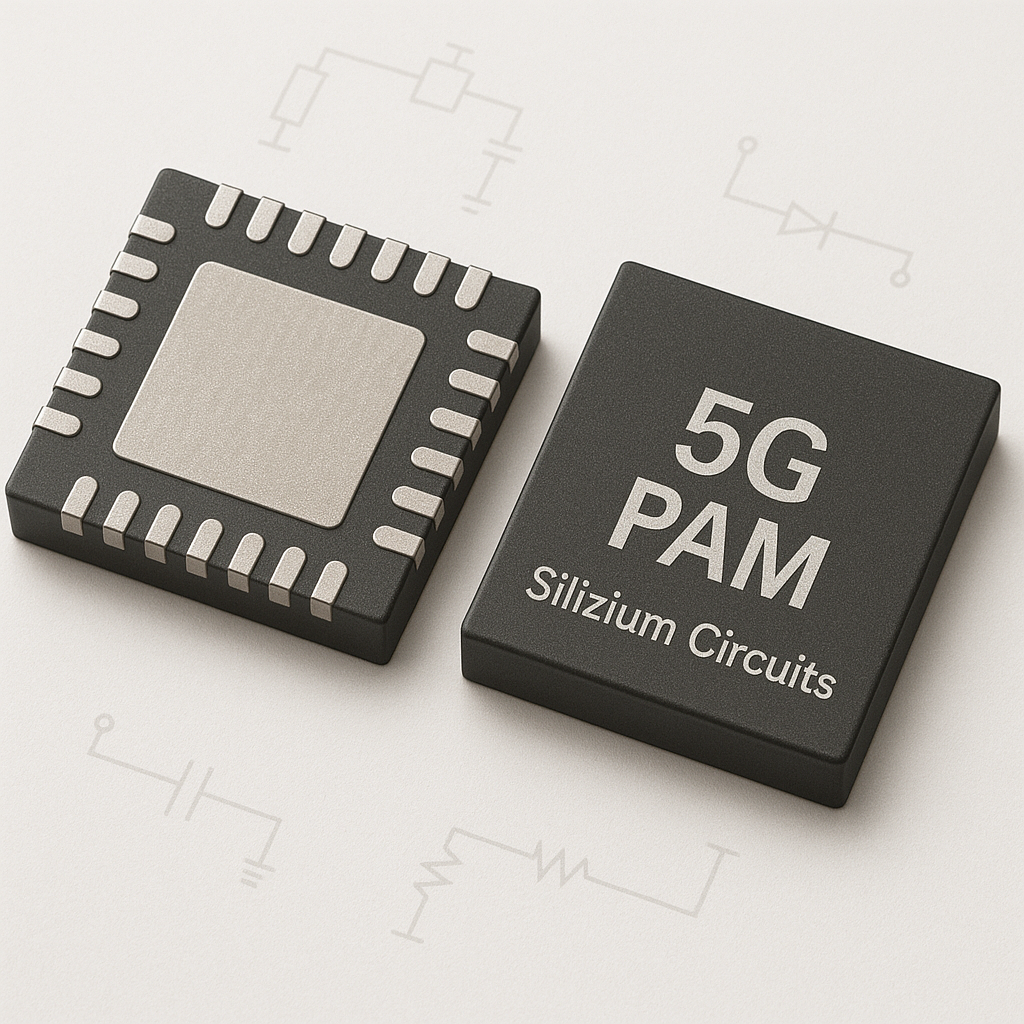
Silizium Circuits’ 5G power amplifier module (company image).
From Kochi to the world’s fabs
Silizium Circuits was founded in September 2020 by Rijin John and Arun Ashok, and it works out of Kochi — incubated at Maker Village and the Rajagiri Incubation Centre, with research teams in Kochi and Hyderabad — and the FabCI incubator at IIT Hyderabad. Its focus from day one has been the hardest corner of chip design: analogue, radio-frequency and mixed-signal intellectual property for wireless.
The company says it has already produced two working chips with TSMC, and it showcased its work at SEMICON Taiwan 2024 as part of the India–Taiwan semiconductor exchange programme. The recognition has followed: the company has won the Most Promising Semiconductor Startup Award from the India Electronics and Semiconductor Association (IESA) and a first place in a similar category from ELCINA.
Government backing has followed the engineering. C-DOT, the Department of Telecommunications’ R&D centre, granted the company ₹7.59 crore to develop indigenous LEO satellite components and a GNSS RF front-end ASIC, and Silizium Circuits together with IIT Kanpur secured a ₹5 crore grant from MeitY’s Chips to Startup programme. The company says it already has a paying customer, with confirmed demand of two lakh IPs per quarter.
What comes next
Silizium Circuits says its work has now grown beyond IP licensing into full system-on-chip solutions for high-volume products, alongside the LEO satellite components and GNSS front-end ASIC work under its C-DOT project. The ambition its founders state is bracing: to become the largest analogue, RF and mixed-signal IP exporter from India by 2030.
It is a bet on a simple idea — that the country which builds its own navigation constellation should also build the chips that listen to it. With SC2391 already taped out and its 5G front-end design complete, Silizium Circuits is turning that idea into silicon, one tiny, hardworking chip at a time.
Keep reading: Built in Bengaluru, Walking on Four Legs: Inside PARAM, General Autonomy’s Homegrown Robot Dog · One Tiny Brain for Every Machine: Inside Signalchip’s JEET, the Homegrown Microcontroller From India’s Chip Pioneers · More Industrial Automation & Technology stories
Like stories like this? Add Exceptional Technology as a preferred source on Google to see more of our reporting in your search results and Discover feed.