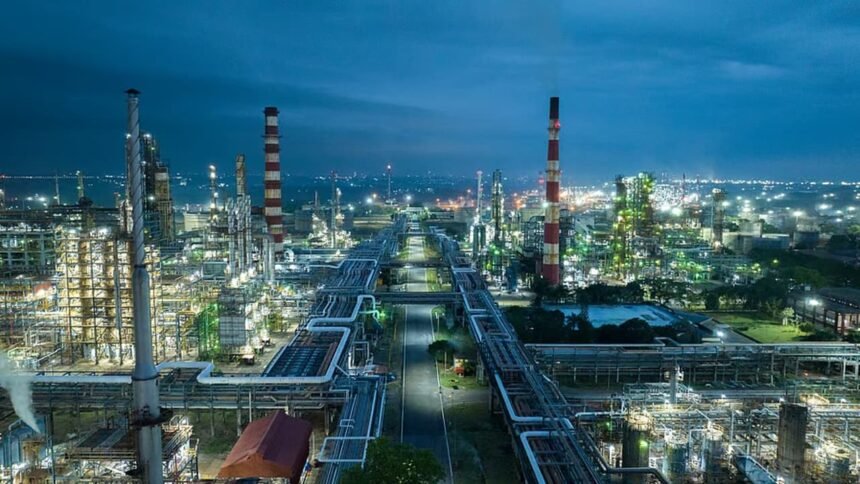
At dusk in Katipalla, north of Mangaluru, the refinery lights come on in rows — towers, columns and pipelines glowing against the Karnataka coast. It looks like what it is: one of India’s largest fuel-making machines, turning crude oil into petrol, diesel, jet fuel and LPG around the clock. But the most interesting thing happening inside Mangalore Refinery and Petrochemicals Limited (MRPL) right now is not a fuel at all. It is chemistry the company invented itself — and in October 2026, that homegrown chemistry won two national innovation awards.
MRPL is a Schedule ‘A’ Miniratna public-sector company and a subsidiary of Oil and Natural Gas Corporation (ONGC), operating under the Ministry of Petroleum and Natural Gas. Set up in 1988, it began commercial operations in 1996 at 3.69 million metric tonnes per annum and has grown into a 15 million metric tonne refinery — about 6% of India’s refining capacity — capable of processing more than 250 types of crude from around the world, from light to heavy and sweet to sour. In 2023-24, the company says, it processed 17.14 million metric tonnes of crude, the highest throughput ever recorded by a single-location public-sector refinery in India.
That scale is the backdrop. The story is what MRPL’s engineers are doing with it.
Two awards, two homegrown technologies
On 27 October 2026, at the 29th Energy Technology and Innovation Meet in Goa, MRPL won two categories of the Innovation Awards 2025-26, instituted by the Centre for High Technology under the Ministry of Petroleum and Natural Gas. The awards were presented by Union Petroleum Minister Hardeep Singh Puri, and the winners were selected by a committee chaired by Dr G. D. Yadav, chairman of the Scientific Advisory Committee. The company says it is the fifth consecutive time it has received national recognition for innovation at premier government platforms.
The first award, for Best Indigenously Developed Technology, went to KARVE IBB — an indigenous process technology for manufacturing isobutyl benzene. The second, for Best Innovation in Refinery, went to REVEAL FCC — an indigenous closed-loop, real-time optimiser for the refinery. One takes MRPL into a new industry. The other makes its core business smarter. Together, they show a refinery that is becoming a technology maker, not just a fuel maker.
KARVE IBB: from refinery streams to pharma ingredients
Isobutyl benzene is a pharmaceutical intermediate — a building-block chemical used in making medicines. It is a key starting material in the manufacture of ibuprofen, one of the world’s most widely used pain-relief medicines, and it also finds use in perfumery and other fine chemicals. Until now, that kind of high-value intermediate chemistry has largely been imported or licensed from abroad. KARVE IBB changes that equation: it is MRPL’s own process technology for making isobutyl benzene, developed in-house by the company’s Innovation Centre.
More Read
The company says the innovation marks its advancement into high-value pharmaceutical intermediates through indigenous technology. It is a natural move for a refinery that already runs an aromatics complex producing paraxylene and benzene, and a polypropylene unit with a capacity of 0.44 million metric tonnes a year. The same streams that become fuels and plastics can now feed the pharmaceutical supply chain — turning a refinery’s chemistry into an ingredient for medicines.
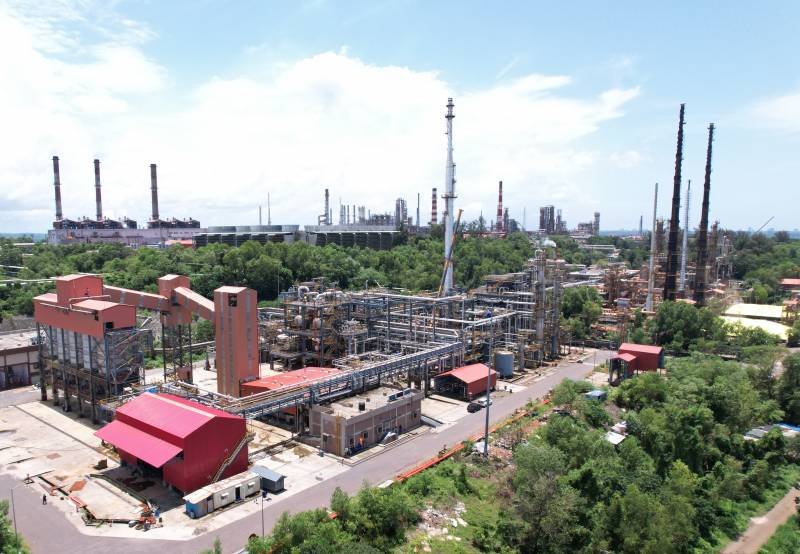
The MRPL refinery complex at Katipalla, near Mangaluru, in daylight.
REVEAL FCC: a refinery unit that tunes itself
At the heart of a modern refinery sits the fluid catalytic cracker, or FCC — the unit that breaks heavy oil fractions into lighter, more valuable products such as petrol and LPG. Getting the most out of an FCC is a balancing act: temperatures, pressures, catalyst circulation and feed quality all shift constantly, and the best operating point moves with them.
REVEAL FCC is MRPL’s answer to that balancing act: an indigenous closed-loop, real-time optimiser that watches the unit continuously and adjusts it on the fly, squeezing more valuable product out of every barrel. Built in-house rather than bought from an overseas licensor, it is digital innovation applied to the most physical of industries — software that makes steel, catalysts and crude work harder together.
An innovation habit, not a one-off
The awards were received in Goa by MRPL’s Managing Director M. Shyamprasad Kamath along with senior leaders including Director (Refinery) Nanda Kumar Velayudhan Pillai, and Chief Managers of the Innovation Centre R. Karthick and S. Nirmal Ganesh. That Innovation Centre is the thread running through both wins: one team, two very different technologies, both developed at home.
For a coastal refinery that began as a joint venture in 1988 and grew into one of India’s most complex refining sites, the direction is clear. MRPL still does what refineries do — it keeps the country’s trucks, planes and kitchens running. But with KARVE IBB carrying its chemistry into pharmaceuticals and REVEAL FCC putting real-time intelligence inside its cracking unit, it is also proving something bigger: that India’s refineries can originate the technology they run on, and that the next ingredient in a medicine cabinet may well have started life as crude oil on the Mangaluru coast.
Keep reading: The Bed That Never Sleeps: Inside Dozee, the Bengaluru Startup Monitoring Patients Without Touching Them · Sugarcane In, Bioplastic Out: Inside Balrampur Bioyug, India’s First Integrated PLA Plant · More Chemicals, Materials & Life Sciences stories
Like stories like this? Add Exceptional Technology as a preferred source on Google to see more of our reporting in your search results and Discover feed.