
Every electric vehicle that rolls out of an Indian factory carries a battery pack that had to prove itself first — charged, discharged, stressed and measured, again and again, before it ever met the road. In Noida, a team of five young engineers decided India should not have to import the machine that does that proving. They built it themselves, and today their test systems stand on production lines and in research labs across the country’s fast-growing EV industry.
The company is Exeliq Tech Solutions, founded in 2017 in Noida by Rahul Gautam, Sharad Gupta, Prince Agarwal, Rishabh Kanojia and Kumar Ashu. It builds automotive testing systems for electric vehicles — the rigs that check whether a battery, a charger, a motor or a battery-management system is safe, reliable and ready. Its flagship is the VoltPRO series, an AI-enabled smart testing system for EV batteries that the company developed entirely in-house, from mechanical design to software and electronics, at its Noida plant.
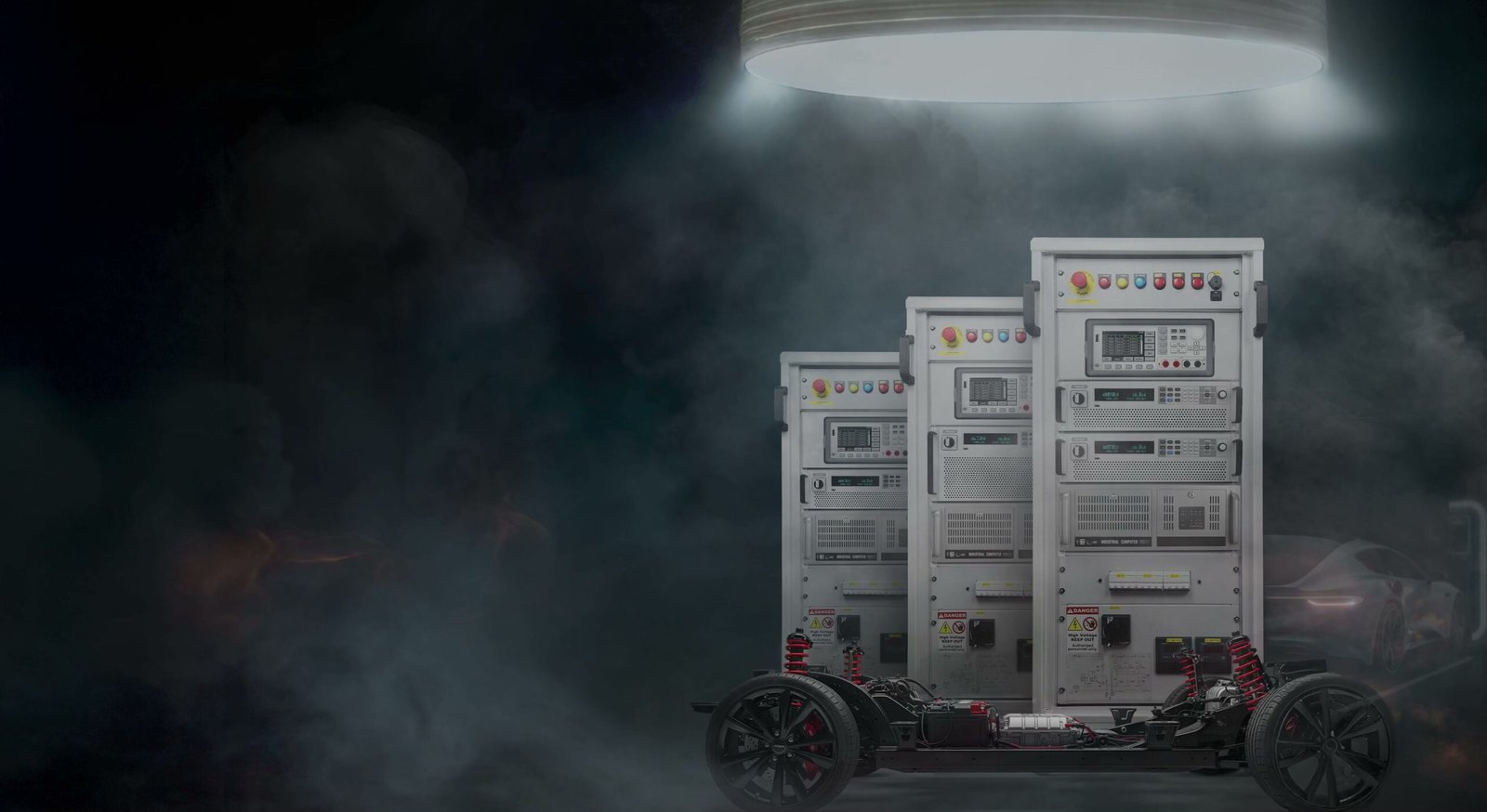
VoltPRO comes in three variants — the BTM80, BTM300 and BTM500 — each built for high-voltage battery testing, from production lines and research labs to large-scale systems and advanced production testing. The company says the series uses a bi-directional regenerative power system, so energy used during a test cycle is recovered rather than wasted, keeping the energy footprint of intensive testing low. Its integrated AI analytics track the numbers that matter most for a battery’s life: state of charge, state of health, and how the pack degrades over time, so manufacturers can spot trouble early instead of after a vehicle is on the road.
The clever part is how much VoltPRO folds into a single machine. The company says an operator connects the battery once, presses start, and the system runs every required test automatically — cutting out the manual steps where errors creep in — while a dedicated monitoring module inside the machine keeps everything within safety compliance. Built on National Instruments hardware and software, including LabVIEW and advanced data-acquisition modules, the systems are designed to deliver accurate results fast, and Exeliq works as an official alliance partner of NI in India.
From EV batteries to the solar grid
Exeliq’s testing story does not stop at vehicles. In February 2026 the company launched the GridX-120, a 120 kW grid-tied inverter test system built for India’s solar manufacturing boom. The automated platform validates solar inverters up to 120 kW in a single setup, combining functional, safety and ageing tests — checking maximum power-point tracking, power quality, grid synchronisation, insulation resistance and high-voltage safety, along with long-duration reliability runs. With a DC source up to 1,000 V and 300 A per string and an AC grid simulator up to 120 kVA, plus regenerative sources that feed energy back during testing, the company says GridX-120 gives inverter makers, research centres and certification laboratories lab-grade validation aligned with IEC and Indian standards, in a modular design that can be tuned for factory quality checks, pre-compliance testing or advanced research.
That breadth — battery testers, charger testers, motor testers, battery-management-system testers, and now grid-tied inverter testers — is why Exeliq stood among the finalists of the Startup World Cup India competition at India Mobile Congress 2026 in October 2026, pitching alongside some of the country’s most promising deep-tech startups. The company says demand for its battery testing systems is rising almost every day, as Indian manufacturers move from importing battery packs to assembling them locally, and as renewable-energy makers look for the same kind of homegrown validation for their inverters.
More Read

It is a quietly essential kind of engineering. Nobody buys a test rig for the thrill of it — they buy it because every battery that passes through it is one more vehicle a family can trust, and every inverter it clears is one more solar installation the grid can rely on. Industry data cited by the company puts India’s automotive testing market at about USD 149 million in 2024, on its way to about USD 244 million by 2032, and Exeliq is building the homegrown machines to serve it. From a Noida workshop started by five engineers fresh out of college, the company is now putting Indian-built test intelligence behind two of the country’s biggest energy transitions — electric mobility and solar power — one verified battery and one validated inverter at a time.
Keep reading: The Factory Floor Has a New Brain: Inside Tecnod8.AI, the Mandi Startup Building an Industrial AI Copilot · One Call, Four Transcripts: Inside Gnani AI’s Prisma v3.0, the Speech Model That Hears India the Way India Speaks · More Industrial Automation & Technology stories
Like stories like this? Add Exceptional Technology as a preferred source on Google to see more of our reporting in your search results and Discover feed.