
When a rocket lifts off, the headlines go to the rocket and its satellite. Almost nobody notices the dozens of small boxes inside them — the electronics that keep the vehicle on course, talk to the ground, manage its power and tell it exactly which way it is pointing. On the GSLV-F18 mission that put India’s new navigation satellite NVS-03 into orbit, 55 of those boxes came from a single Hyderabad company.
The company is Ananth Technologies, founded in 1992 by Dr Subba Rao Pavuluri, a former ISRO scientist, and headquartered at Ananth Info Park in HITEC City, Hyderabad. For more than three decades it has designed, built and tested mission-critical electronics for launch vehicles, satellites and defence systems — and the company says it has been part of every single Indian space programme since 1992.
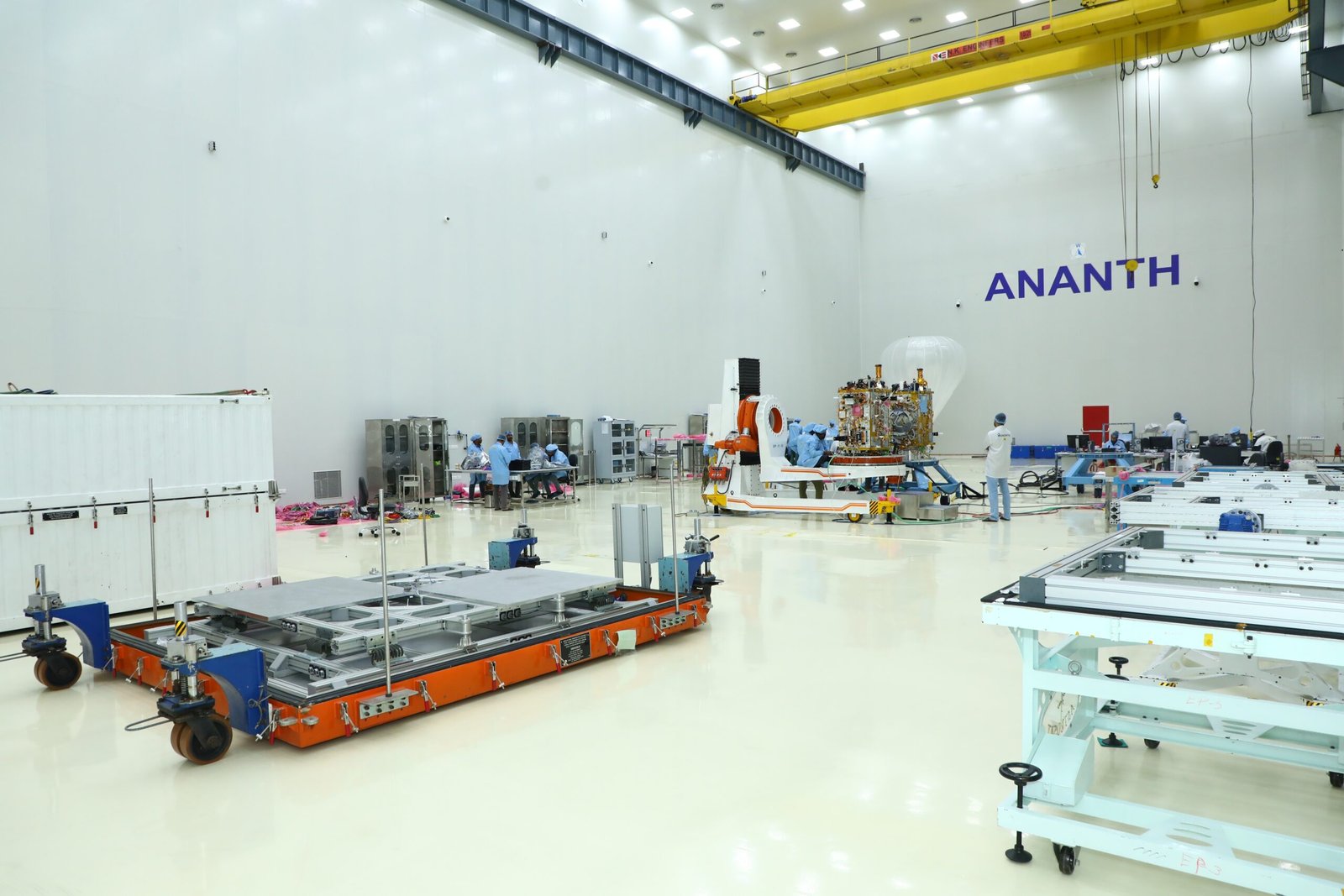
For GSLV-F18, Ananth supplied 46 flight hardware packages for the launch vehicle, covering functions across its stages: telemetry, data acquisition, navigation, guidance and control, power management, relay units, structural monitoring, actuator control and the transponder. For the NVS-03 satellite itself, the company contributed nine more systems, including power-management packages, DC-DC converters, star sensors and attitude and orbit control systems — the hardware that converts and distributes power, works out the spacecraft’s orientation from the stars, and keeps it pointed exactly where it needs to be.
What NVS-03 means for India
NVS-03 is the third satellite in India’s next-generation navigation system, built to keep the IRNSS and NavIC services running without a break. The satellite adds the L1 signal to the existing L5 and S-band services, and carries an indigenous atomic clock alongside procured clocks — the heartbeat that lets a navigation system measure time precisely enough to fix a position on the ground.
Every one of those signals depends on the unglamorous electronics underneath: stable power, clean data, sensors that never blink. That is exactly the layer Ananth has spent 34 years perfecting, in facilities the company runs in Bengaluru for satellite assembly, integration and testing, and in Thiruvananthapuram for the fabrication, assembly and testing of launch vehicle subsystems.
A track record written across India’s space story
Ananth’s hardware has flown far beyond one navigation mission. The company says it delivered mission-critical onboard electronics and satellite integration support across all three Chandrayaan lunar missions, provided assembly, integration and testing facility support and key electronic subsystems for Mangalyaan, India’s first interplanetary mission, and offered its testing facility for Aditya-L1, India’s first dedicated solar observatory.
More Read

More recently, the company says the SPADEX Target and Chaser satellites — India’s first in-space docking experiment — were completely assembled, integrated and tested at its Bengaluru facility. It is also contributing testing facilities and critical electronic systems to Gaganyaan, India’s maiden human spaceflight programme, where the margin for error is smaller still.
From supplier to satellite owner
Ananth’s next leap is the boldest of all. In July 2025, the company received authorisation from IN-SPACe, India’s space regulator, to offer broadband-from-space services by 2028 using a satellite it will build itself — a 4-tonne Ka-band high-throughput satellite with a planned capacity of up to 100 Gbps, backed by a reported investment of Rs 3,000 crore. The company’s own banner for the project puts it simply: high-speed satellite broadband for underserved regions, and a new generation of applications built on top of it.
It is a remarkable arc: a company that began in 1992 making subsystems for other people’s missions, now preparing to fly a satellite of its own. Chairman Subba Rao Pavuluri called the NVS-03 success another significant milestone in India’s space programme, and one that reinforces the country’s commitment to developing and strengthening indigenous space capabilities. “We look forward to contributing to India’s ambitious space journey in the years ahead,” he said.
That journey has always had a quiet Hyderabad engine room. Fifty-five boxes on one mission is just the latest proof.
Keep reading: Rehearse the Fight on the Ground: Inside Threye, the Delhi Startup Training IAF Mirage 2000 Pilots in Virtual Reality · India’s Own GPS, Back on Its Feet: Inside ISRO’s GSLV-F18 Launch of NVS-03 · More Aerospace & Defense stories
Like stories like this? Add Exceptional Technology as a preferred source on Google to see more of our reporting in your search results and Discover feed.