The link every drone depends on
A drone is only as good as the link back to its ground station. Telemetry, live video and flight commands all travel over that connection — and for the drones now flying surveillance, border monitoring, reconnaissance, logistics and critical-infrastructure missions across India, that link has become a strategic asset in its own right. Quanshium AI Core, an Odisha deep-tech startup incubated at NIT Rourkela, has built its answer to that challenge, and the company says it has now proved it on a live, moving platform.
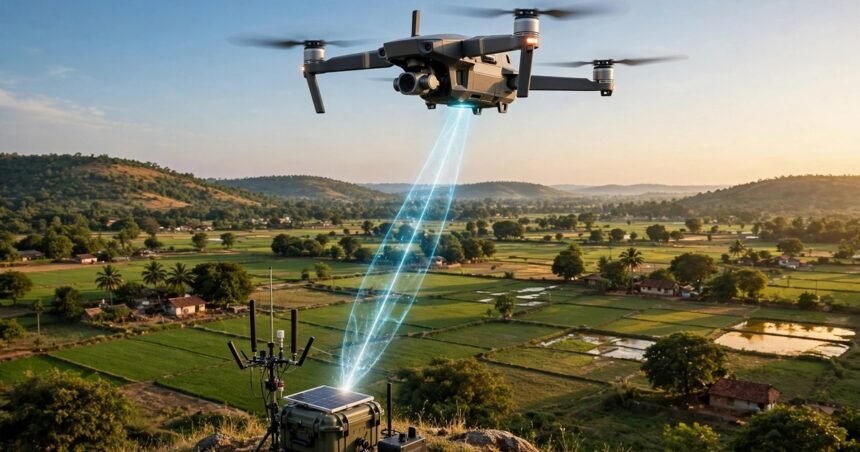
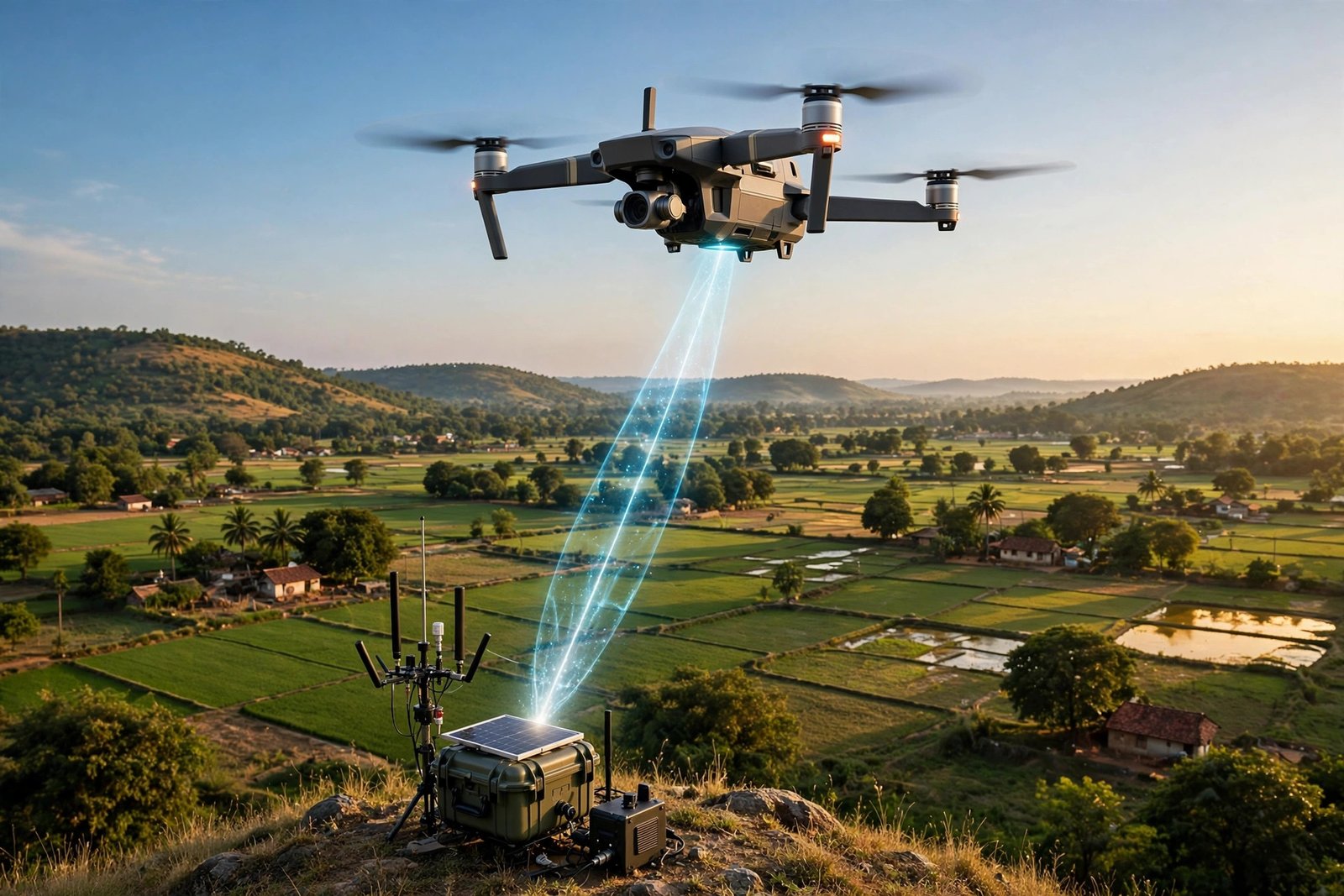
The company says it has successfully developed and tested a quantum-secure communication link between a ground control station and a 4G/5G-enabled drone over a distance of 10 kilometres. The test matters because it moves quantum-grade security out of the laboratory and onto a real aircraft in flight — the exact environment where intercepted, manipulated or disrupted communications could expose sensitive surveillance, derail a mission or open the door to unauthorised interference.
Two technologies, one unbreakable link
Quanshium’s system pairs two technologies the company developed in-house. The first is a quantum random number generator, or QRNG, which produces random numbers from a physical quantum source rather than from conventional software algorithms. Those numbers seed cryptographic keys with a high degree of unpredictability — the foundation on which the whole security chain rests.
The second is post-quantum cryptography, or PQC: encryption algorithms designed to withstand attacks from both conventional computers and the powerful quantum computers of the future. Where QRNG strengthens how keys are generated, PQC protects the information in transit. Together, the company says, they give operators a more complete answer to the emerging quantum threat than either technology alone.
The architecture is elegantly practical. The QRNG hardware sits at the ground control station, while the post-quantum encryption layer operates at both ends of the link. That means telemetry, video and command data enjoy end-to-end protection over the 4G/5G network without the drone itself having to carry quantum hardware — keeping weight and hardware demands on the aircraft low while the security stays high.
Built for defence and critical infrastructure
The drone link is one deployment of a much broader platform. Quanshium’s flagship product, QUANSHIELD, is a rugged security gateway that combines quantum key distribution, post-quantum cryptography and edge threat detection in a single deployable appliance. The company says it is built for grid, telecom, finance, space and defence deployments, with nine sector-tuned variants.
More Read

The gateway implements NIST-standard ML-KEM for key encapsulation and ML-DSA for digital signatures, accelerated in dedicated hardware alongside secure boot and a TPM 2.0 root of trust. An on-device neural processing unit runs anomaly detection and predictive analytics at the edge, without a round trip to the cloud. It is fanless, rated from minus 40 to plus 85 degrees Celsius and IP65/67 sealed, and it speaks the industrial protocols that critical infrastructure actually runs on — IEC-61850, Modbus, DNP3 and OPC-UA among them.
That rugged, deployable character is the point. The company says QUANSHIELD is built for deployment, not demos: a full hardware stack in one appliance, designed and built in India, for the substations, telecom networks, financial channels and defence systems whose data carries a shelf life measured in decades.
From drones to satellites
Having proved the architecture on a drone, Quanshium is now looking skyward. The company’s roadmap includes extending its quantum-safe communication architecture to satellite applications, exploring quantum-secure satellite communication using free-space optical links for quantum key distribution between ground stations and satellites, and eventually between satellites themselves.
Satellite QKD would use quantum states of light to establish cryptographic keys between distant nodes, adding a further layer of security for strategic, long-distance communications. It is a longer-range test of the same idea the company has just proved over 10 kilometres — and a natural next step for a team already working across electronic warfare, drones, counter-drone systems and tactical communications.
The team from Rourkela
Quanshium AI Core Private Limited is led by founder and chief executive Shaswat Kumar Lenka, with Kundan Kumar Munda as chief development engineer and Alish Patel as chief hardware engineer, mentored by Hanumantha Rao Bokkisam, an assistant professor in the electrical engineering department. The company is incubated at NIT Rourkela’s Foundation for Technology and Business Incubation, is DPIIT-recognised in the Aerospace and Defence sector, and aligns its work with National Quantum Mission procurement frameworks.
The ambition behind it all is proudly sovereign. As Lenka puts it, the team wanted to build something quantum-safe from the ground up, tested on a real platform rather than a lab bench, and designed and built entirely in India. With its 10-kilometre drone link now demonstrated, Quanshium is turning that ambition into working infrastructure — securing the machines India increasingly relies on, with technology India itself owns.
Keep reading: Seconds That Save a Crew: Inside Xinfiniti Aerospace, the Bengaluru Startup Keeping Naval Helicopters Afloat · Thirty Kilos Over the Mountains: Inside Unmannd, the Bengaluru Startup Teaching Drones to Supply and Defend · More Aerospace & Defense stories
Like stories like this? Add Exceptional Technology as a preferred source on Google to see more of our reporting in your search results and Discover feed.