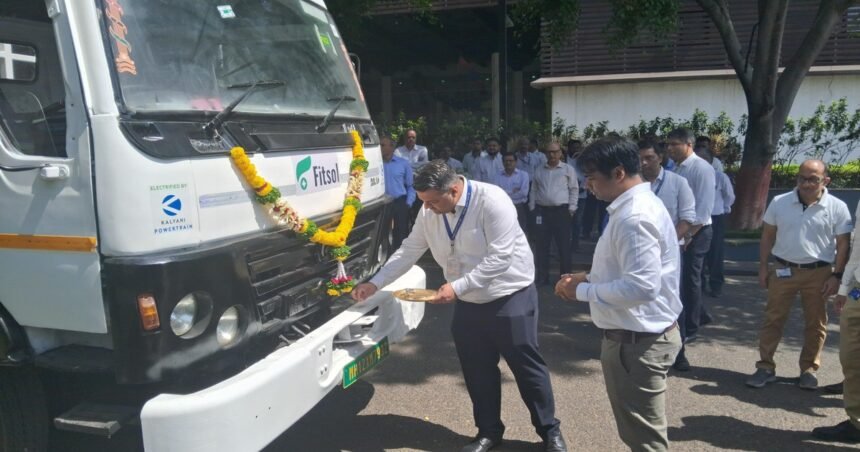
Walk through a factory in India and you can see the machines, the trucks and the finished goods rolling out of the gate. What you cannot see is the largest part of that factory’s carbon footprint. For most manufacturers, the company says, more than 70% of emissions do not come from their own chimneys at all — they are buried in the supply chain, in suppliers, freight, packaging and energy bought from elsewhere. Gurugram-based Fitsol has built its business around making that invisible carbon visible, measurable — and then smaller.
Fitsol, founded in 2022, offers what it calls Decarbonization-as-a-Service for manufacturers. Its AI platform, Kyoto, pulls emissions data from energy, logistics and manufacturing sources, turns it into a single carbon picture across Scope 1, Scope 2 and Scope 3, and then helps companies act on it — through cleaner logistics, greener packaging, renewable energy and a marketplace of vetted green service providers.
The blind spot in the factory
Scope 3 is the hardest part of decarbonisation because it is the most spread out. A carmaker’s footprint lives in steel, tyres, components, inbound freight and dealer logistics; a consumer-goods company’s footprint lives in packaging, warehousing and thousands of supplier shipments. Spreadsheets and one-off audits struggle to keep up, and without credible numbers, companies cannot set targets, answer customers or comply with new disclosure rules.
Fitsol’s answer is to automate the messy middle. Kyoto captures data continuously rather than once a year, applies GHG Protocol standards with India-specific emission factors for transport, and produces audit-ready reporting aligned with frameworks including India’s BRSR, the EU’s CSRD and the Carbon Border Adjustment Mechanism. For freight specifically, the company says, its platform is certified by Smart Freight Centre against ISO 14083 with the GLEC Framework — a distinction its co-founder’s Yale profile notes makes Fitsol the only Indian startup on Smart Freight Centre’s global certification registry.
From counting carbon to cutting it
Measurement alone, Fitsol argues, is only half the job. Kyoto’s modules cover the full journey: GreenCount for real-time carbon accounting across Scope 1, 2 and 3, and GreenAlign for automated ESG and climate reporting. Around the software sits a delivery network of close to 100 partners — mostly small transporters, recyclers and packaging manufacturers — who carry out the physical work of decarbonisation, from green logistics and route optimisation to sustainable packaging and energy projects.
The company says that combination is already showing up in tonnes. Since 2023, Fitsol has measured and managed more than 570,000 tonnes of CO2e across more than 50 enterprises and 120 manufacturing plants, delivering more than 69,000 tonnes of emission reductions and avoided emissions. It also says its carbon-reduction projects have typically delivered 15–20% cost savings, turning sustainability from a compliance cost into an operating gain.
More Read

A year of recognition
2026 has brought Fitsol a run of national recognition. Google selected it as one of 20 AI-first startups for the Google for Startups Accelerator: India 2026 cohort, chosen from around 2,500 applications, describing Fitsol as driving decarbonisation for enterprises through carbon tracking, smart packaging, logistics optimisation and automated ESG compliance. In October 2026, JSW MG Motor India named Fitsol among the eight winners of its MG Developer Program Season 6.0, focused on innovation in automotive, opening the way to pilot projects and real-world deployments with the carmaker and its partners. The company also won the Mumbai Climate Week Innovation Challenge, hosted with the National Stock Exchange of India.
The company behind Kyoto
Fitsol Supply Chain Solutions was founded in Gurugram in 2022 by Anand Pathak, Akshay Tandon, Manoj Sharma, Sunil Bansal and Vikas Kalra, and raised $1 million in seed funding from Transition VC. Its client roster, the company says, spans automotive and industrial manufacturing, including names such as JK Tyre, JBM Group, Rockman Industries and Hindware, alongside supply chains serving major automotive brands. A practitioner course and a Logistics Decarbonization Playbook co-published with Smart Freight Centre India extend the same work beyond its own customers, training supply-chain operators to run decarbonisation themselves.
For Indian manufacturing, the stakes are rising fast: exporters face carbon border taxes, investors ask for audited emissions data, and customers increasingly want proof, not promises. Fitsol’s bet is that the companies that win will be the ones that can see their whole footprint — factory, fleet and suppliers together — and then shrink it, tonne by tonne, with data they can stand behind.
Keep reading: Quantum Keys on a Beam of Light: Inside NavTech’s OpticSpectra 10G QKD · The Motor With No Magnets: Inside Gyrodrive, the Pune Company Freeing India’s EVs From Rare Earths · More Industrial Automation & Technology stories
Like stories like this? Add Exceptional Technology as a preferred source on Google to see more of our reporting in your search results and Discover feed.