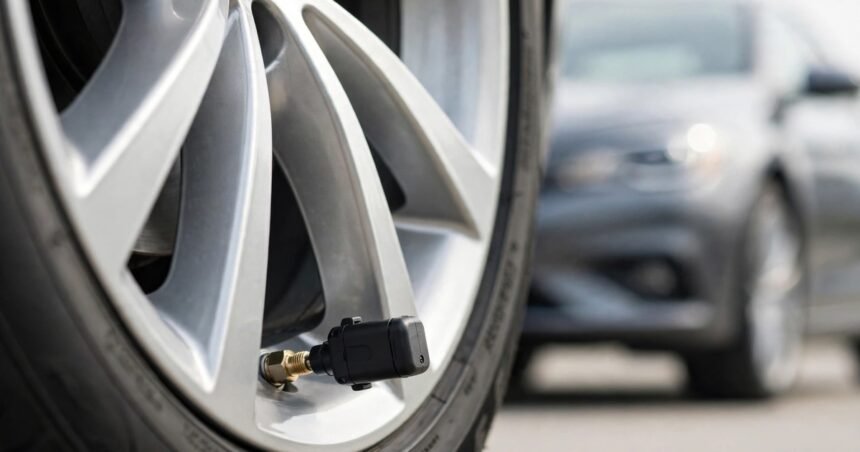
Every car on the road today rides on four small patches of rubber, and the air inside them decides far more than most drivers ever think about — safety, mileage, tyre life, even how the car handles in an emergency. A tiny chip from Dharwad is now watching that air, and it is the first of its kind to be designed in India.
Entra Innovations LLP, a Dharwad-based hardware startup, has built VAAYU, described as India’s first indigenous automotive Tyre Pressure Monitoring System (TPMS) system-on-chip (SoC), developed out of IIT Dharwad. The chip was honoured at India Mobile Congress 2026, where Entra won the Dr. M J Zarabi Indigenisation Award, powered by Dixon Technologies, at the inaugural Viksit Tech 47 (VT47) awards.
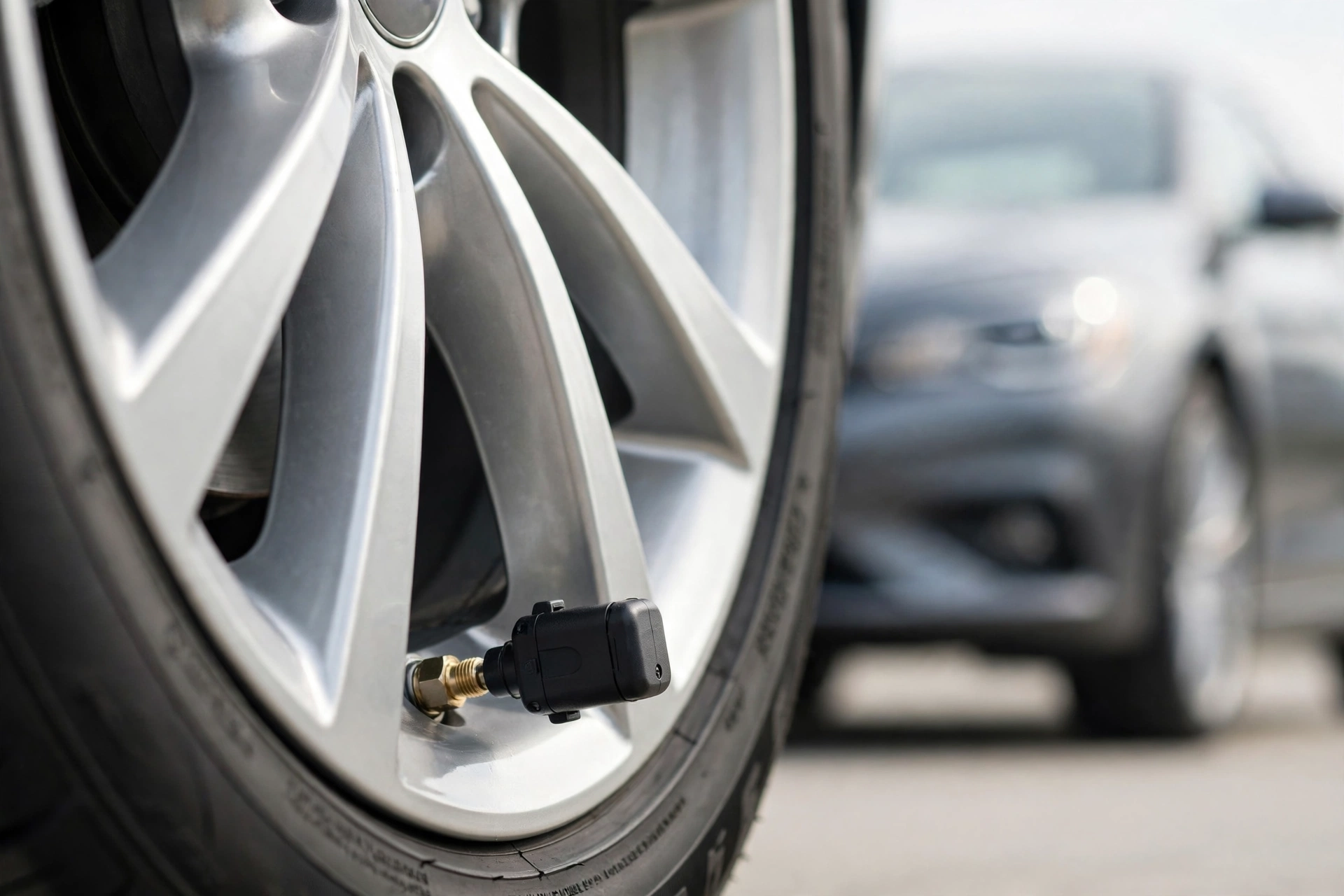
Illustration: a tyre pressure sensor on a car wheel.
The chip inside the safety system
A TPMS is the car’s early-warning system for its tyres. Sensors measure the air pressure inside each tyre and send that information to the vehicle, warning the driver long before a slow leak turns into a blowout. Properly inflated tyres grip better, brake better and last longer, and they cut rolling resistance, which means better fuel economy and, in an electric car, more range from the same charge.
Until now, the silicon at the heart of these systems has come overwhelmingly from a handful of global chipmakers. VAAYU changes that equation: it is an Indian-designed SoC for the job, built by a team working out of Dharwad, a city far better known for its classical music than its semiconductors. That is exactly the kind of indigenisation the award was created to recognise.
More Read

An award named for a chip pioneer
The Dr. M J Zarabi Indigenisation Award carries a cash prize of Rs. 10 lakh and honours Dr. M.J. Zarabi, former Chairman and Managing Director of Semiconductor Complex Limited (SCL), Mohali, and one of India’s most distinguished microelectronics pioneers. It recognises early-stage hardware startups whose innovation reduces India’s reliance on imported technology, and it was judged by a panel spanning industry and the India Semiconductor Mission, including Atul B. Lall of Dixon Technologies and Jaswinder Ahuja of the India Semiconductor Mission’s advisory committee.
The award was presented as part of VT47, the flagship spotlight programme of India Mobile Congress 2026, which also released its first report, “Building India’s Global Brands in Gadgets, Devices, Appliances and Connected Cars.” Prepared by Techarc as knowledge partner, the report indexes 129 Indian-owned consumer technology brands and sets out an ambition of 50 Indian brands each crossing Rs. 1 lakh crore by 2047. Entra’s win puts a Dharwad chip startup on that national stage, alongside winners such as Lava International and MediaTek India.
Why a tyre chip matters
Tyre pressure monitoring has quietly become one of the most widely fitted safety features in modern cars, standard on a growing share of new models in India. Every one of those systems needs a chip that can live inside a wheel, survive heat, cold, vibration and years of potholes, and report faithfully for the life of the vehicle. Designing that chip at home means the know-how, the intellectual property and the supply chain stay in India, and Indian carmakers get a homegrown option for a component every new car increasingly carries.
For Entra, the award is a beginning, not a finish line: it is recognition that a small team in Dharwad can design silicon for one of the auto industry’s most demanding corners. And for India’s semiconductor ambitions, VAAYU is a reminder that indigenisation is not only about giant fabs and flagship processors — sometimes it is about the tiny chip that keeps four tyres, and the people riding on them, safe.
Keep reading: Built to Outrun the Vacuum: Inside BEML’s B28, India’s First Indigenous Bullet Train · Seven Minutes to a Full Charge: Inside Energy In Motion, the Pune Company Electrifying India’s Heaviest Trucks · More Automotive & Mobility stories
Like stories like this? Add Exceptional Technology as a preferred source on Google to see more of our reporting in your search results and Discover feed.