In the sky above a border post, a drone swarm is a problem measured in seconds. A missile costs a fortune and takes a magazine slot; a gun has to find a speck moving at speed. A beam of light, though, arrives instantly, costs almost nothing per shot, and never runs out of ammunition while the power holds. That is the bet a small workshop in Belagavi, Karnataka, has just turned into hardware.
Carbine Systems, a deep-tech startup founded in 2023 by brothers Girish Joshi and Kedar Joshi, has built H.A.R.A. Mk 1 — short for Hyper Amplification Radiant Array — a 10 kW-class directed-energy weapon prototype that the company says is the first privately developed laser weapon of its kind in India. In the first week of January 2026, the team ran controlled indoor static tests of the system against multiple target objects, validating beam stability, energy delivery and system reliability against all of its internal benchmarks.
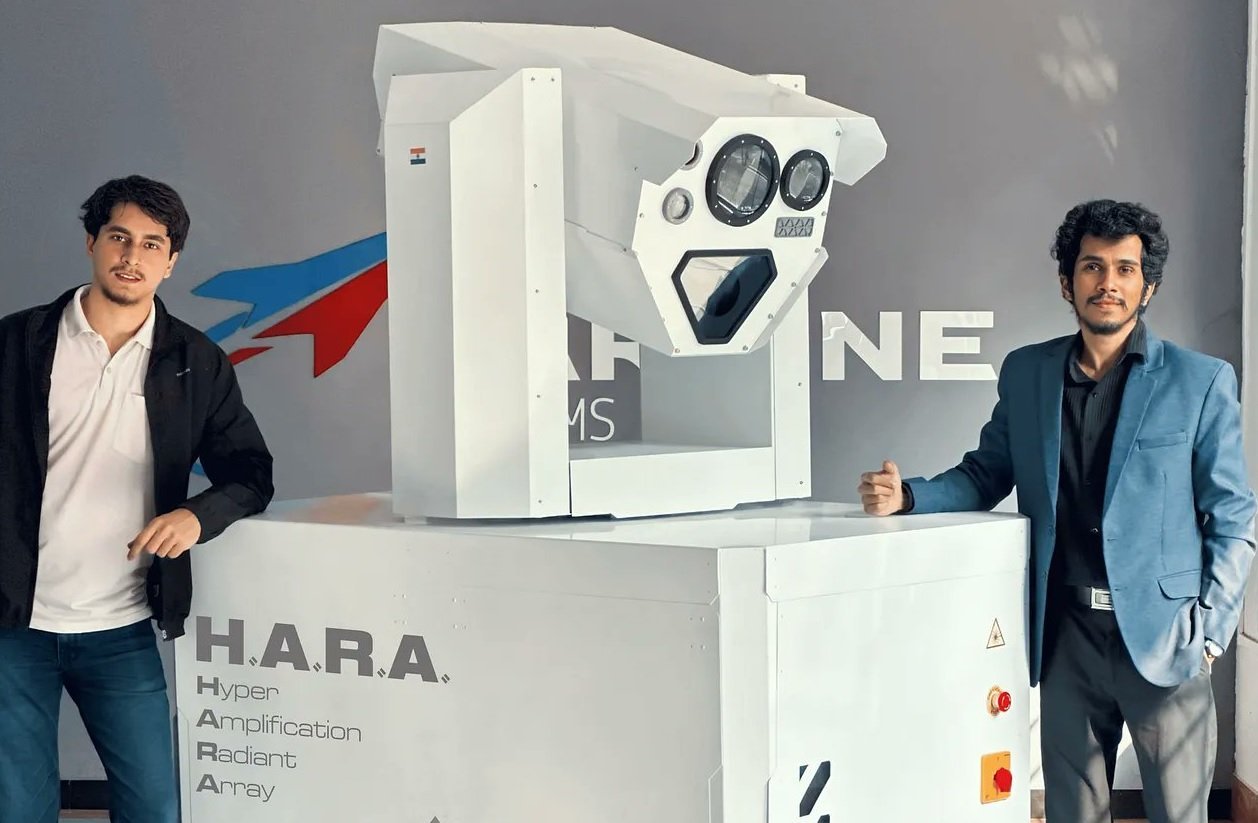
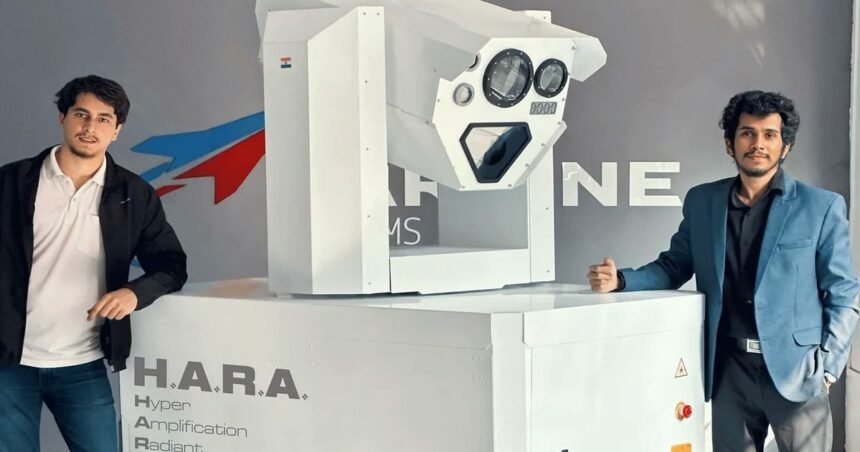
H.A.R.A. Mk 1, Carbine Systems’ directed-energy prototype, with founders Girish Joshi and Kedar Joshi. (Image: Carbine Systems)
A laser born in a manufacturing workshop
Carbine Systems did not start out building weapons. Girish, an electronics engineer, and Kedar, a physicist from NIT Karnataka, began with laser-based additive manufacturing for aerospace components — using high-energy lasers to print and finish precision parts. The startup was incubated at KLS GIT’s GRID research and innovation centre in Belagavi, among the first ventures to receive dedicated floor space purely for R&D.
That manufacturing work turned out to be the perfect apprenticeship for a laser weapon. High-energy additive manufacturing and directed-energy weapons share the same hard problems: keeping a beam coherent, managing extreme heat, holding optical alignment steady, and conditioning power precisely. The company says it adapted capabilities built for the factory floor — including AI-driven beam quality monitoring — into a defence system, largely on an indigenous supply chain and entirely without venture capital or institutional funding.
More Read

How H.A.R.A. works
H.A.R.A. Mk 1 is designed for an engagement range of 1 to 2 kilometres, according to the company. At its heart is a proprietary implementation of Coherent Beam Combining, a technique that merges multiple laser beams into a single, far more powerful beam, sharpened further by in-house beam-shaping techniques and advanced thermal management. The name carries its own story: Hara, from Sanskrit, means the remover, the absorber, the destroyer — an echo of Shiva’s disciplined force of destruction and renewal.
Directed-energy weapons are prized for exactly what H.A.R.A. promises: engagement at the speed of light, a cost per shot measured in electricity rather than explosives, and a magazine as deep as the power supply. For counter-drone and point-defence roles — the missions that moved to the top of every military’s list after the drone threats of 2025 — those are decisive advantages. The founders say that urgency is what pushed them from proposals to hardware: after years of technical submissions to defence institutions that did not convert into funded programmes, they chose what they call bootstrap engineering and built the system with the resources they had.
Why a private laser weapon matters
Until now, India’s directed-energy story has been written almost entirely inside government laboratories — the Defence Research and Development Organisation demonstrated its 30 kW Mk-II(A) laser weapon in April 2025. A credible private-sector system changes the shape of that ecosystem: it brings a second, faster-moving source of innovation to a capability every major military now treats as essential, and it proves that world-class strategic hardware can come out of a tier-2 city’s engineering base, not just a national lab.
Carbine Systems is now setting up a dedicated Laser R&D facility in Belagavi, tapping the region’s pool of precision engineers and fabrication specialists. Beyond defence, the company’s roadmap reaches for megawatt-class laser systems for renewable-energy research, supercontinuum free-electron lasers, and advanced photonics linked to next-generation fusion research. The January tests were the first proof that the platform works; the ambition is a family of Indian high-energy laser systems built from first principles, in Belagavi, for the world.
Keep reading: Clocks in the Sky: Inside VyomIC, India’s Homegrown GPS Alternative · A Shield That Moves: Inside Indrajaal’s Ranger, India’s Mobile Anti-Drone Patrol Vehicle · More Aerospace & Defense stories
Like stories like this? Add Exceptional Technology as a preferred source on Google to see more of our reporting in your search results and Discover feed.