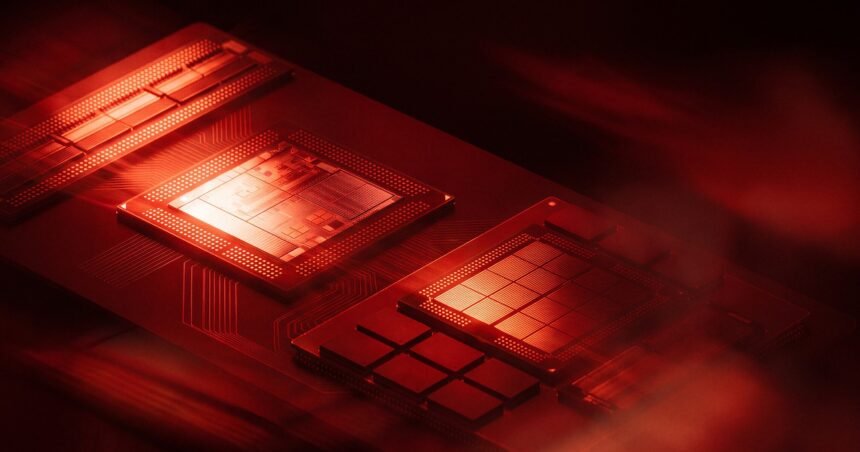
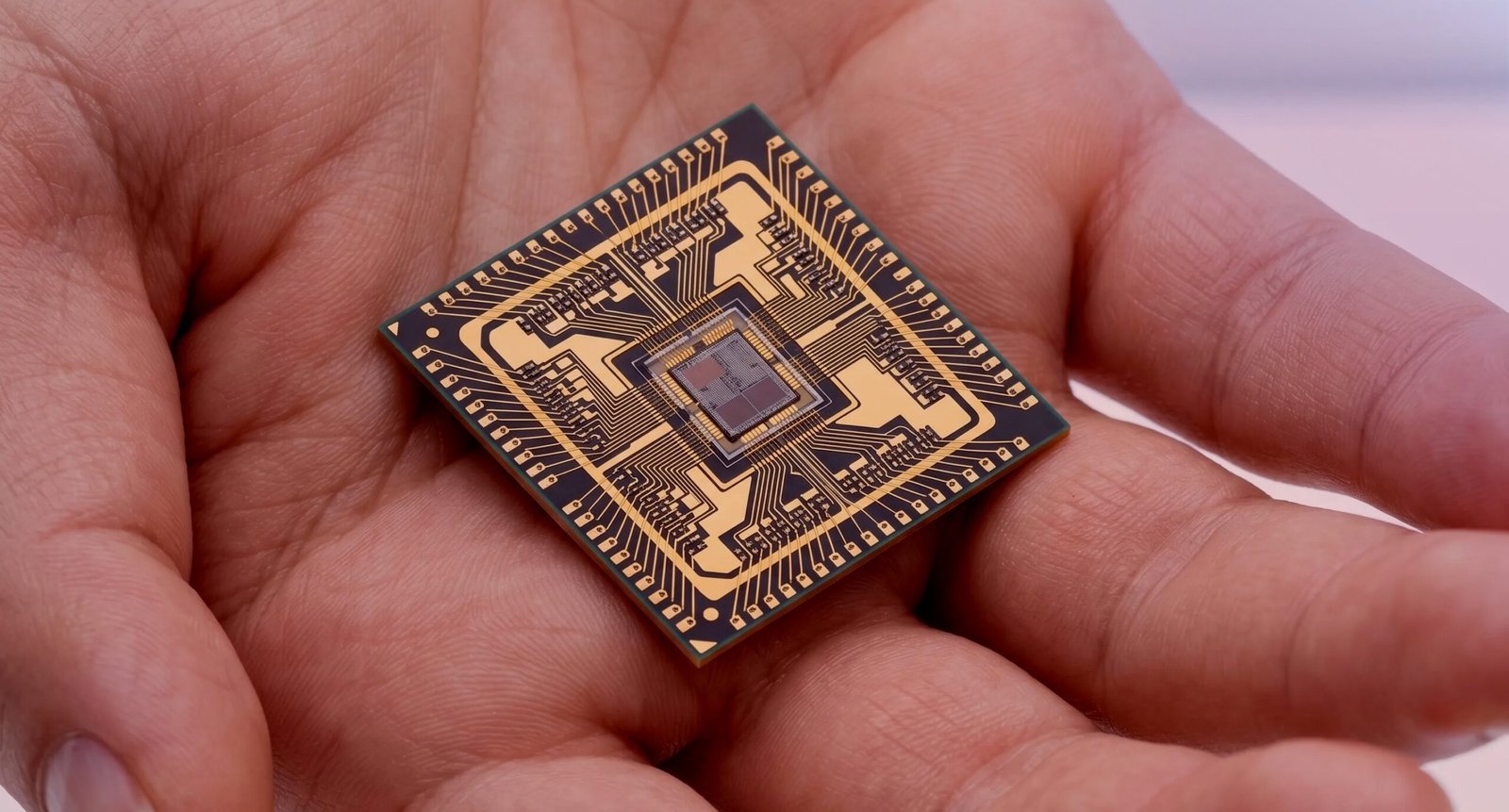
Every chip designer knows the trade-off by heart. A processor can be blazingly fast, like an ASIC built for one job — or it can be flexible, like an FPGA that can be rewired for anything. It has never been both. At SEMICON India 2026, a Bengaluru company showed what happens when that trade-off finally breaks: MuDRA, a chip designed in India, back from the fab and held in the palm of a hand.
Morphing Machines began in 2005, growing out of decades of research at the Indian Institute of Science. The founders spent years on processor architectures, VLSI systems and the software around them — Prof. S. K. Nandy, who spent 40 years at IISc, and Dr Ranjani Narayan, who holds a PhD in computer architecture from IISc and worked at Siemens and HP. Deepak Shapeti, a Stanford graduate and entrepreneur, joined as co-founder and CEO in 2021. Across the team, the company counts more than 200 cumulative years of semiconductor experience and over 30 tapeouts. Two decades of research, the company says, is now in silicon.
The idea at the heart of the company is called REDEFINE, a runtime-reconfigurable many-core processor. Instead of a fixed layout, the compute fabric arranges itself around each piece of work as it arrives, fires the moment its operands are ready, and releases when the work is done. The result, the company says, is ASIC-level performance with FPGA-like reconfigurability on a single fabric — one chip that can switch between CPU-style and GPU-style work as the workload demands, running everything from large-language-model inference to real-time sensor fusion without the waste of reserving idle resources. It ships with a complete software stack built alongside the hardware, including custom ISA extensions, an MLIR compiler and runtimes.
MuDRA is the physical realisation of that idea: a many-core system-on-chip fabricated on 28nm TSMC, and the first silicon validation of the REDEFINE IP. The company unveiled it at SEMICON India 2026 in New Delhi, and in the weeks that followed, the chip returned from the fab — the moment every fabless startup stakes years on. Packaging and bring-up come next, with a commercial-grade MuDRA to follow. The company is aiming the architecture at the workloads that strain today’s data centres hardest: AI inference, high-performance computing, telecom and edge intelligence.
The work has been backed from the start by India’s semiconductor mission: Morphing Machines is a beneficiary of the Ministry of Electronics and Information Technology’s Design Linked Incentive and Chips to Startup schemes, with support from the India Semiconductor Mission, C-DAC, IESA and the Semiconductor Future Accelerator Lab Foundation. The company raised a $2.76 million seed round led by Speciale Invest, followed by a ₹38.36 crore Series A in October 2025 led by IAN Alpha Fund, with Speciale Invest, IvyCap Ventures and Navam Capital joining in. The team is growing from around 50 people to more than 90, with customer demos and paid pilot projects with data-centre operators planned over the coming months as the chip is brought to life. From there, the company says, the road leads to advanced nodes, larger systems and frontier AI inference — all on an architecture that was drawn up in Bengaluru, and now exists in silicon.
Keep reading: No Keys to Steal: Inside Pantherun, the Bengaluru Startup Encrypting India’s Trains, Airbases and Laptops · From Molecule to Factory Floor: Inside Shodh AI’s LUCAN, the Physical AI Designing How India Makes Things · More Industrial Automation & Technology stories
More Read

Like stories like this? Add Exceptional Technology as a preferred source on Google to see more of our reporting in your search results and Discover feed.