


A solar farm does its best work at noon, when the sun is high and demand is low. By evening, when India switches on its lights, fans and factories, the panels have gone quiet. For years the country built the farms and lived with the mismatch. Now the answer is arriving in steel containers full of batteries — and one of the companies building them started in Pune nine years ago, before India had a storage market at all.
AmpereHour Energy was founded in 2017 by four IIT Bombay alumni — Ayush Misra, Rahul Shelke, Harshal Thakur and Neehar Jathar — with a simple idea: a grid battery is not just cells in a box. It is racks of modules, power conversion equipment, thermal management, safety systems and, above all, software that decides when to charge and discharge, balances the packs and keeps the whole installation within its limits for twenty years. AmpereHour builds all of it, and installs it too.
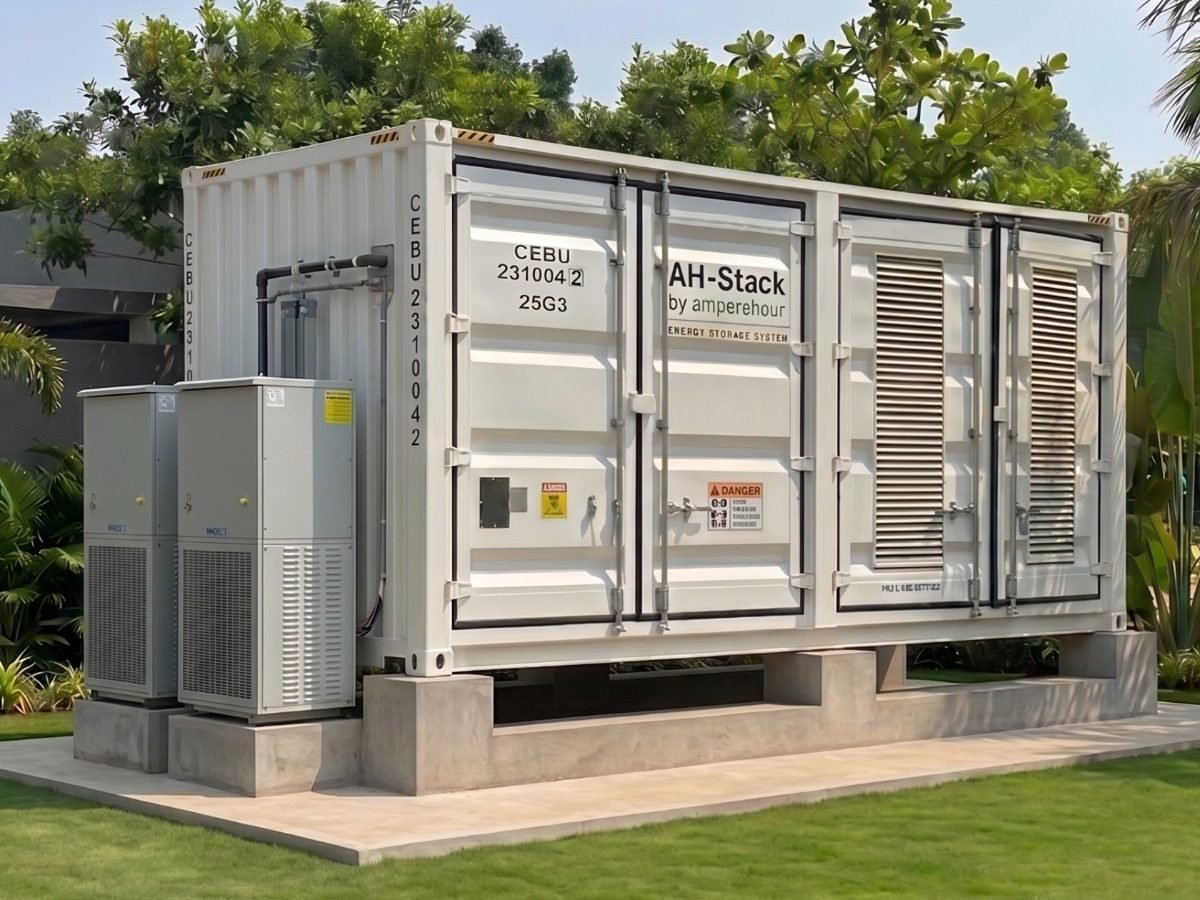
The hardware starts with a building block the company calls AH-Stack. The modules combine into installations of different sizes, so the same product can serve a factory that needs backup power and a utility that needs grid-scale storage. The newest block, the AH-5MWh, is a high-density, liquid-cooled, utility-scale unit, the company says, with early thermal-runaway detection built in to keep large installations safe. An AH-Recombiner manages the high-current 1500 V DC architecture that ties the blocks together, and a containerisation programme turns battery supply into certified, grid-ready storage blocks that can be shipped and switched on fast.
The software is where AmpereHour locates its difference. Its energy management platform, ELINA, is AI-driven and hardware-agnostic: it watches every battery in real time, predicts the best moments to charge and discharge, tracks performance and warranties across equipment from different makers, and folds renewable generation into the plan. Before anything ships, a digital factory acceptance test validates every signal, component and performance metric, so defects are caught in the factory rather than discovered on site.
The newest idea is to cut out steps between the solar panel and the battery altogether. In a direct-to-battery architecture, solar arrays connect straight to the battery’s DC bus, skipping conversion stages that waste energy and capturing power that would otherwise be clipped away at midday. In October 2026 AmpereHour partnered with Ampt, the American DC optimiser company, to bring that architecture to utility and commercial projects across India, South Asia, the Middle East and Africa — pairing Ampt’s string optimisers with AmpereHour’s storage systems and energy management software.
The deployments are already substantial. The company says it has more than 40 MWh of storage commissioned and around 1,000 MWh under execution across some 50 sites, for customers including IndiGrid, Cummins, Siemens, Coca-Cola, Amazon and BRPL, the Delhi distribution utility, along with a customer in the UAE. In May 2026 it switched on a 500 kVA / 608 kWh centralised battery system for Organo Antharam, a residential community near Hyderabad — the first residential community in India to run on a centralised storage system, the company says, with solar, grid and batteries orchestrated into seamless, uninterrupted power.
More Read

The timing is on AmpereHour’s side. The Ministry of Power now requires solar tenders to include co-located storage equal to a tenth of the installed capacity, for at least two hours — and storage, unlike panels, is a system that has to be engineered, installed and operated as one. AmpereHour raised a $5 million Series A in March 2025, led by Avaana Capital with UC Impower participating, taking its total funding to about $7.45 million. Nine years in, the Pune company that started before India had a storage market is now building the hardware and software that lets the grid keep the afternoon sun for the evening.
Keep reading: Solar Paint: Inside Pavakah Energy’s Printable Thin Film That Turns Any Surface Into a Power Plant · Spinning Carbon Out of Smoke: Inside Carbon Clean’s CycloneCC, the Indian-Born Machine Decarbonising Heavy Industry · More Energy & Power stories
Like stories like this? Add Exceptional Technology as a preferred source on Google to see more of our reporting in your search results and Discover feed.







