Steel, cement and refineries make the world run — and together they produce roughly 30% of all global emissions. The smoke pouring out of their chimneys has always been the hardest carbon to catch: conventional capture plants are vast forests of tall absorption columns, expensive to build and hungry for space most factories simply do not have. In 2009, two students at IIT Kharagpur decided the problem was not the chemistry. It was the cost — and the size.
Aniruddha Sharma and Prateek Bumb began working on the problem while still at university, chasing a cheaper, more efficient way to pull carbon dioxide out of flue gas. After restarting their process sixteen times, they landed on a proprietary solvent — the amine-promoted buffer salt solvent the company now calls APBS-CDRMax — that captures CO2 far more cheaply than the industry-standard amine. Incubated at IIT Kharagpur and backed early by Blume Ventures, the company they founded, Carbon Clean, moved its headquarters to London in 2012, where UK grants and entrepreneur visas helped it grow. Today it has offices in the US, Canada and India, and its technology is running at 50 sites around the world.
The first proof that the idea worked at real scale came in 2016, at Tuticorin in Tamil Nadu. There, Carbon Clean’s technology was installed at Tuticorin Alkali Chemicals & Fertilisers in what the company describes as the world’s first fully commercial carbon capture and utilisation plant: carbon dioxide captured from a coal-fired boiler is converted into soda ash, used in glass, detergents and sweeteners. The plant captures a projected 60,000 tonnes of CO2 a year at a cost of about $30 a tonne — so cheaply, the company says, that it needed no government subsidy. Before Carbon Clean arrived, the chemicals plant had to buy its carbon dioxide. Now it harvests it from its own smoke.
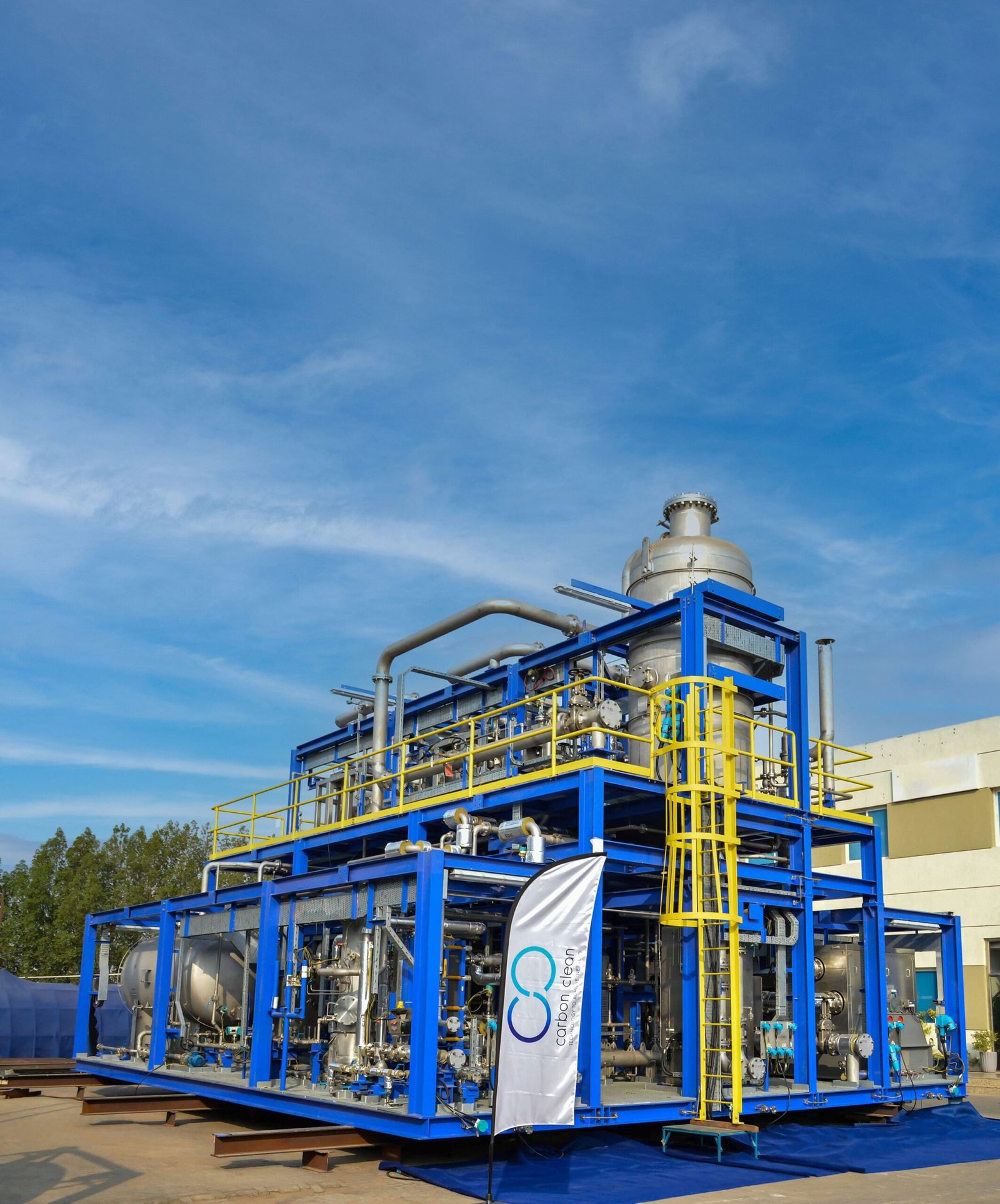
CycloneCC, launched in October 2021, is the company’s answer to the size problem. Instead of tall columns, it uses a rotating packed bed — a centrifuge that spins flue gas through the solvent at high speed. Co-founder and chief technical officer Prateek Bumb describes it simply: the technology works like a washing machine. The spinning bed and the CDRMax solvent together shrink the mass-transfer equipment to a tenth of the size of a conventional system, and the company says the modular units can cut the cost of capture by up to 50%, install in under eight weeks, and be shop-fabricated and scaled up module by module as a plant’s decarbonisation targets grow.
In May 2025, the technology reached commercial scale. At Thomas Broadbent and Sons in Huddersfield, Carbon Clean factory-tested the CycloneCC C1 — the world’s largest rotating packed bed for carbon capture, the company says — capturing up to 285 tonnes of CO2 a day. That is more than a twenty-fold scale-up from the first industrial CycloneCC demonstration, which captured 10 tonnes a day. Each C1 unit can capture up to 100,000 tonnes of CO2 a year, while cutting equipment height by 70%, steel requirements by 35% and overall footprint by up to 50%. The company plans to mass-produce the units in a gigafactory, bringing carbon capture closer to the production economics of solar panels and EV batteries.
The world’s heaviest industries are lining up to use it. CycloneCC units have already been demonstrated with cement maker Cemex and waste operator Veolia, and a pilot with Chevron is planned at a co-generation plant in California’s San Joaquin Valley. In December 2024, Aramco and Samsung E&A agreed to install a CycloneCC unit on a gas turbine exhaust stack, capturing CO2 from streams containing just 4% carbon dioxide. In June 2025, offshore platform leader MODEC signed on to put CycloneCC on its floating production, storage and offloading vessels — a pilot targeted for 2026, followed by commercial units capturing up to 100,000 tonnes a year per vessel, and eventually 300,000 tonnes for full decarbonisation. And in March 2026, JSW Steel and BHP began a joint study to install CycloneCC at JSW’s Vijayanagar steelworks in Karnataka, exploring up to 100,000 tonnes a year of capture at India’s leading private steelmaker.
More Read

The backing matches the ambition. Carbon Clean has cumulatively captured more than 2.8 million tonnes of CO2, holds over 131 active patent assets across 24 patent families in more than 30 countries, and in May 2022 closed a $150 million Series C round led by Chevron — described as the largest-ever equity round for a point-source carbon capture company — with CEMEX, Marubeni, Samsung Ventures, Saudi Aramco Energy Ventures, AXA and TC Energy joining in. In November 2026, the company was named to the ASK Private Wealth Hurun India Gazelle Index, recognising it among India’s fastest-growing technology companies. Its stated goal is industrial decarbonisation on a gigatonne scale by the mid-2030s.
From a campus idea at IIT Kharagpur to a soda-ash plant in Tuticorin, a factory-tested centrifuge in Huddersfield, and now steelworks in Karnataka and oil platforms at sea, Carbon Clean has spent seventeen years turning carbon capture from a towering, unaffordable monument into a modular machine that fits where industry actually works. The smoke is still there. Now, finally, something small enough, cheap enough and proven enough exists to catch it.
Keep reading: From Farm Waste to Full Charge: Inside Nexus Power, the Bhubaneswar Startup Building Batteries Out of Crop Stubble · UPI for Electricity: Inside Pulse Energy, the Bengaluru Startup Letting Farmers Sell Sunshine on WhatsApp · More Energy & Power stories
Like stories like this? Add Exceptional Technology as a preferred source on Google to see more of our reporting in your search results and Discover feed.