

India speaks in 22 scheduled languages and hundreds of mother tongues, yet almost all of the world’s most powerful AI was built in English first and adapted to India later. The result is familiar to anyone who has typed a question in Marathi or Tamil into a chatbot: slow answers, mangled words, and a model that clearly learned your language as an afterthought. A team anchored at IIT Bombay decided the fix was not a better translation layer. It was to build the model itself, from scratch, for India.
That team is BharatGen, and its flagship model is Param2 — a 17-billion-parameter language model that works in all 22 scheduled Indian languages and English, trained on more than 19 trillion tokens of Indian text, and released as open weights for anyone to download and build on. It was unveiled at the India AI Impact Summit in New Delhi in February 2026, and it is the centrepiece of India’s sovereign AI programme.
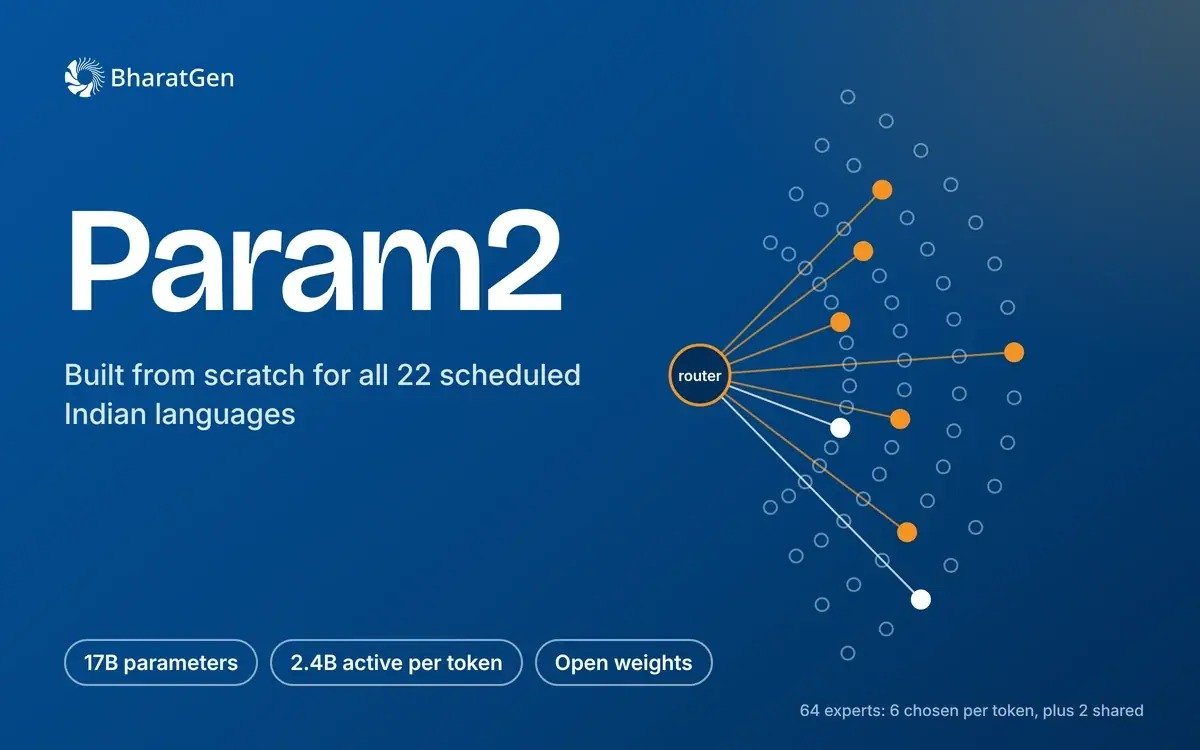
Param2, BharatGen’s 17-billion-parameter model. (Image: BharatGen)
The problem: AI that learned India as an afterthought
Most global language models are trained overwhelmingly on English text, and their tokenisers — the components that chop words into pieces before the model reads them — are built mainly for English too. An Indian-language word can splinter into many small fragments, which makes the model slower, costlier to run, and weaker at understanding what it reads. BharatGen’s answer was to start over: pretrain a model from the ground up on Indian data, with a tokeniser of its own, built with a 128,000-token vocabulary trained across all of its target languages, so words in Indian languages split into far fewer tokens than they do in global models.
Param2: 17 billion parameters, 2.4 billion at work
Param2 is a mixture-of-experts model. A conventional model uses every parameter for every word it reads or writes, so a bigger model is a slower and costlier one. Param2 divides much of its network into 64 smaller sub-networks called experts, and for each word a routing network picks just 6 of them, alongside 2 shared experts that are always active. The company likens it to a large hospital: each patient sees a general physician and a few relevant specialists, not every doctor in the building. The result is a model that holds 17 billion parameters of knowledge but spends compute on only about 2.4 billion of them per word, so it runs at the cost of a much smaller model.
More Read

The released version, Param2-17B-A2.4B-Thinking, is a reasoning model: it works through a problem step by step before giving its answer. It handles reasoning, code, mathematics and tool use across Indian languages, with up to 32,768 tokens of context, and its examples on the model card include a Python binary search with all comments in Telugu and an answer in Hindi on why languages, food and festivals differ across Indian states.
Built from scratch, on Indian data
Param2 was pretrained from the ground up, with data chosen for linguistic diversity and cultural grounding, drawn from Bharat Data Sagar, the programme’s curated data repository. According to the model card, it leads the Indian-language benchmarks it was measured on — scoring 59.23 on MMLU Hi, 75.98 on Indic BoolQ and 36.37 on the ARC Challenge in Indian languages, and topping the code test HumanEval as well — while staying competitive in English. Its training pipeline was built in collaboration with NVIDIA, using NVIDIA AI Enterprise software and infrastructure.
A whole family, not one model
Param2 is the flagship of a full stack. Shrutam2 turns speech into text in 12 Indian languages, trained on more than 17,000 hours of Indian speech. Sooktam2 turns text back into speech in 12 languages. Patram, a document vision model, reads complex Indian documents — built on more than 60 domains of real Indian paperwork across 23 languages. And domain models already spin off the base: Ayur Param for Ayurveda, Agri Param for agriculture and Legal Param for the Indian legal domain. The weights are open on Hugging Face and on AIKosh, the IndiaAI Mission’s platform, so researchers and builders can download them, fine-tune them and run them on their own servers in India.
The consortium behind it
BharatGen is a Section 8 not-for-profit, the BharatGen Technology Foundation, anchored at IIT Bombay and built by a consortium of nine of India’s top academic institutions, including IIT Madras, IIIT Hyderabad, IIT Kanpur, IIT Hyderabad, IIT Mandi, IIM Indore, IIIT Delhi and IIT Kharagpur. It is led by Professor Ganesh Ramakrishnan of IIT Bombay as principal investigator, with Rishi Bal as chief executive, and backed by ₹235 crore from the Department of Science and Technology’s National Mission on Interdisciplinary Cyber-Physical Systems and ₹1,058 crore through MeitY’s IndiaAI Mission.
The programme launched in September 2024, released its first foundation model, the 2.9-billion-parameter Param1, in July 2025, and unveiled Param2 at the India AI Impact Summit, where the Prime Minister launched the latest models. The roadmap runs further still, with the IndiaAI Mission’s ambitions reaching toward trillion-parameter-scale models. For a country with 22 official languages and a billion people waiting to be heard in their own tongue, BharatGen is building the AI that finally speaks their language — because it was built in it.
Keep reading: From Sarees to Semiconductors: Inside Suchi Semicon, the Surat Company Packaging a Billion Chips a Year · Drive In, Walk Away: Inside Relipark, the Pune Company Teaching Robots to Park Your Car · More Industrial Automation & Technology stories
Like stories like this? Add Exceptional Technology as a preferred source on Google to see more of our reporting in your search results and Discover feed.