


For most of us, a conversation is the easiest thing in the world — we open our mouths and the words come out. For the 4.8 million sign-language users in India, it is anything but. Sign language is their first language, yet almost nobody around them speaks it: the company behind a remarkable new device says 70 per cent of deaf people rely on friends and family just to translate for them. A Pune startup decided the answer was not to ask deaf people to change how they communicate. It was to build a glove that listens to their hands — and speaks for them.
That startup is Glovatrix, and its flagship product is Fifth Sense — an AI-powered smart glove that turns Indian Sign Language into spoken words in under a second, and spoken words back into sign language on a companion app. Founded in Pune in 2020 by Aishwarya Karnataki and Parikshit Sohoni, the company has spent six years refining the glove through eight hardware iterations, and in March 2026 it won a National Startup Award from the Department for Promotion of Industry and Internal Trade. The glove is now piloting in schools and training institutes, and working with hotels, governments and workplaces that employ deaf people.
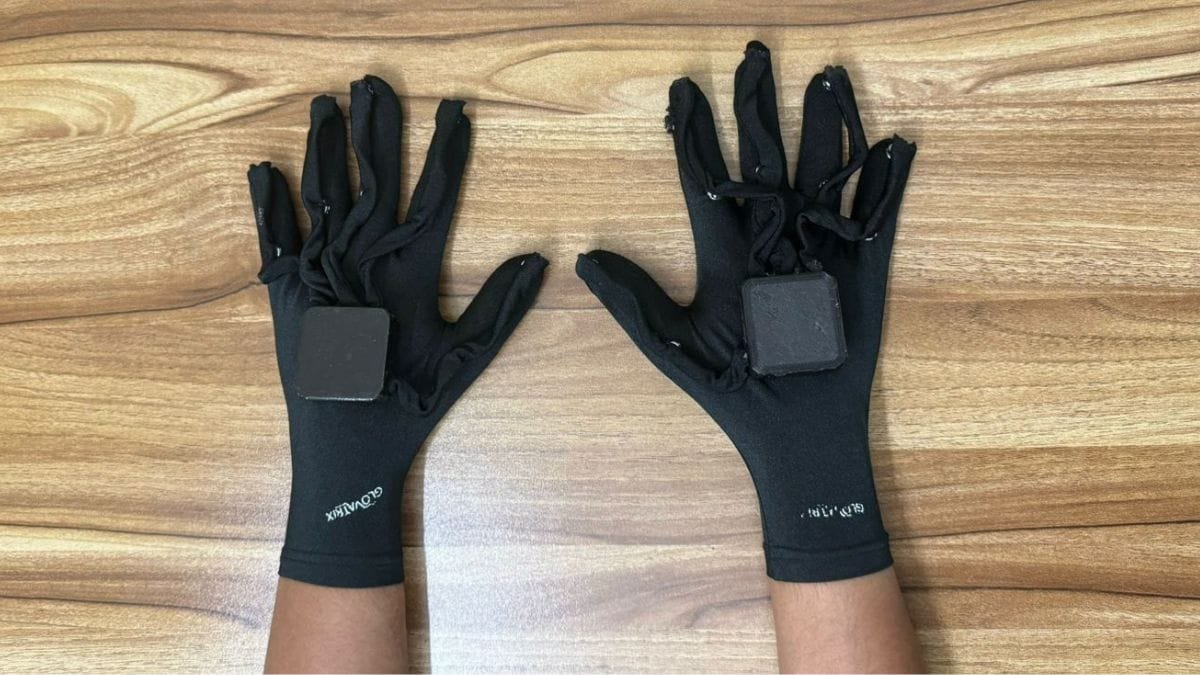
Glovatrix’s Fifth Sense gloves. (Image: Glovatrix)
A glove that listens to hands
Fifth Sense looks like an ordinary pair of black gloves with a small smartwatch-like unit on the back of each hand, and that ordinariness is the point — it is light fabric a person can wear for six to eight hours at a stretch, with openings at the fingertips so the wearer can still use a phone. Inside the fabric, flex sensors, motion sensors, a gyroscope and an accelerometer capture every hand movement, gesture and finger position. The company’s in-house machine-learning model — built from scratch, trained on Indian Sign Language — reads those movements and turns them into speech, played out loud through a speaker. The company lists latency at under 500 milliseconds, so the conversation flows almost in real time.
The conversation runs both ways. When a hearing person replies, the companion app listens and shows the words as sign language for the glove’s wearer to read — and it picks up other sounds too, like a doorbell ringing. The glove pairs with Android and iOS devices over Bluetooth, its battery lasts 10 to 12 hours on a charge, and the fabric detaches from the electronics so it can be washed. The company says its model recognises around 200 gestures at about 98 per cent accuracy, and it is building toward the full Indian Sign Language library of some 20,000 signs, with custom signs and vocabulary the user can add themselves.
More Read

Built for the real world, not the lab
What makes Fifth Sense quietly clever is how much of it works without the internet. The listening side of the app runs entirely on the device, so the audio a user hears never leaves their phone — no connection needed, no lag, no privacy worry. A limited set of signs is stored on the glove itself for offline translation, and the full library is available when the device is online. In an emergency, the device can sound an alert and send an SOS message to emergency contacts.
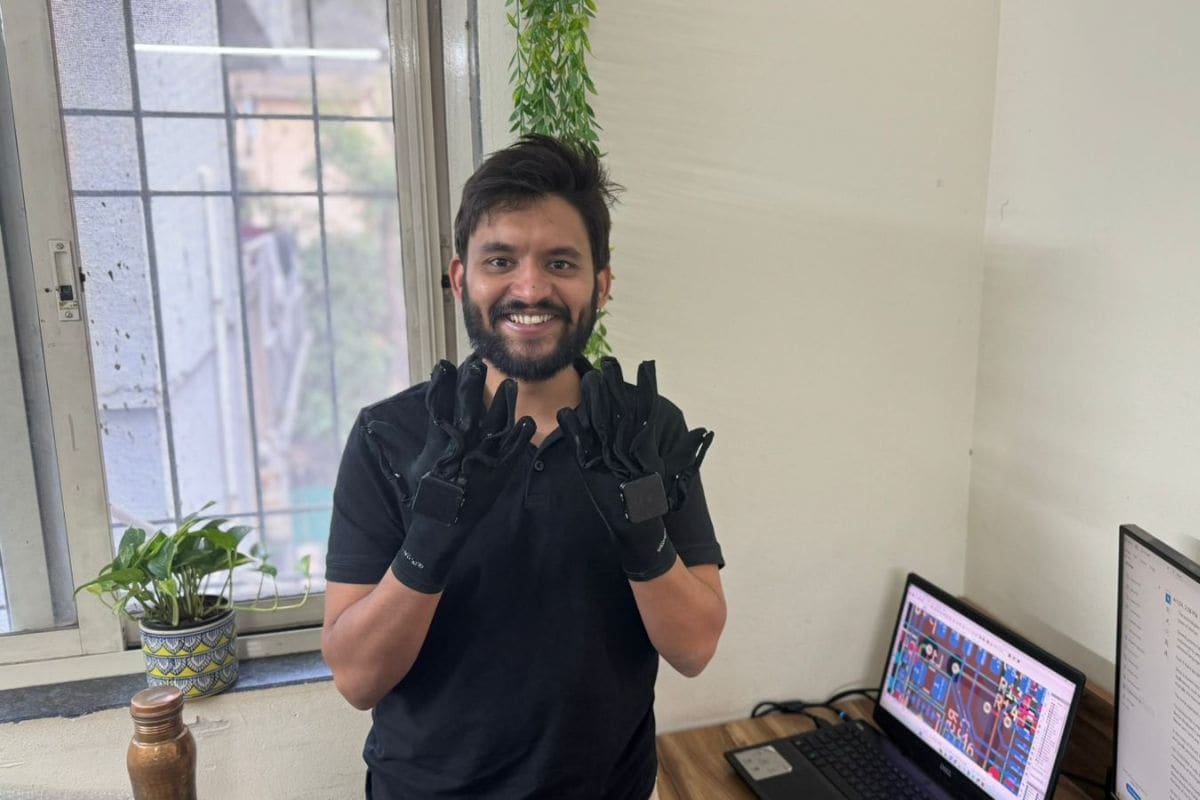
Fifth Sense in use. (Image: Glovatrix)
The glove grew out of a personal story. Karnataki met a child with hearing impairment in 2009, learned sign language, and carried the idea for years before meeting Sohoni, a data scientist whose own family had lived the same struggle. The pair began with a visit to a deaf school, then built seven prototypes over two years and more than twenty iterations, testing every version with the deaf community at each step. Their vision, in Karnataki’s words, is to give every deaf and speech-impaired person the ability to express themselves and be heard in their natural language — sign language.
From a classroom to the world
Fifth Sense is finding its first homes where communication matters most. Its first deployment is with Royal Orchid Hotels in Bengaluru, which pre-ordered ten devices for its deaf employees, and the company is working with the Odisha government on a UN-funded assistive-technology experience centre. The company says a speech-impaired person landed a job after using Fifth Sense to communicate with his interviewer — a small story that says everything about what the glove is for. It is also in conversation with the Indian Sign Language Research and Training Centre, and its technology has been used to translate national-level speeches, including the Prime Minister’s address at the India AI Summit.
The work is drawing recognition from every direction. Alongside the National Startup Award, Glovatrix finished in the Top 10 at the WIPO Global Awards, won BeChangeMaker 2025 at the WorldSkills conference in Croatia, took first prize at the Saksham assistive-technology accelerator, and won the HDFC CSR Parivartan Start-up Grand, the Shell E4 programme and a BIRAC grant. It is backed by HDFC, Shell, Boeing, Schaeffler, BIRAC, IIMA Ventures, IIMB NSRCEL, Venture Center and BITS Pilani, and has raised about Rs 1 crore in equity-free grants and prize money. The glove is priced at Rs 20,000 — roughly a mid-range smartphone — and the company is building MIRA, a sign-language avatar, alongside it.
For a world where 450 million people use sign language, and 1.5 billion people live with some hearing impairment, a glove that turns hands into speech is not a gadget. It is a door — and a Pune startup just built the key.
Keep reading: The X-Ray Machine That Fits in One Hand: Inside Lenek, the IIT Kanpur Startup Taking Diagnostics to India’s Villages · The Bed That Learns How You Sleep: Inside DreamSpan’s Lucid Pro, the Adaptive Sleep System That Cools to 13°C · More Chemicals, Materials & Life Sciences stories
Like stories like this? Add Exceptional Technology as a preferred source on Google to see more of our reporting in your search results and Discover feed.









