



India is building renewable energy faster than almost any country on Earth, racing toward 500 GW of non-fossil capacity by 2030. But sunshine and wind do not keep a schedule. A solar plant can swing from full output to a fraction of it in minutes, and every megawatt that misses its promised schedule can draw a penalty. The missing piece of the transition was never the panels or the batteries. It was the brain that tells them all what to do, every fifteen minutes, all day long. A Bengaluru company named Smartgrid Analytics has spent the last four years building exactly that brain — and at the Renewable Energy India Expo 2026, it unveiled the newest part of it: Solvyn AURA, an AI platform that turns solar plants, wind farms and batteries into a single thinking grid.
The problem: sunshine doesn’t keep a schedule
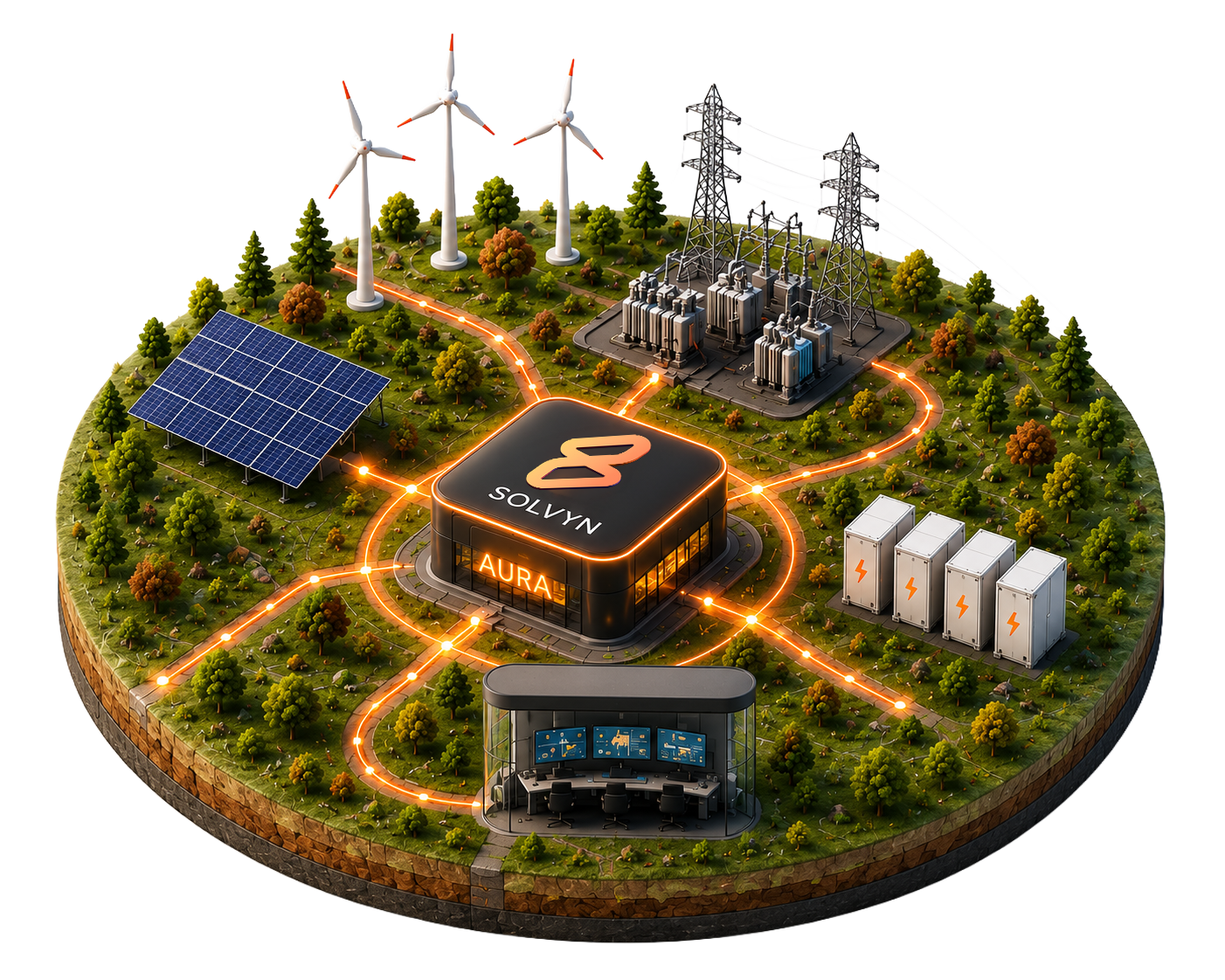
A renewable power plant is really three businesses running at once: generation, storage and trading. The sun and wind decide how much power exists, the battery decides when it is worth anything, and the power market decides what it is worth — with prices changing through the day and penalties waiting for anyone who misses a promised schedule. Until now, those three jobs have usually been handled by separate teams and separate tools, while the battery was used reactively, as a backup, rather than as a planned economic asset. Smartgrid Analytics built Solvyn to close that gap. The platform brings SCADA, power plant control, energy management, digital twins, forecasting and dispatch optimisation into one operating layer, so a hybrid plant can be run as one machine instead of three.
AURA: the brain on top of the battery
Solvyn AURA — short for Automated Utility Resource Allocation — is the decision layer on top of that operating system. It pulls together live plant data, generation forecasts, market signals and asset performance, then works out when to charge, when to dispatch and how much energy to commit, while respecting the battery’s own limits. The company says its forecasts reach 95% reliability, and its digital twins model each battery’s degradation, cycle cost and warranty limits, so the platform can chase revenue without wearing the asset out. AURA supports scheduling and dispatch optimisation, battery charge and discharge recommendations, firm and dispatchable renewable energy (FDRE) contract management and compliance reporting, along with decision support for the Day-Ahead, Real-Time and Green Day-Ahead power markets. The philosophy behind it is deliberate: as the company’s founder puts it, AI should propose, while deterministic systems keep control of the critical grid decisions.
Proven at grid scale
What sets Solvyn apart is how much of India’s clean-energy build-out already runs through it. The company says its platform has now commissioned more than 107 GW of renewable assets across 500-plus projects in 21 countries and 21 grid codes, including over 9 GWh of battery storage. Its deployments over the past year include two grid-scale battery projects for an Indian independent power producer — 300 MW / 1,400 MWh and 300 MW / 600 MWh — along with five distributed storage sites, among them a 22 MW / 44 MWh system for a metropolitan distribution utility. In the United States, it supplied a 75 MW battery project in California, providing grid-code compliance logic for both CAISO and Southern California Edison. One of its earliest Indian deployments, a 40 MW / 120 MWh battery system at Rajnandgaon, was built around a hard requirement: the battery charges only from its co-located solar plant, while meeting Central Electricity Authority norms. The newest vote of confidence came at the REI Expo itself, where Smartgrid Analytics signed an agreement with BluPine Energy to deploy AURA progressively across a portfolio exceeding 1 GWh in Andhra Pradesh, Karnataka and Rajasthan — and the company says it already holds FDRE contracts across Andhra Pradesh, Karnataka, Maharashtra and Rajasthan. Its stated target now is to serve more than 200 GW of renewable capacity in India over the next five years.
The company behind it
Smartgrid Analytics was founded in Bengaluru in 2022 by Kumar M, a control engineer with a master’s degree in automatic control from Karlstad University in Sweden, who had earlier founded Armax Automation in 2005. He leads the company alongside co-founders Venkata Krishnan, chief growth officer, and Tirumaleswara Reddy K, chief technology officer — a team the company describes as control engineers, grid architects and energy technologists. The engineering shows up in the patent book: the company has filed 21 patents, including two in the United States, covering digital twin modelling, EMS dispatch logic and the AURA intelligence framework. A $3.3 million round from strategic investors and clean-energy veterans in October 2025 is funding the next phase, and the company has opened a subsidiary in Abu Dhabi as it looks toward the Middle East, Australia and the United States. Back home, its timing is sharp: the Ministry of Power now requires indigenous energy management software for battery storage projects under its viability gap funding scheme, and Smartgrid Analytics builds exactly that, in India, for Indian grid codes. The grid of the renewable century will be run by software — and this Bengaluru company is writing the software that runs it.
Keep reading: From Powder to Power: Inside Agratas, the Tata Company Building India’s Battery Cells at Gigafactory Scale · Every Drop Counts: Inside Solabot, the Ghaziabad Startup Cleaning India’s Solar Panels Without Water · More Energy & Power stories
More Read

Like stories like this? Add Exceptional Technology as a preferred source on Google to see more of our reporting in your search results and Discover feed.







