In the spring of 2025, drone swarms became the defining threat on India’s borders — cheap, fast, and brutally hard to stop with missiles that can cost far more than the drones they chase. The answer taking shape in Navi Mumbai does not fire a single bullet. It fires light.
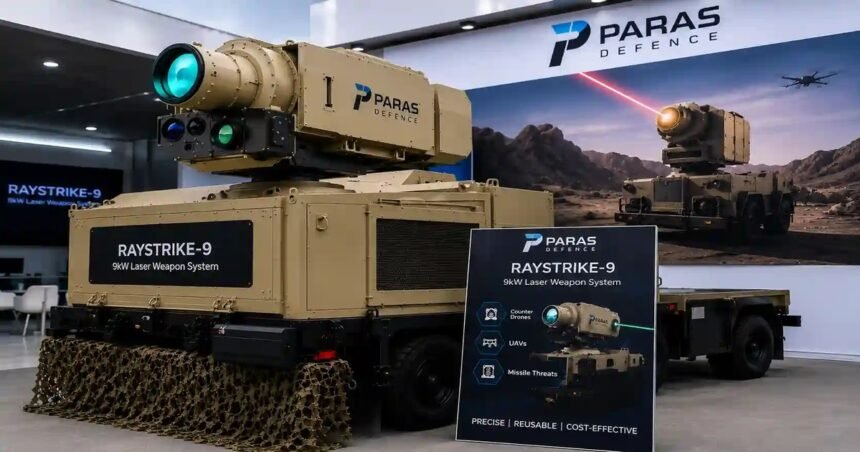
That answer is RayStrike-9, a high-power laser weapon system built by Paras Defence and Space Technologies. The company says the system tracks a hostile drone, locks on with AI-driven targeting, and destroys it with a concentrated beam of laser light — at the speed of light, at ranges of up to 2.5 kilometres, and for as long as it has power, without ever needing to reload.
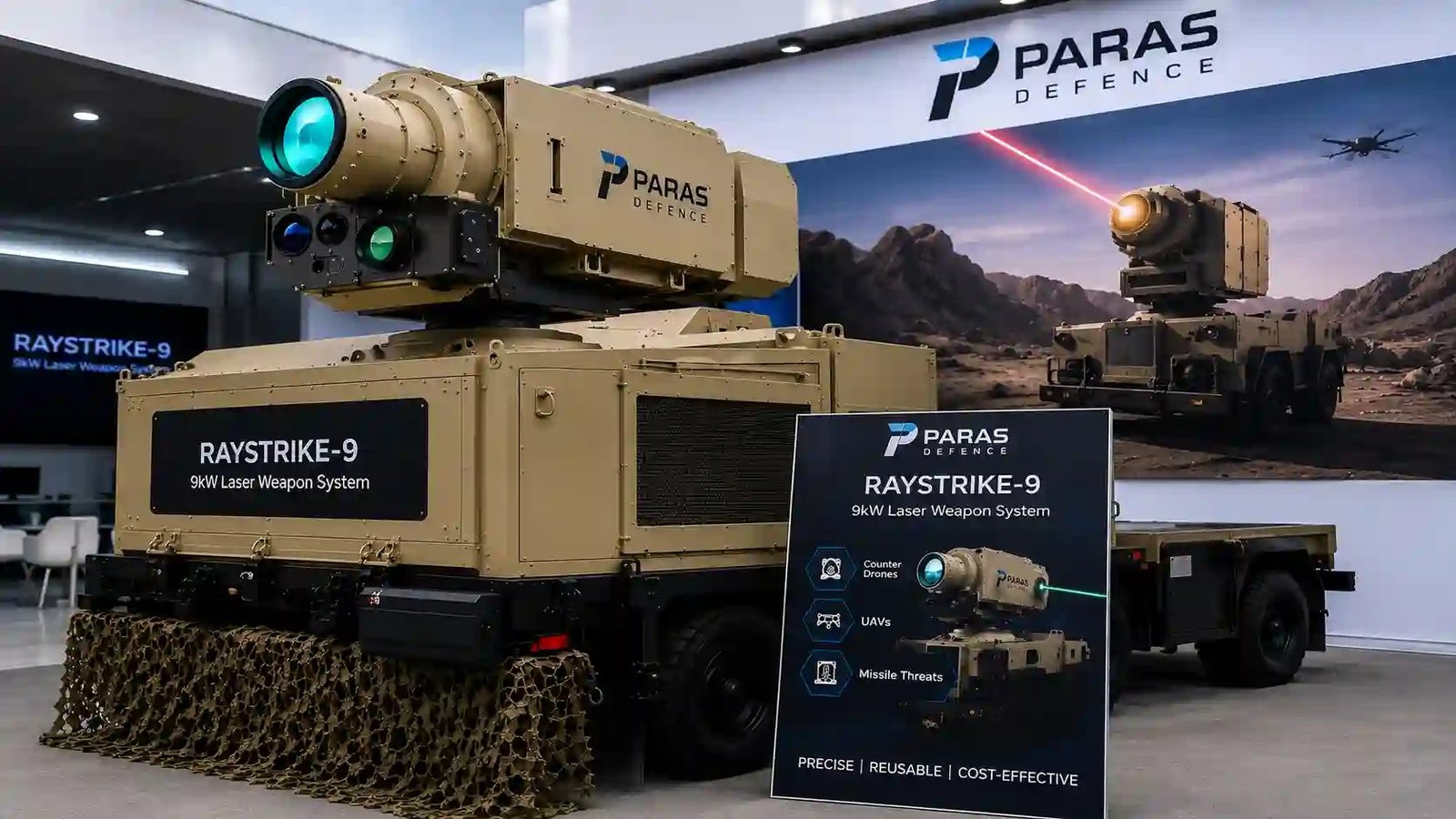
Paras Defence’s RayStrike-9 9kW laser weapon system on display. (Image: Paras Defence)
A weapon that never runs out of ammunition
Every air-defence system in history has carried the same weakness: a finite magazine. A missile battery that has fired its last interceptor is an empty launcher. RayStrike-9 turns that arithmetic on its head. The company describes an effectively infinite magazine — as long as the system has power, it keeps firing, shot after shot, at the cost of electricity rather than the cost of a missile. Against drone swarms, where the attacker can afford to send dozens of cheap aircraft at once, that changes the economics of defence completely.
Speed is the other half of the story. A laser beam reaches its target at the speed of light, so there is no flight time to calculate and no lead to estimate — the beam is simply there, the instant the system fires. The company says that makes RayStrike-9 especially effective against swarming drones and fast-moving aerial targets that twist and dodge in ways a conventional interceptor struggles to follow.
More Read
Track, Locate and Kill
RayStrike-9 works on a principle the company calls “Track, Locate and Kill”. High-resolution electro-optical sensors scan the sky day and night, an AI-driven targeting system identifies and prioritises threats by their speed and trajectory, and the laser does the rest — burning through the target with a focused beam of concentrated energy.
The system comes in configurations from 3kW to 9kW, with the company putting its engagement range at 1.2 to 2.5 kilometres depending on the power configuration and the target. It is built as a compact, modular platform that can be carried by soldiers or mounted on a vehicle, so the same weapon can guard a military base, an ammunition depot, a forward operating location, or a piece of critical national infrastructure. The day-and-night sensor suite draws directly on Paras Defence’s deepest expertise — the company has spent decades building the advanced optics that let machines see clearly in the dark.
From optics supplier to weapon-maker
RayStrike-9 marks a remarkable transformation for Paras Defence. The company was incorporated in 2009 and listed on the NSE and BSE in October 2021, but its roots in defence engineering run back more than four decades, through the family business founded by chairman Sharad Virji Shah and now led by managing director Munjal Sharad Shah. From its headquarters in Nerul, Navi Mumbai, with facilities in Ambernath, Bengaluru and Hyderabad and a team of more than 500 people, it has grown into one of India’s most versatile private-sector defence houses.
For most of that journey, Paras Defence was the quiet enabler behind other people’s systems — the company says it is the only company in India manufacturing infrared optics in large quantities, and the sole Indian supplier of vital imaging components for space applications, including large-size optics and diffractive gratings. Its work spans defence and space optics, optronic systems, defence electronics, electromagnetic pulse protection and heavy engineering, and its components have flown on many of the country’s most prestigious defence and space programmes. RayStrike-9 takes all of that accumulated craft — the optics, the precision engineering, the systems integration — and turns it into a weapon system of the company’s own.
The &rupee;142-crore DRDO partnership
The foundation of the programme is a &rupee;142.31-crore order Paras Defence secured in March 2025 from the Defence Research and Development Organisation’s Centre for High Energy Systems and Sciences (CHESS), the Hyderabad laboratory at the heart of India’s directed-energy research. The 24-month project covers the development of a Laser Source Module and its integration with a mobile Beam Control System, the core of a high-power laser system built for anti-drone and anti-missile missions — and it puts RayStrike-9 on course for field trials by 2027.
Paras Defence is building out the counter-drone portfolio around it. The company has also secured the exclusive Indian manufacturing and commercialisation rights for the Guardian-1 Interceptor from US-based Tandem Defense LLC, adding a kinetic interceptor to a family that now spans sensing, tracking and directed-energy engagement. It is a complete counter-UAS play: find the drone, follow it, and stop it — with light, or with a missile, as the mission demands.
What comes next
Field trials in 2027 will be the proving ground, and the ambition reaches well beyond them. In June 2026, ahead of Eurosatory in Paris, managing director Munjal Sharad Shah set out a vision to take the company’s homegrown, indigenously designed, developed and manufactured solutions to the world — a private Indian defence house stepping onto the global stage with technology it built from first principles at home.
RayStrike-9 is a measure of how far that journey has come. A company that began by grinding lenses and building the optics other people’s weapons look through now builds a weapon that needs no ammunition at all — only power, precision, and light.
Keep reading: The 2.5-kg Drone That Hunts Other Drones: Inside Stravex Technologies’ AgniStrike · Beyond the Last Tower: Inside Nibiaa, the Imphal Startup Keeping Assets Visible From Space · More Aerospace & Defense stories
Like stories like this? Add Exceptional Technology as a preferred source on Google to see more of our reporting in your search results and Discover feed.