


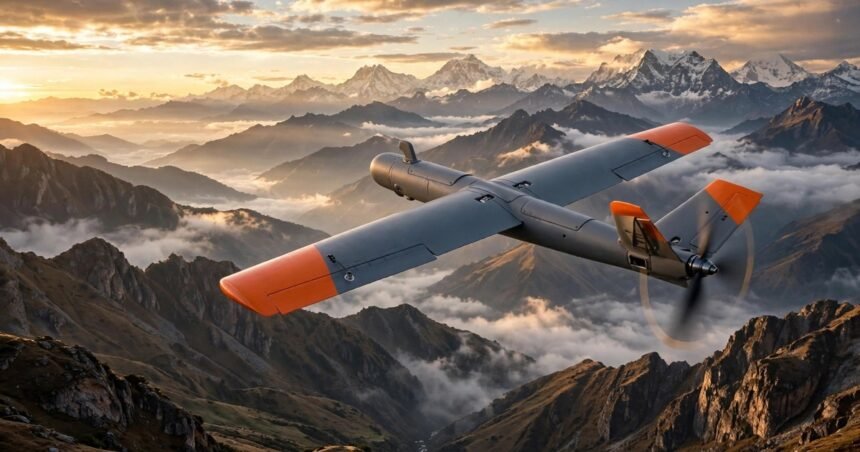
Cover image: Exceptional Technology — an AI-generated illustrative scene of the SYENA ASTRA-1 in flight, based on Pixiu Systems’ official product photograph, pictured below.
High on a Himalayan ridgeline, a small team of soldiers faces a problem that has nothing to do with firepower and everything to do with weight. Every kilogram they carry has to be hauled up the slope on their own backs — and until now, the ability to watch a valley for an hour and then strike a target inside it belonged to systems far too heavy for a patrol to carry. A new aircraft from Bengaluru is built to change that arithmetic: it weighs just 6.5 kilograms, folds into a backpack, and flies for more than an hour.
That aircraft is the SYENA ASTRA-1, a lightweight fixed-wing loitering munition unveiled by Bengaluru-based aerospace technology company Pixiu Systems Private Limited. Named for the Sanskrit word for the falcon, it is designed to give small military units both eyes and strike capability in a single, highly portable package — a drone that can watch a patch of ground, find its target, and then become the weapon itself.

The SYENA ASTRA-1 in Pixiu Systems’ workshop — a grey fixed-wing airframe with orange wingtips, built for hand launch. (Image: Pixiu Systems)
An hour over the target
The numbers tell the story of a system built around endurance and portability. The company says the ASTRA-1 has a maximum take-off weight of 6.5 kg, a wingspan of 1.60 metres, and a standard payload of 1 kg. It stays airborne for more than 60 minutes, cruising at 21 metres per second and reaching a maximum speed of 35 metres per second, with a service ceiling of 10,000 feet above mean sea level — high enough to work across the Himalayan terrain where India’s soldiers operate.
More Read
That hour in the air is what makes a loitering munition different from an ordinary reconnaissance drone. Instead of flying a pre-planned route and coming home, the ASTRA-1 can hold over an area of interest while its operators watch, identify a target, and only then commit to the strike. The company describes a fire-and-forget concept with GPS-guided strike capability: once the mission is authorised, the operator does not need to steer the aircraft all the way in.
Built for the smallest unit
Every design choice bends toward the soldier carrying it. The ASTRA-1 is backpack-portable, and it can be launched by hand or from a pneumatic launcher — no vehicle, no runway, no heavy ground station. A small team can unpack it, launch it, and have eyes over the next ridge within minutes, then use the same aircraft for the strike if the situation demands it.
That dual role is the point. Surveillance and strike usually mean two different systems, two different loads, and two different operators. By folding both jobs into one 6.5-kg airframe, Pixiu Systems is offering small units a capability that once needed a far larger footprint — and doing it with a lightweight, cost-effective design that a fast-moving team can actually carry.
India’s loitering-munition moment
The ASTRA-1 arrives as India’s private sector builds a whole family of loitering munitions. Economic Explosives Limited’s Nagastra-1, developed with Bengaluru startup Z-Motion, is an 8–9 kg man-portable system already in the armed forces’ hands, while Zulu Defence’s DRAP hovering loitering munition has been through field evaluations with the Indian Army and the Navy’s marine commandos — and has even won an order from the Netherlands Special Forces. Pixiu Systems is staking its claim at the lightest, most portable end of that spectrum, where the aircraft is small enough for a single soldier to carry and launch by hand.
What comes next
Pixiu Systems is now opening the ASTRA-1 for demonstrations and collaborations, putting the little falcon in front of the people who would fly it for real. If it earns its place with the forces, the smallest units on India’s borders could soon carry their own eyes and their own strike — in a backpack, at 6.5 kilograms, for more than an hour at a time.
Keep reading: Light-Speed Defence: Inside Paras Defence’s RayStrike-9, the Laser Weapon Hunting India’s Drones · The 2.5-kg Drone That Hunts Other Drones: Inside Stravex Technologies’ AgniStrike · More Aerospace & Defense stories
Like stories like this? Add Exceptional Technology as a preferred source on Google to see more of our reporting in your search results and Discover feed.








