


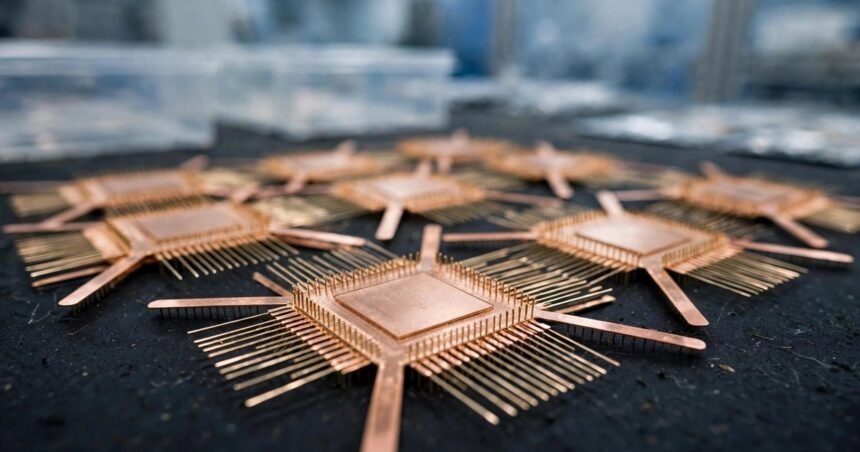
Every chip inside a phone, a car or a power inverter sits on a tiny metal skeleton that almost nobody ever sees. It holds the silicon die in place, carries its electrical signals out to the circuit board, and pulls heat away while it works. That skeleton is called a lead frame — and until now, India has had to buy nearly all of them from overseas. In Sanand, Gujarat, an 18-year-old from Ahmedabad is setting out to change that.
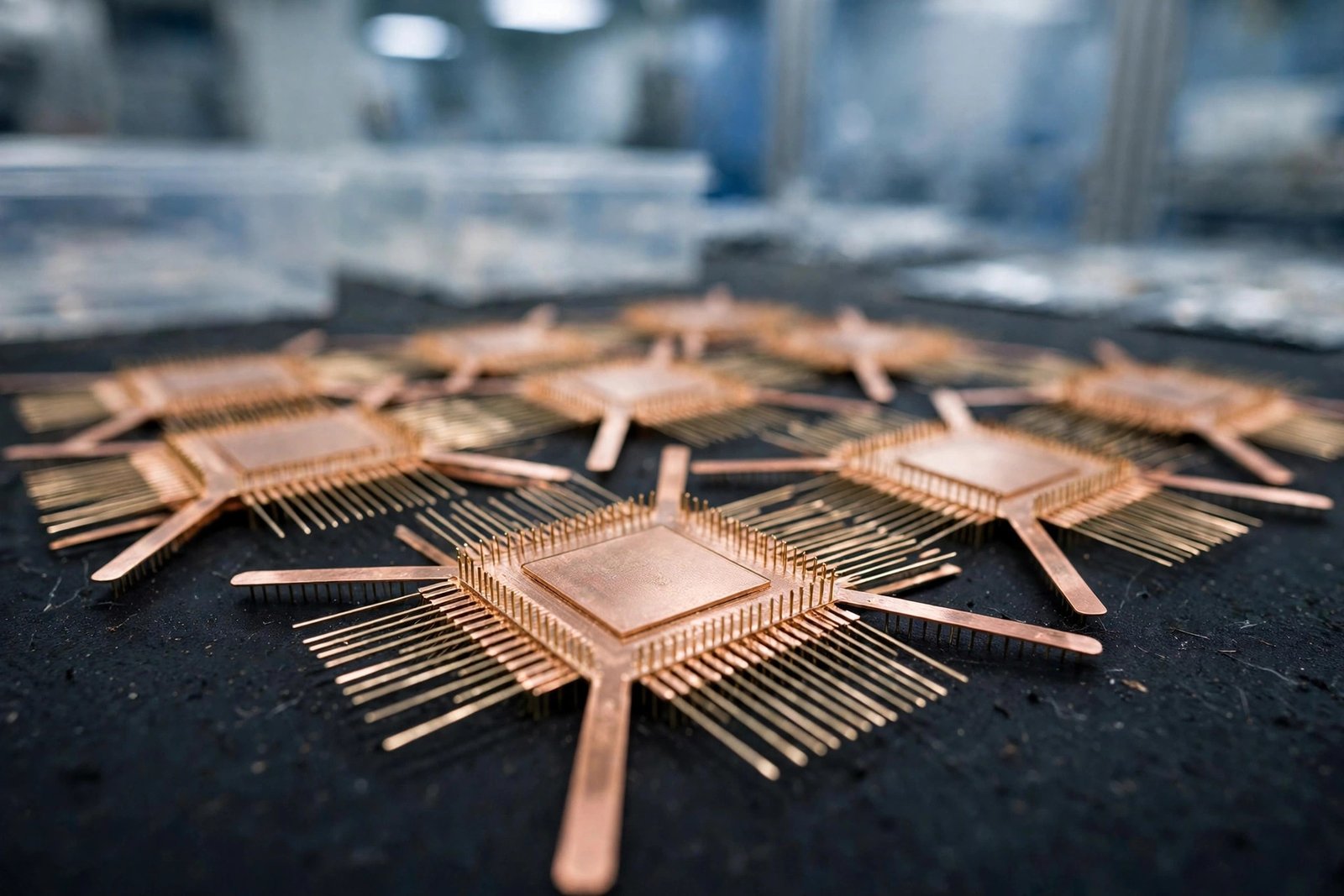
Copper-alloy lead frames, visualised. (AI illustration)
The part of the chip nobody sees
A lead frame is an ultra-thin metal frame, thinner than a sheet of paper in places, etched or stamped from copper alloy into a precise pattern of pins around a central pad. The silicon die is mounted on that pad, fine wires connect it to the pins, and the whole assembly is moulded into the familiar black package of a finished chip. Without it, there is no chip packaging at all — no way to connect a die to the world outside.
Micronex, the startup founded by Rehan Mansuri, will manufacture these frames from copper alloy in thicknesses from 0.1 mm to 0.25 mm. It is precision metalwork at a scale where a fraction of a millimetre decides whether a package works, and it is exactly the kind of unglamorous, deeply technical component that a serious semiconductor ecosystem cannot do without.
An 18-year-old’s ₹80-crore bet
Mansuri, 18, comes from a business family that runs seven plastic waste recycling units across India — a background in making things at industrial scale, even if the material is entirely different. His company, Micronex Technology, is building its first plant at the Sanand Industrial Estate with an investment of ₹80 crore. Construction has already begun, production is targeted for May 2027, and the first phase is planned to turn out 50 crore lead-frame units a year, creating around 250 direct jobs.
More Read

The first customers Micronex has in its sights are the power electronics and automotive sectors, where India’s chip demand is growing fastest, with consumer electronics and telecom to follow as capacity scales. The company also plans to submit a proposal under the India Semiconductor Mission 2.0 programme.
Plugging into Sanand’s semiconductor cluster
Micronex is not arriving in an empty field. At SEMICON India 2026 in New Delhi, the company signed a business partnership MoU with Kaynes Semicon, opening a supply channel to the semiconductor and packaging companies operating in Gujarat. The state has attracted around ₹1.4 lakh crore in semiconductor investments and hosts six of the twelve semiconductor projects approved by the Government of India. Micron’s Sanand assembly and test facility began commercial production in February 2026, and Kaynes Semicon’s own Sanand facility started production in March.
That is the bet in a nutshell: as India’s fabs and packaging plants come online, someone has to make the components they consume by the crore. A lead frame is a small thing. But a country that can make fifty crore of them a year, at home, has filled one more gap in the chain between sand and silicon — and it took an 18-year-old to spot the opening first.
Keep reading: The Shoe That Comes Out of a Printer: Inside Drifbolt, the Delhi Startup 3D-Printing Footwear in One Piece · From Five Months to 45 Days: Inside STCH, the Bengaluru Startup Teaching India’s Factories to Make Fashion on Demand · More Manufacturing & Engineering stories
Like stories like this? Add Exceptional Technology as a preferred source on Google to see more of our reporting in your search results and Discover feed.







