Every electric vehicle on Indian roads today carries a small, flammable secret: the liquid electrolyte inside its battery. It is the part that makes the battery work — and the part that can catch fire when a cell is damaged, overcharged or simply pushed too hard. A Chennai startup has spent years working on a simple, radical fix: take the liquid out entirely. That is the idea behind Inventus Battery Energy Technologies, a Chennai company building India’s first lithium-metal all-solid-state battery around a flexible ceramic electrolyte it calls Ceramion+.
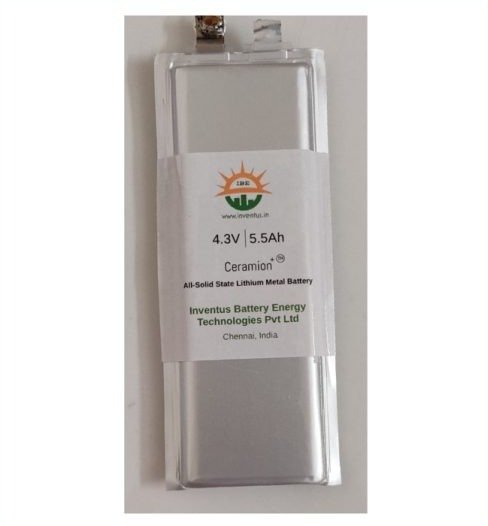
Inventus’s Ceramion+ all-solid-state pouch cell — a 4.3V, 5.5Ah prototype built at the company’s Battery Technology Development Centre in Chennai. (Image: Inventus Battery Energy Technologies)
A ceramic sheet instead of a liquid
At the heart of the battery is Ceramion+, a flexible ceramic oxide solid electrolyte that does the job of both separator and electrolyte — with no liquid anywhere in the cell. The company says the membrane is cast thinner than 50 microns, conducts lithium ions at more than 4 mS/cm at room temperature — rivalling liquid electrolytes — and stays thermally stable up to 800°C. Through interface engineering and surface coatings, Inventus says it has made the ceramic work with high-voltage cathodes such as NMC811 at up to 4.45 V and LNMO at up to 4.8 V, and with a lithium-metal anode whose theoretical capacity of 3,860 mAh/g dwarfs the roughly 372 mAh/g of the graphite used in today’s cells.
The payoff is safety by construction. With no flammable liquid to leak, no dendrite-friendly liquid interface and a ceramic backbone that does not burn, the company says its cells survived 180°C heat, nail penetration and external short circuits in abuse testing without fire or rupture — the kind of punishment that would destroy a conventional lithium-ion cell.
The cell itself
Inventus’s prototype is a 5.5Ah pouch cell: 4.3 volts, 46 by 110 millimetres, just 8 millimetres thick. The company says it delivers around 350 Wh/kg at the cell level — comfortably above the 250 Wh/kg benchmark in India’s PLI scheme for Advanced Chemistry Cells — and has held 92.8% of its capacity after 1,000 cycles, with the company projecting more than 6,000 cycles for future commercial cells with an NMC811 cathode. It also charges fast, the company says, reaching 80% charge in under 15 minutes at a 5C rate, and keeps working from -20°C to +70°C.
More Read

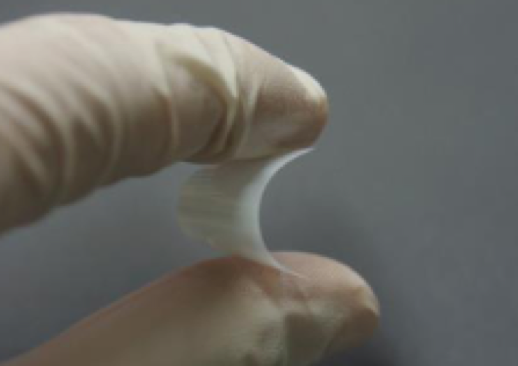
The Ceramion+ membrane is a flexible ceramic solid electrolyte, thin enough to run through existing cell-making lines. (Image: Inventus Battery Energy Technologies)
Built for the factories India already has
The most practical part of the invention may be how ordinary it is to make. Because the Ceramion+ membrane is flexible — about 25 microns thick, analogous to the Celgard 2325 separator used in today’s lines — Inventus says it can be processed roll-to-roll on conventional cell winding machines, using a dry process with no solvents and no external stack pressure to keep the cell working. The company’s own description puts it plainly: the technology holds good for existing lithium-ion cell winding machines, so a factory does not need new machinery to build a solid-state cell.
That manufacturability is the point. Inventus also offers turnkey solutions for lithium-ion cell plants, cathode active materials in LFP, LMFP, NMC and LNMO chemistries, and LiPF6 electrolyte manufacturing know-how, positioning itself as a one-stop technology shop for India’s cell-making ambitions. Its Protected Lithium Metal Cassette anode carries Indian patent 385777, granted in December 2021, and the company says its technology has reached Technology Readiness Level 8. It was named to YourStory’s Tech30 list in 2024, and to a global top-50 list of solid-state battery developers.
From a professor’s lab to the cell mission
The company was founded in 2020 by Dr S.R.S. Prabaharan, who earned his PhD in lithium-ion conducting solid electrolytes in 1991 and spent decades teaching and researching batteries in India, Japan, the UK, the US and Malaysia before leaving a secure academic career in 2022 to build Inventus full-time. He leads the company alongside co-founders Dr Siluvai Michael and Dr J. Malathi, with Cecil Lazarus as co-founder and chief financial officer.
The work has drawn government backing: Inventus says it was selected for the Technology Development and Validation Commercialisation project of the National Research Development Corporation under the Department of Science and Technology, with Phase 1 funding supporting its prototype demonstrations, and that it is in mutual discussions with TVS-Lucas in Chennai. Its roadmap, the company says, runs through third-party validation in the first half of 2026, a pilot-scale stack assembly line and A-sample trials with OEM partners in early 2027, B-sample trials later that year, and a commercial launch through partners in early 2028.
Where the battery goes first
Inventus sees its earliest homes in defence, where cells must survive extreme cold and long storage; in aerospace, where every gram matters for satellites, drones and electric aircraft; and in premium electric vehicles, consumer electronics and wearables, where a thin, safe, fast-charging cell earns its keep. It is a technology built for the hardest jobs first — and for a country determined to make its own cells rather than import them.
The liquid inside today’s batteries made the electric age possible, and it also made it flammable. A team in Chennai has spent years proving that the liquid was never the point — the ions were. With a ceramic sheet barely thicker than a separator, Inventus is building the battery India’s electric future can stand on, without ever catching fire.
Keep reading: Turning Electricity Into Metal: Inside Sthyr Energy’s Zinc-Air Battery That Stores Power for Months · The Robot That Cleans India’s Solar Panels Without a Drop of Water: Inside Greenleap’s LOTUS · More Energy & Power stories
Like stories like this? Add Exceptional Technology as a preferred source on Google to see more of our reporting in your search results and Discover feed.