Every aircraft, drone and ship in service today leans on satellites to know where it is. But satellite signals can be jammed, spoofed or simply switched off — and in a conflict zone, they often are. A Pune company has spent eighteen years building the answer to that problem: small, rugged boxes that work out exactly where they are, entirely on their own. That is the craft of Aeron Systems, a Pune deep-tech company building India’s indigenous inertial navigation systems.
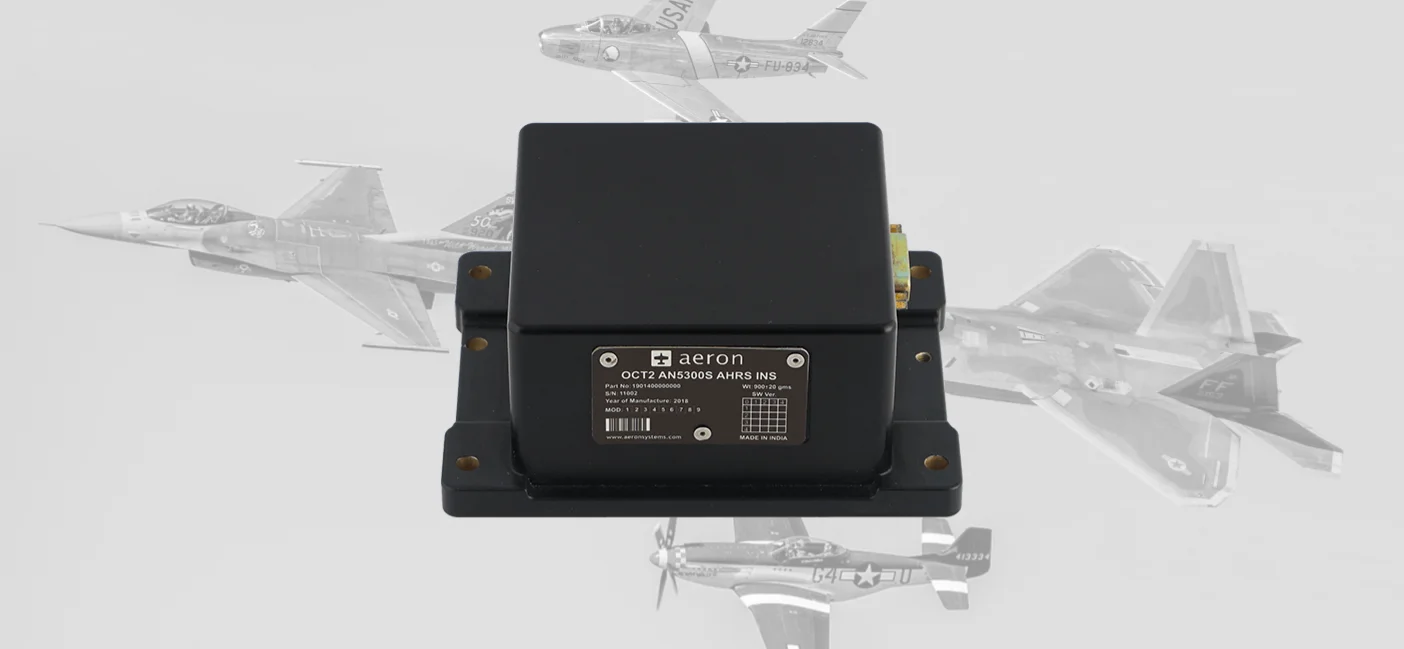
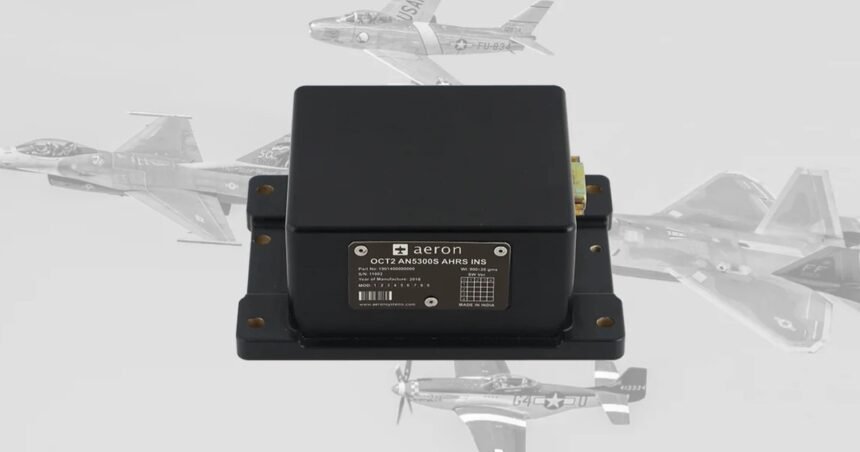
Aeron’s Octantis 2 AHRS INS, the airborne-qualified attitude and heading system at the heart of its navigation family. (Image: Aeron Systems)
Navigation that needs no satellite
An inertial navigation system does its sums the old-fashioned way: gyroscopes feel every turn, accelerometers feel every push, and the box integrates those measurements thousands of times a second to track exactly where it has gone from where it started. No radio, no satellite, nothing to jam. Aeron’s proprietary NavPro sensor-fusion engine — an extended Kalman filter refined over eighteen years — turns those raw sensor readings into position, velocity, attitude and heading, and keeps delivering them when the satellites vanish: in tunnels and urban canyons, over rough off-road terrain, and across jammed battlefields.
The numbers show how far the company has pushed the art. Its flagship Aldebaran system holds its course with as little as 0.5% distance-travelled drift during long GNSS outages with external aiding, and its smallest unit, Pollux 3, carries a feature called DriftLoc that holds an accurate position and true heading when satellites disappear altogether. It is the kind of capability that turns a drone, a missile or an armoured vehicle from a platform that depends on GPS into one that simply keeps going.
The family: from 38 grams to tactical fibre-optic gyros
Aeron’s catalogue is built around three navigation families, each aimed at a different corner of the sky, land and sea.
More Read

Pollux 3 is the featherweight: a micro-miniature inertial navigation system measuring 37 by 37 by 15 millimetres and weighing about 38 grams, drawing under 1.5 watts. The company says it delivers 1.5-metre position accuracy, updates its navigation solution 200 times a second, and is built to MIL-STD-810G and IP65 — small and tough enough to ride on micro-UAVs and unmanned ground vehicles.
Octantis 2 is the workhorse. Its attitude and heading reference system is airborne-qualified, CEMILAC certified, and qualified to MIL-STD-461E and MIL-STD-810E/F/G as well as DO-178B Level B software standards, serving as a primary or standby instrument for electronic flight instrumentation and cockpit displays in fighter, transport and passenger aircraft — and for autonomous control in unmanned aerial vehicles. Its INS-GNSS sibling, the company says, has been in service for ten years, delivering centimetre-level RTK positioning with an integrated multi-constellation, multi-frequency GNSS receiver.
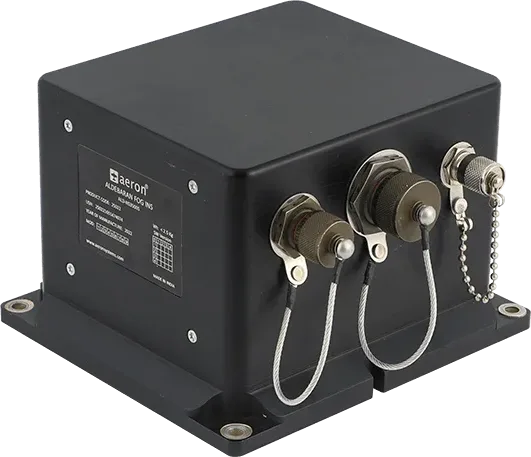
Aldebaran, Aeron’s tactical-grade fibre-optic gyro inertial navigation system, with closed-loop fibre-optic gyros holding bias instability below 0.1° per hour. (Image: Aeron Systems)
At the top of the range sits Aldebaran, a tactical-grade fibre-optic gyro system. Its closed-loop fibre-optic gyros hold bias instability below 0.1° per hour, its multi-frequency, multi-constellation GNSS receiver tracks GPS, Galileo and NavIC, and it delivers RTK accuracy below 0.8 centimetres while drawing under 12 watts. The company says the system is built for positioning and pointing across airborne, land and naval platforms, and holds its bias under vibration where lesser sensors drift away.
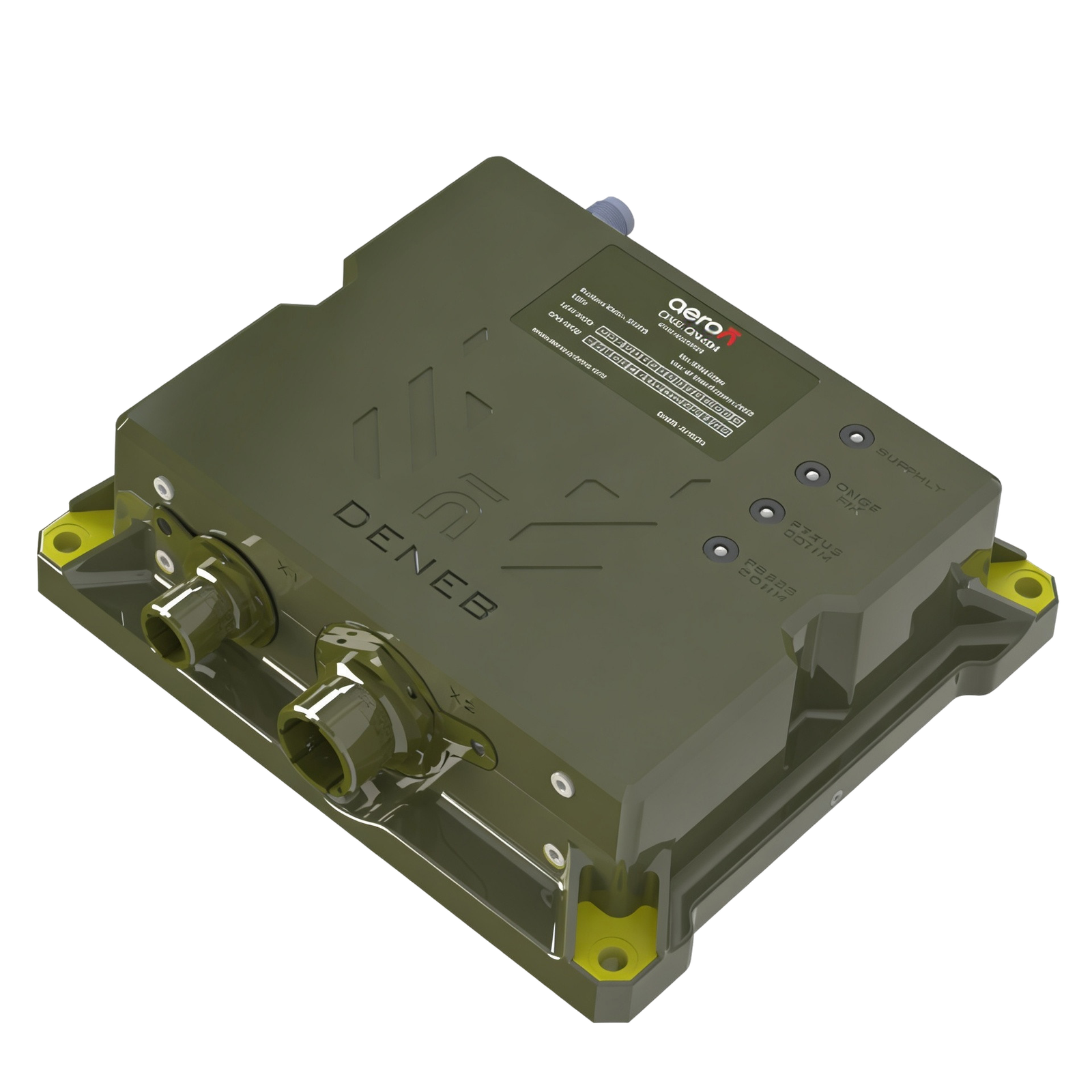
Deneb, Aeron’s Cold Oven inertial measurement unit, built for rugged land-system applications. (Image: Aeron Systems)
Eighteen years, 10,000 systems, 20 countries
Aeron Systems was founded in Pune in 2008 by Ashvani Shukla, its chief executive, and Abhijeet Bokil, its managing director and chief technology officer, with a vision of building globally competitive electronics from India. The company says it has now deployed more than 10,000 inertial systems and over 2,500 weather stations, serving more than 200 customers in over 20 countries. Its technologies are trusted by Hindustan Aeronautics, Bharat Electronics, the Defence Research and Development Organisation, the Indian Army and the Indian Navy, and the company says it supplies inertial navigation systems for demanding, high-dynamics fighter aircraft and trainer platforms.
The work has drawn serious backing. The Kalyani Group came on board as a strategic investor in 2019, and in December 2025 Aeron received the SIDM Champions Award (Special Jury) in the import-substitution category, presented by Defence Minister Rajnath Singh, for its contribution to self-reliance in inertial navigation. Today the company designs in Pune, manufactures at its plant in Talegaon, and runs sales and support from Bengaluru, Vijayawada and Sharjah.
The other half of the business: reading the weather
Navigation is only half of Aeron. Its second business builds industrial IoT weather monitoring — Class A weather stations for solar power plants, and environmental monitoring for agriculture, smart cities and industry. The same obsession with precise, reliable sensing that keeps an aircraft on course also tells a solar plant exactly how much sun is falling on its panels. The company says more than 2,500 of its weather stations are deployed worldwide.
What the new money builds
In September 2026, Aeron raised ₹45 crore in a pre-Series B round jointly led by Riverwalk Holdings and MGF-Kavachh (MountTech Growth Fund). The company says the capital will expand its manufacturing capacity for advanced inertial navigation systems, accelerate research and development, meet growing customer demand and strengthen its presence in international markets — scaling the cleanroom production of MEMS sensors, fibre-optic gyroscopes and defence avionics that sit at the heart of its products.
It is a quiet kind of strategic technology: no headlines, no spectacle, just a box that always knows where it is. As more of India’s aircraft, drones, ships and vehicles learn to fly, drive and sail on their own, that box is becoming one of the most important pieces of hardware in the country — and it is designed and made in Pune.
Keep reading: Built to Catch Drones Mid-Air: Inside ASTRA’s High-Speed Interceptor · A Jet Engine in Nine Months: Inside Nabhdrishti Aerospace, the Bengaluru Startup Building India’s Micro Gas Turbines · More Aerospace & Defense stories
Like stories like this? Add Exceptional Technology as a preferred source on Google to see more of our reporting in your search results and Discover feed.