


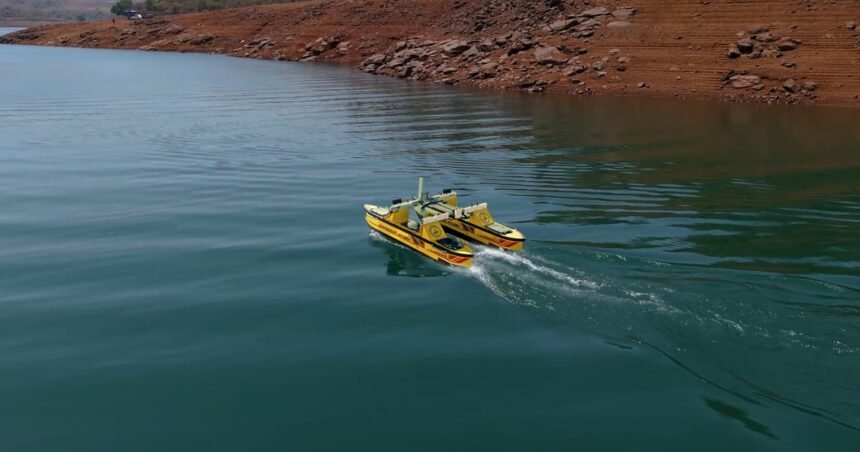
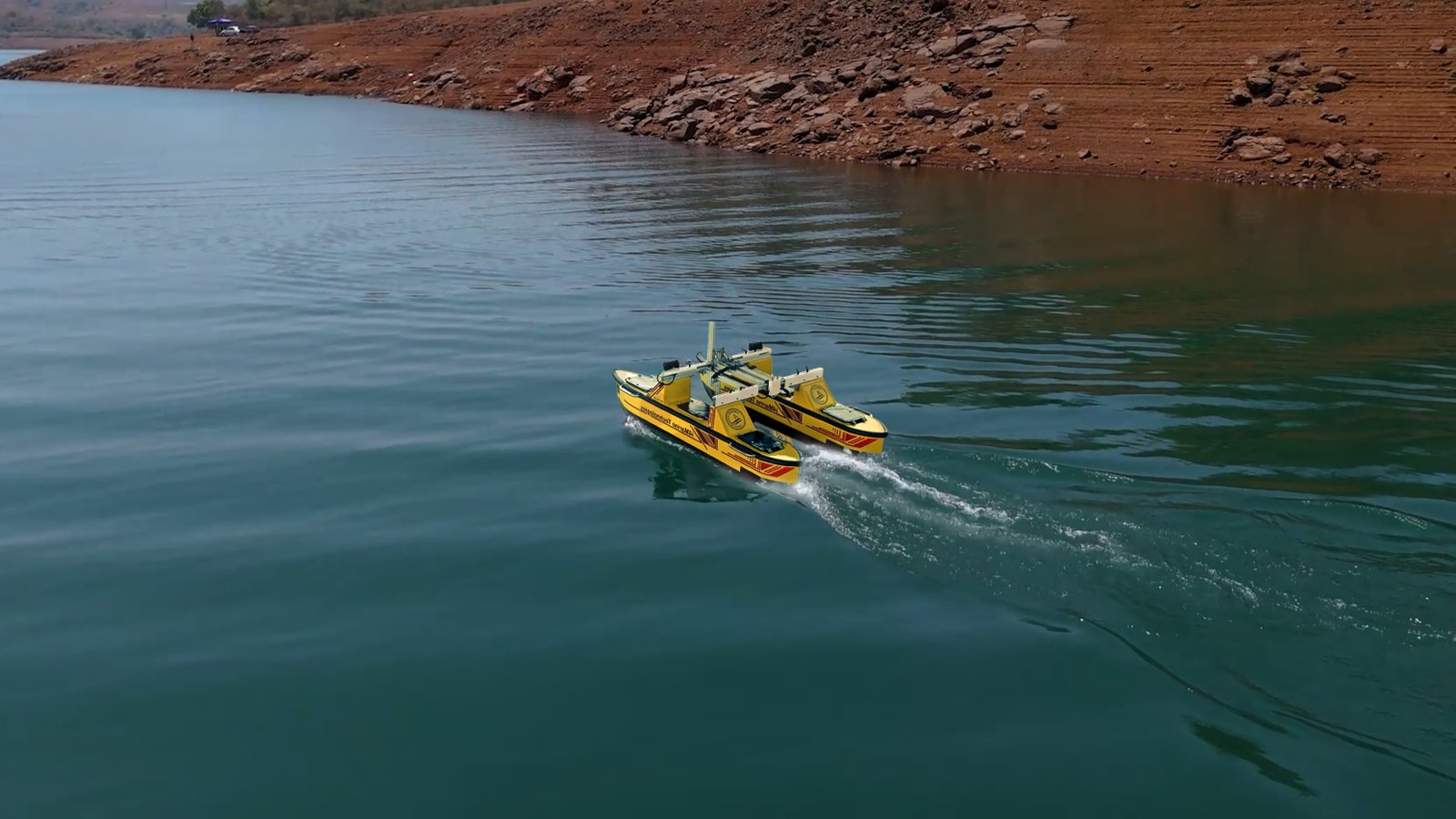
On a reservoir in Maharashtra, a bright yellow catamaran cuts across the water on its own, leaving a clean white wake behind it. There is no one aboard. No one steering, no one holding a rope, no one watching a depth gauge. Under the hull, a sonar is sweeping the lakebed, and every reading is streaming back to shore in real time. That is the AQUA-SCANNER, and it is the way a small Pune company called i4 Marine Technologies thinks India’s waters should be mapped.
i4 Marine builds unmanned boats and underwater robots for the jobs that happen on and under the water: surveying dams, rivers, ports and canals, inspecting ship hulls and dam walls, and watching over the water bodies India depends on. The company says its platforms are designed and built in India, from the hulls to the electronics, and they run on batteries, quietly, with no crew on board.
The survey that used to take a month
Mapping a dam or a reservoir the old way is slow, hands-on work. Survey teams carry instruments and laptops out on boats and take measurements point by point across the water, a process that can stretch to around 30 days for a large dam. i4 Marine’s answer is to send a robot instead.
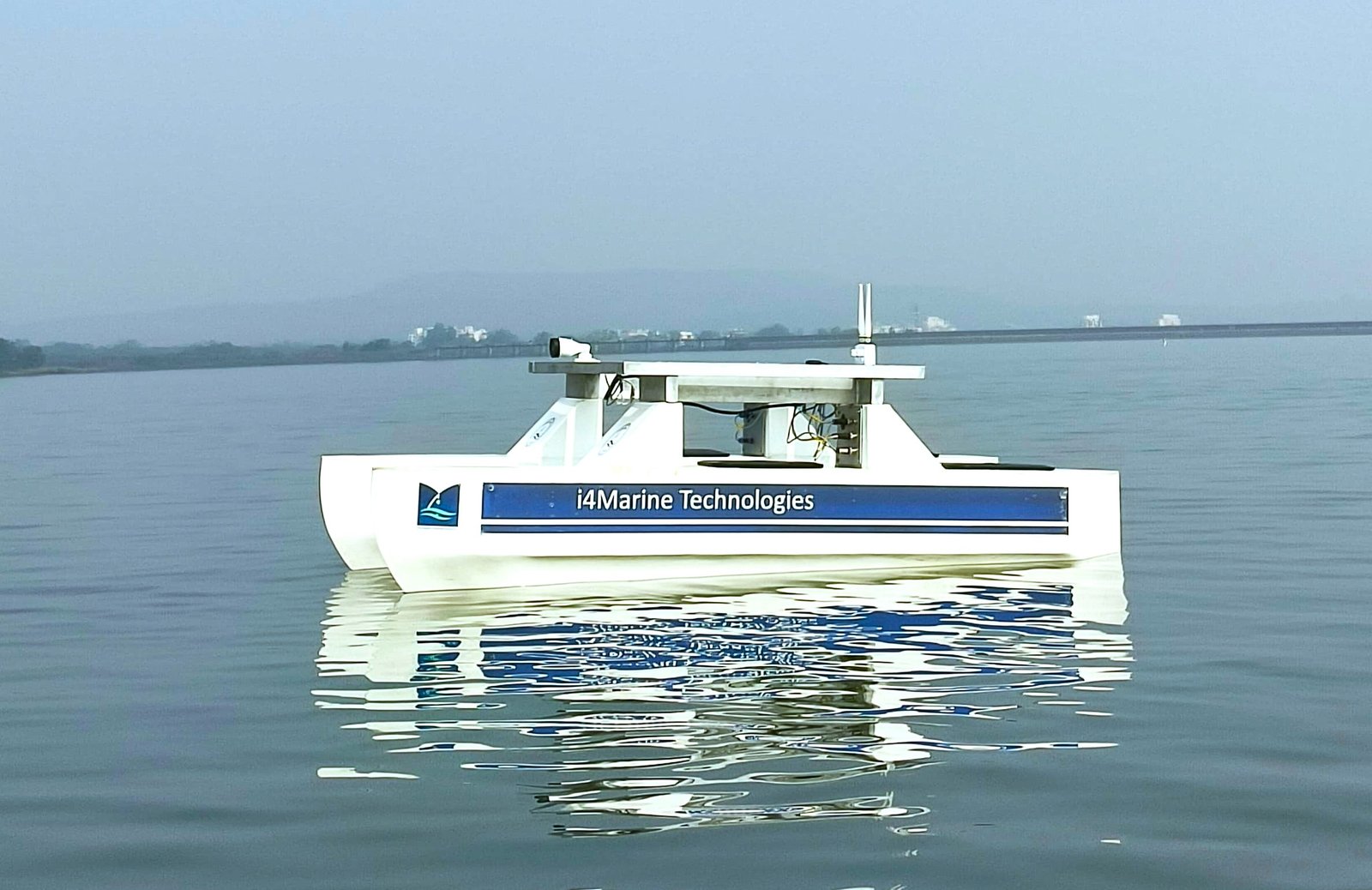
The AQUA-SCANNER is a twin-hull catamaran that sails itself along a pre-programmed path. The company says it carries sonar for bathymetry, GPS and inertial navigation to hold its course, a navigation camera, and a live data and video link to a ground station, so the survey team watches the lakebed take shape on screen as the boat works. The modular hulls come apart for transport and reassemble quickly at the water’s edge. The company lists a top speed of 6 knots, around four hours of endurance on its rechargeable lithium-ion battery, a 2 km operating range, and headlamps for night work. An echo sounder can be fitted for deeper survey work, and the boat can be driven by remote control up to 2,000 metres when a human wants the helm.
A fleet, not a single boat
The AQUA-SCANNER comes in two sizes, the 1000 and the 500, and it is only one part of the fleet i4 Marine is building. The AQUA-NAUT is its remotely operated underwater vehicle, a compact machine that dives to inspect dam walls, ship hulls and bridge piers, with AI-enhanced high-definition video streaming back to the operator. The Inf-USV is an inflatable unmanned surface vessel for work where a light, quickly launched boat is what the job needs.
Around those core platforms, the company is building for the wider water economy: smart buoys that gather oceanographic data and watch the environment, an electric coastal-survey catamaran, solar-electric ferries for green tourism and inland transport, and an autonomous feed dispenser for shrimp farms. It is also working on collaborative projects that pair surface and underwater robots, including a marsupial system in which an underwater vehicle rides out on a surface craft, and a long-endurance stealth craft for defence work.
More Read

Built by people who know the water
i4 Marine is led by chief executive Alok Mukherjee, a retired DRDO scientist and a pioneer in unmanned defence robotics. Around him is a founding team drawn from the worlds the company works in: Sunny Sebastian brings more than 35 years of boat building, Raja Mahbubani is an IIT Bombay alumnus working in electronics and unmanned systems, and Prakash Khanzode brings decades of industrial product design. The technical backbone is chief technology officer Dr Sanjeev Afzulpurkar, a former scientist at the National Institute of Oceanography.
The company launched its first product, the AquaScanner, in 2024 at the Conclave on Autonomous Technologies and Systems at ARDE in Pune, and won its first order soon after: an underwater remotely operated vehicle for ship-hull inspection. Its work is supported by innovation hubs including the IHFC Technology Innovation Hub at IIT Delhi, TIHAN and MIT-WPU, and it has signed memoranda of understanding with institutions including C-DAC Thiruvananthapuram, DIAT Pune and MIT College Pune. Its riverside research and development facility near Pune has its own jetty, boat shed, mechanical workshops and electronics labs, so the boats are tested on real water, a short walk from where they are built.
Why it matters
India has a 7,500-km coastline, vast inland waterways, and thousands of dams, ports and reservoirs that need to be measured, inspected and watched over. Much of that work is still done by hand, slowly, and sometimes dangerously. A small, quiet, battery-powered boat that can map a lakebed on its own, and a small robot that can swim down to look at a dam wall, turn that work into something faster, cheaper and safer.
The same platforms have a second life in coastal surveillance and defence, watching harbours and shorelines without putting a crew at risk. From dams to the open sea, i4 Marine is building the unmanned fleet that lets India know its waters, metre by metre, without ever sending a person out on the water to do it.
Keep reading: The Manta Ray That Watches the Ocean: Inside BlackVolt’s 45-Day AUV · No Dry Dock, No Divers: Inside Stingray Robotix’s Hull Crawler, the Robot That Cleans Ships While They Sail · More Shipbuilding & Maritime stories
Like stories like this? Add Exceptional Technology as a preferred source on Google to see more of our reporting in your search results and Discover feed.







