


Picture a helicopter hangar on a warship at sea. Inside the steel box sit a helicopter, aviation fuel and crew — and if a fire starts, there is nowhere to run and no fire engine to call. For decades the answer has been sailors with handheld equipment, racing the flames through the most dangerous minutes of the emergency. A Navi Mumbai engineering company asked a different question: what if the hangar could fight its own fire, in seconds, with nobody having to walk into it?
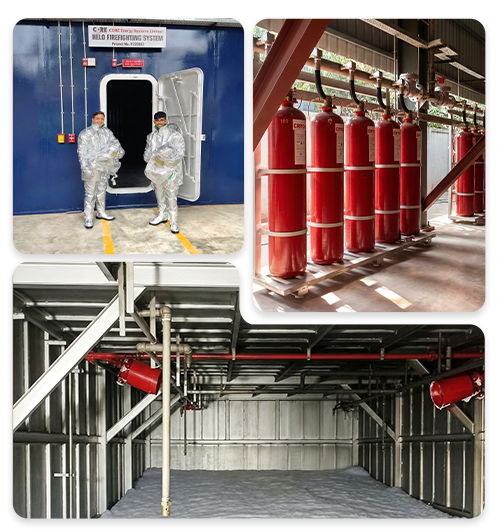
CORE Energy Systems’ answer is Helo FF, an indigenous automated fire-fighting system built for helicopter hangars on naval ships. The company says it detects a fire and discharges extinguishing medium across the entire hangar from the roof — automatically, and within ten seconds of detection.
Ten seconds from spark to suppression
Helo FF works as one automated sequence. A sensor network of flame, heat and IR-UV detectors watches the hangar, and the moment it identifies a fire, a controller discharges the extinguishing medium — AFFF foam or Halon — through a network of spray nozzles mounted at roof level, covering the full hangar area. The system is designed for fire scenarios involving aviation fuel, and it cools the affected areas as it suppresses the flames. The company says the response time from detection to discharge is within ten seconds.
That speed is the whole point. Hangar firefighting on ships has traditionally depended on crews applying the extinguishing medium with handheld equipment. Helo FF adds automated detection and full-area coverage to that practice, giving a faster first response, wider and more uniform coverage, and far less reliance on manual intervention in the opening moments of an emergency — the minutes when a hangar fire is decided.
Built for life at sea
A system that lives on a warship has to survive the warship. CORE engineered Helo FF around ship motion, vibration, restricted installation spaces and maintainability, and every stage of its development was approved by the Indian Register of Shipping. The same engineering covers the company’s wider fire-safety family: foam-based systems with tanks, pumps and proportioner nozzles for rapid flame knockdown, clean gas-based systems that leave no residue and let critical assets return to service quickly, and deck-integrated systems for offshore helidecks.
The recognition has followed the engineering. Helo FF received the Special Jury Award at the SIDM Champions Awards 2026, in the Import Substitution category for mission-critical parts, sub-systems and systems, presented by the Society of Indian Defence Manufacturers in New Delhi on 9 October 2026. The proposal is now to be progressed with Mazagon Dock Shipbuilders as the defence public sector partner under the Make-I framework, putting the system on the path to India’s warships.
More Read

“By combining automated fire detection with rapid, uniform suppression across the helicopter hangar, this indigenous system enhances crew safety while reducing dependence on manual intervention during a critical fire emergency,” says P. Padmanabhan, Associate Director – Design & Engineering at CORE Energy Systems. “The SIDM recognition validates India’s growing capability to design and engineer mission-critical naval safety systems indigenously.”
The company behind it
CORE Energy Systems Limited is a high-technology engineering and EPC enterprise headquartered in Navi Mumbai, serving nuclear energy, defence, aerospace, clean energy and infrastructure. Its defence work runs wider than Helo FF: the company holds a technology transfer agreement from DRDO and its Centre for Fire, Explosive and Environment Safety for advanced magazine fire-fighting systems for warships, and it runs a dedicated research centre, CETRA, at IIT Bombay’s ASPIRE Research Park, where industry engineers work alongside academics on nuclear, defence and clean-energy problems. More than 500 engineers work across the company’s teams.
The same architecture has somewhere else to go, too. With modifications, the company says Helo FF can be adapted for aircraft hangars at airports, maintenance, repair and overhaul facilities and other aviation installations, where large enclosed volumes, high-value aircraft and fuel loads present a comparable fire-protection requirement — in India and overseas.
A warship’s helicopter hangar is one of the most unforgiving rooms in the Indian Navy: fuel, aircraft and people packed into steel, moving on the sea. CORE’s Helo FF turns that room into one that can look after itself — sensing a fire, and answering it in ten seconds, with a system designed, engineered and manufactured in India.
Keep reading: The Robots That Climb Ships: Inside BlueForge’s Fleet Cleaning the World’s Hulls · The Boat That Sails Itself: Inside i4 Marine’s Robot Fleet Mapping India’s Waters · More Shipbuilding & Maritime stories
Like stories like this? Add Exceptional Technology as a preferred source on Google to see more of our reporting in your search results and Discover feed.







