


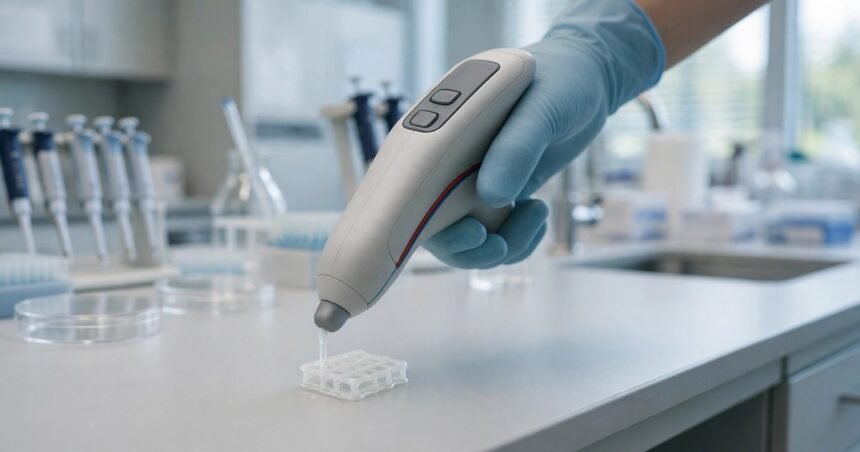
A bad burn leaves a surgeon with a cruel arithmetic problem. Skin grafts work, but they need healthy skin taken from somewhere else on the patient’s own body — and when burns cover a large part of the body, there simply is not enough healthy skin left to harvest. A startup from Rourkela in Odisha is building a different answer: a pen-shaped printer that lays living material directly onto the wound, exactly where it is needed.
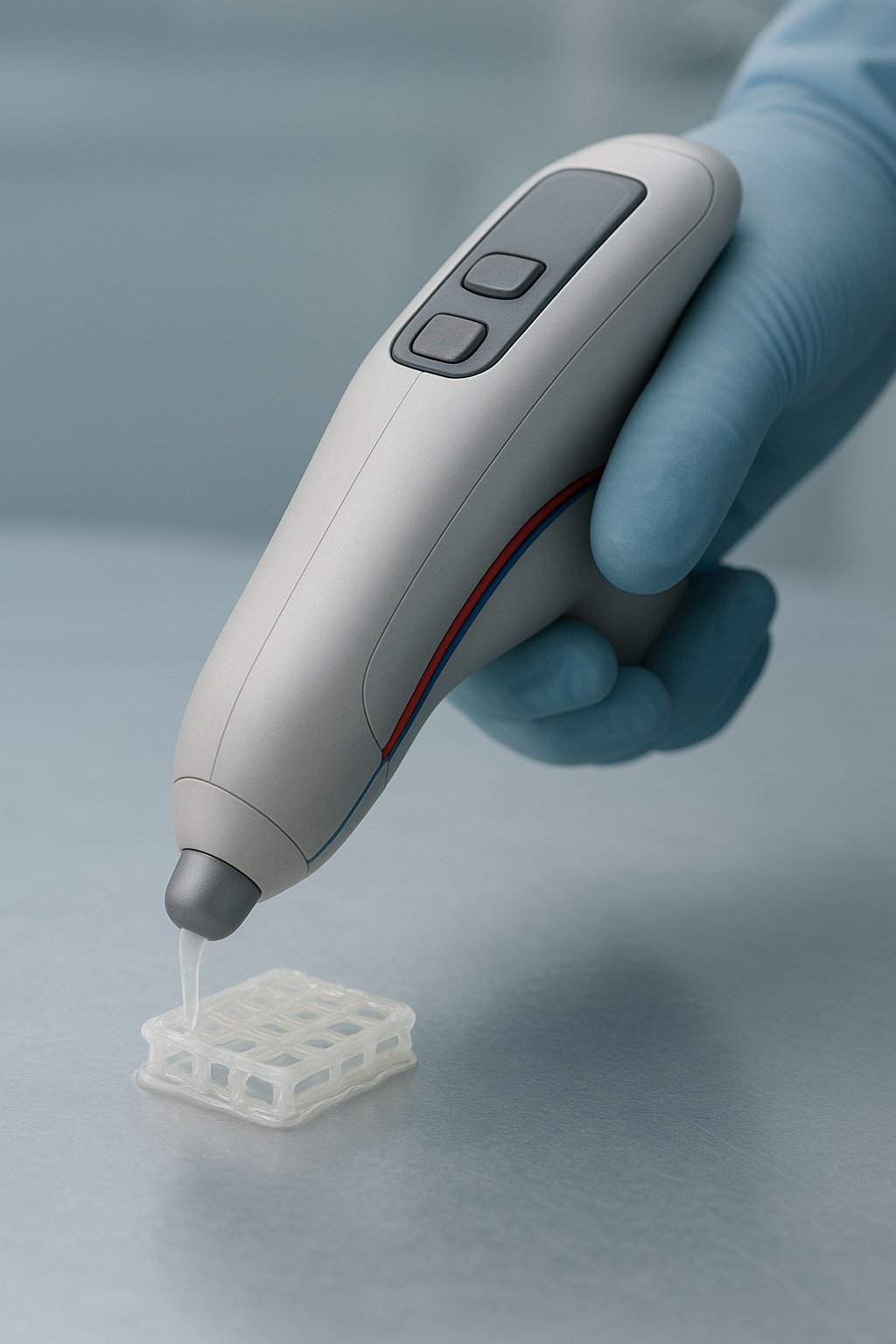
Quixotix Bioprinting, a spinout from NIT Rourkela, has spent the last two years turning that idea into patented materials and a working handheld device. Its bio-inks are made from natural, body-friendly ingredients, and its printer — called Clutch 1.0 — is designed to be held in a surgeon’s hand and used right at the operating table.
An ink made to become bone
The story starts with a bio-ink. The NIT Rourkela team, led by Prof Devendra Verma of the Department of Biotechnology and Medical Engineering, developed a natural bio-ink from chitosan, gelatin and nanohydroxyapatite — three materials the body already knows how to live with. The ink stays liquid at room temperature and turns into a gel the moment it meets body temperature and pH, which means it can be printed directly onto an injury instead of being printed separately and implanted later.
That trick matters because bone defects are rarely neat shapes. The team says the ink suits irregularly shaped defects and supports stem cells growing into new bone, with particular promise for reconstructive surgery of the skull and face, where precise repair is everything. The research was published in the journals Biomaterials Science and Carbohydrate Polymers, and the technology was granted Indian patent number 562791 on 18 March 2025. The work was funded by the Department of Health Research, Government of India.
A second ink, for bone and cartilage
The team did not stop at one ink. A second bio-ink, built from bovine serum albumin, sodium alginate and polyelectrolyte complexes of gelatin and chitosan, was designed for high shape fidelity — it holds its printed shape while still supporting the cells inside it. In laboratory studies the material mimicked the extracellular matrix of bone tissue, and scaffolds containing 2% of the gelatin-chitosan complex achieved more than 90% cell viability, with the team reporting potential for both bone tissue formation and collagen synthesis. The findings were published in the International Journal of Biological Macromolecules, and a second patent for the technology was granted in March 2026.
The research keeps moving. A 2026 paper in Carbohydrate Polymers from the same group tested a thermosensitive chitosan bio-ink carrying bone marrow stem cells, with self-assembled nanofibrous aggregates and nanoparticles added to strengthen the printed scaffolds — again with cell viability above 90%. Each paper and patent adds another piece to a library of printable materials that behave like real tissue.
More Read
Printing where the injury is
Materials are only half the story. The other half is the printer itself. Clutch 1.0 is a handheld bioprinter the company describes as bridging science and surgery: instead of printing a scaffold in a lab and carrying it to the patient, a clinician holds the device over the wound and deposits the bio-ink directly onto it, following the wound’s own contours and depth.
The company is shaping the device around the hardest cases first. In June 2026 the Quixotix team visited the National Burns Centre at Airoli, including its skin bank, and met burns surgeon Dr Sunil Keswani to study how burns are managed in India today — the kind of groundwork that decides whether a lab device ever becomes a surgical tool.
From a Rourkela lab to the clinic
Quixotix Bioprinting Pvt Ltd was incorporated in December 2023, founded by Prof Verma with research scholars Tanmay Bharadwaj and Shreya Chrungoo, and is based at NIT Rourkela’s Foundation for Technology and Business Incubation. The company is also an incubatee at the Foundation for Science Innovation and Development at IISc, and a grant winner under the Healthcare Incubation Program of NSRCEL at IIM Bangalore.
The road ahead runs through animal studies and clinical validation, with a good-manufacturing-practice production process being built for trials. It is a long road — regenerative medicine always is — but the pieces are falling into place in Rourkela: patented inks that behave like tissue, a printer that fits in a hand, and a team that has spent years making the science work before asking a surgeon to trust it.
From a NIT Rourkela laboratory to the burns ward, Quixotix Bioprinting is working toward a future where the treatment for a wound is printed onto the wound itself — one layer of living material at a time.
Keep reading: The Chemicals Inside Every Chip: Inside Shivtek Spechemi’s Bid to Supply India’s Fabs · The Urban Mine: Inside Neo Seekermetals, the Hyderabad Company Turning Dead Batteries Into Battery-Grade Metals · More Chemicals, Materials & Life Sciences stories
Like stories like this? Add Exceptional Technology as a preferred source on Google to see more of our reporting in your search results and Discover feed.







