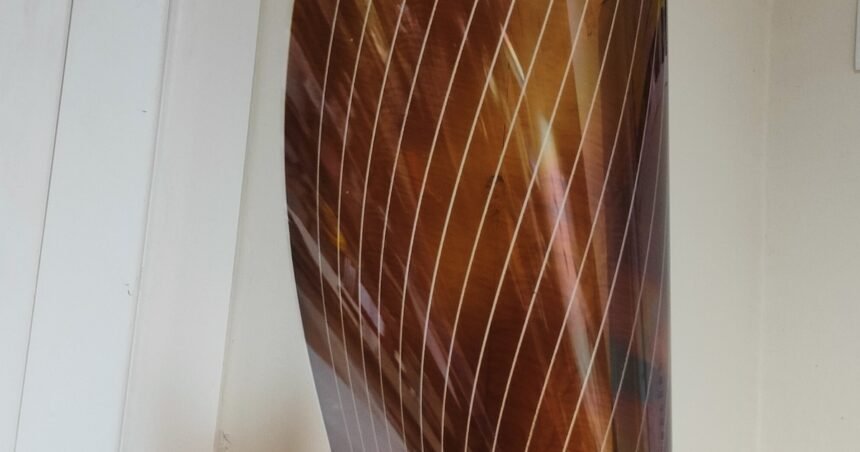
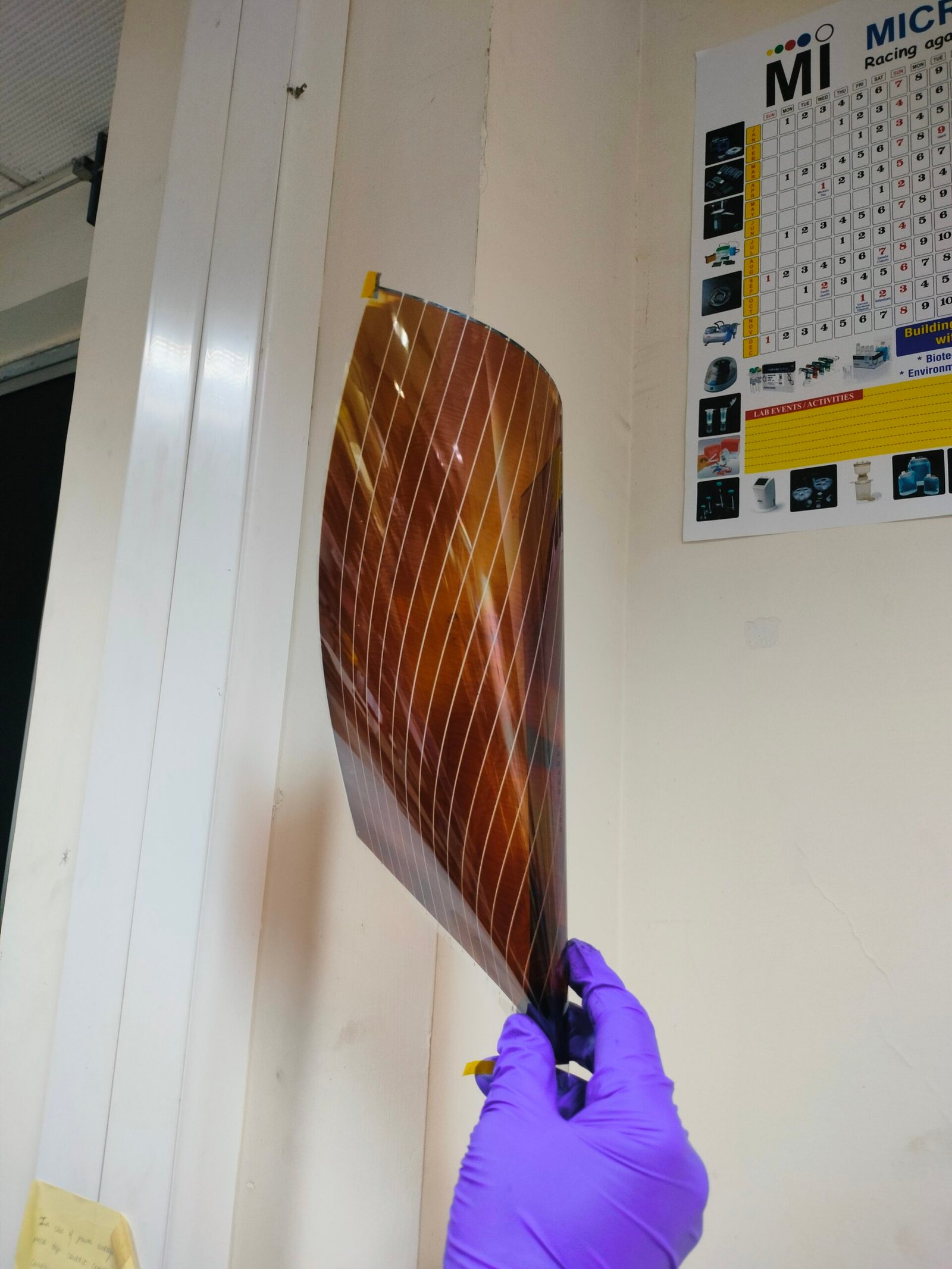
Picture a solar panel you can roll up like a poster, bend around a curve, or stick onto a surface that was never built to hold glass. In a laboratory at the Indian Institute of Science in Bengaluru, that panel already exists. It is a sheet of amber-brown film, thin enough to flex in a researcher’s gloved hand, and it turns sunlight into electricity. The company behind it is ABX3 PV, and it is building India’s next generation of solar technology from the crystal up.
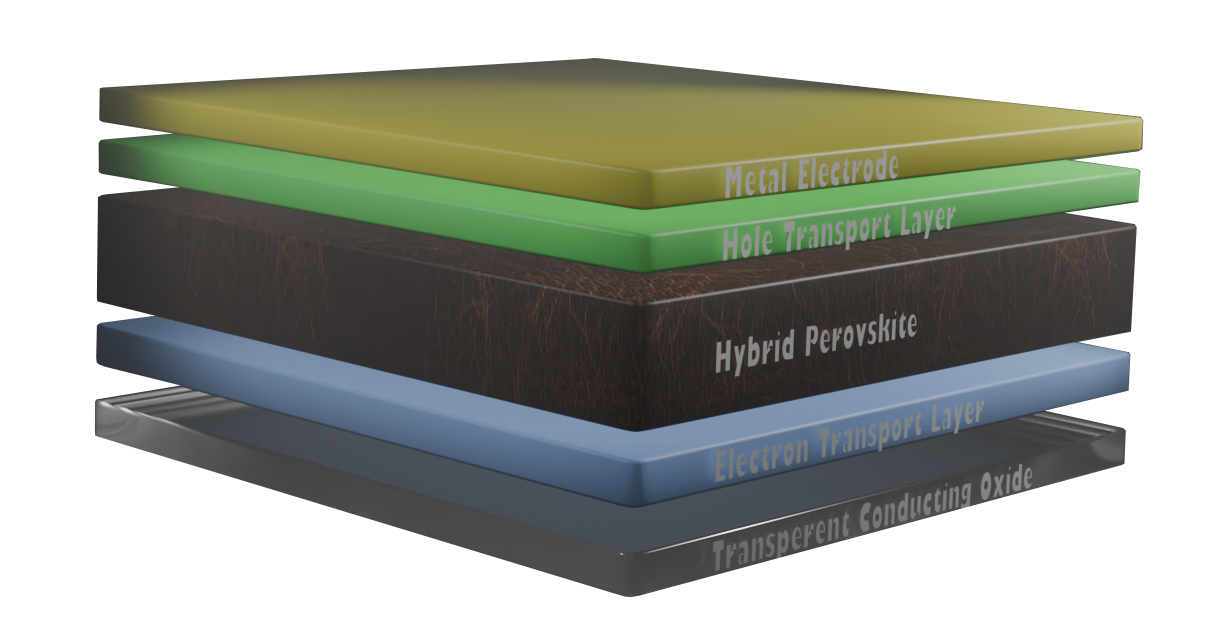
ABX3 PV works with perovskite, a family of materials named after a crystal structure written as ABX3. Swap the ingredients at each corner of that crystal and the material changes its behaviour, which is what makes perovskites so adaptable. The company, founded in 2023 and incubated at IISc’s Foundation for Science Innovation and Development, builds perovskite solar modules on rigid sheets and on flexible substrates, and describes itself as an end-to-end technology provider, developing the process, the equipment and the cell design together.
A panel that bends
The headline achievement is a flexible module. In July 2025, ABX3 PV showed the Union Minister for New and Renewable Energy, Shri Pralhad Joshi, what the company calls India’s first stable, A4-sized flexible perovskite solar cell module, built for lightweight, portable and curved-surface applications. The minister called startups like ABX3 PV the true torchbearers of India’s renewable energy revolution, and the visit marked a coming-out moment for a company that had been quietly building inside IISc’s Centre for Nano Science and Engineering.
Alongside the flexible module, the team demonstrated a working prototype of its M12 tandem module, a device that stacks multiple light-absorbing layers so each catches a different slice of sunlight. The company says the tandem’s preliminary efficiency figures surpass the current global state of the art, and tandem architecture is where the field’s biggest gains now live, with perovskite cells pushing past 26% efficiency in laboratories around the world.
Why perovskite
Silicon has carried solar power for decades, but it is heavy, rigid and energy-hungry to manufacture, with wafers processed at temperatures above 1,000°C. Perovskite films can be processed at a fraction of that heat, printed onto flexible sheets, and tuned to catch different colours of light. The result is a solar cell that is lighter, cheaper to make and able to go where glass panels cannot: curved rooftops, building facades, vehicles, drones and satellites.
ABX3 PV’s own numbers show the progress. The company has demonstrated a stable lab-scale perovskite cell with efficiency greater than 24%, a minimodule above 17%, and scalable coating techniques for A4-size substrates. It has already produced a 15 W panel, and it is now scaling up to a 500 kW production line aimed at drone and satellite applications, where every gram of weight matters and a panel that rolls up is worth more than one that does not.
More Read

From the lab to a production line
The step from laboratory to factory is where most solar startups stall, and ABX3 PV is building for it deliberately. The company says it holds letters of intent worth more than $11 million, and at Bharat Innovates 2026 in Nice, France, it signed two agreements with leading European partners to accelerate manufacturing, improve device stability and expand global collaboration, showcasing its technology to the Union Minister of Commerce and Industry, Shri Piyush Goyal, and to the Principal Scientific Adviser, Prof. Ajay Kumar Sood.
Back home, ABX3 PV hosted the first international workshop on best practices in perovskite fabrication and scale-up with IISc’s Centre for Nano Science and Engineering in March 2026, bringing researchers, industry experts and students together around the single hardest question in the field: how to take a brilliant lab device and make a million of them.
Where the panels go
The company’s first markets are the ones silicon serves worst. Flexible modules can wrap onto curved surfaces and moving things, from rooftops and building-integrated panels to electric scooters, aircraft and indoor devices that harvest light where they sit. The satellite and drone work is the sharpest edge of that story: a solar panel that is light, flexible and efficient is exactly what a small satellite or a long-endurance drone needs, and ABX3 PV is aiming its production line squarely at that demand.
The team behind it
ABX3 PV was founded by IISc scientists Dr Laxman Gouda, Prof. Aditya Sadhanala, Prof. Sushobhan Avasthi, Prof. Praveen C Ramamurthy and Dr V S Gangadhara Rao, a team that spans materials science, device physics and manufacturing. Their experience runs from the laboratory bench to the factory floor, and the company’s pitch is that India should not just install solar panels, it should invent the next kind of panel and build it at home.
Why it matters
India imports most of its solar cells, and the panels on Indian rooftops are overwhelmingly made of silicon from elsewhere. A homegrown perovskite technology changes that equation twice over: it gives India a solar cell it can manufacture itself, and it gives the world a lighter, bendier panel that can go places silicon cannot. From a garage-sized lab at IISc to a ministerial visit, European partnerships and a production line on the way, ABX3 PV is turning a crystal structure into a roll of sunlight.
Keep reading: The Battery That Breathes: Inside Hindustan Zinc and IIT Madras’s Zinc-Air Three-Wheeler · The Motorcycle That Runs on Hydrogen: Inside Hydrovert Energy’s Fuel-Cell Powertrains · More Energy & Power stories
Like stories like this? Add Exceptional Technology as a preferred source on Google to see more of our reporting in your search results and Discover feed.