


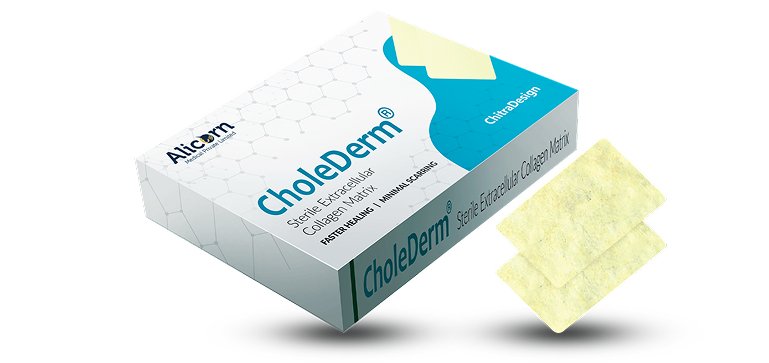
For the millions of Indians living with a wound that will not heal — a diabetic foot ulcer that has stayed open for years, a burn that keeps breaking down, a bedsore that no dressing seems to close — the options have long been expensive, imported, and out of reach. A team in Thiruvananthapuram spent eighteen years working on a different answer, and they found it in the most unlikely place: the gall bladder of a farm animal.
A scaffold from an unlikely source
CholeDerm is a thin, lyophilised sheet of extracellular matrix — the collagen-rich scaffolding that holds living tissue together — recovered from the gall bladder of farm animals and cleaned of every cell that could trigger rejection. The company says its proprietary PrisTINE process uses no enzymes and no detergents, preserving the natural architecture of the matrix along with 154 biomolecules the company says are essential to healing. Laid over a wound, the sheet gives the body’s own cells a structure to climb across: faster re-epithelialisation, new blood vessels, organised tissue growth — and, the institute says, minimal scarring.
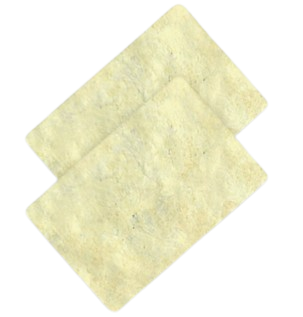
Eighteen years from lab bench to hospital shelf
The science began in 2008, when Prof. T. V. Anilkumar, a veterinary pathologist at the Sree Chitra Tirunal Institute for Medical Sciences and Technology (SCTIMST) in Thiruvananthapuram, and his team in the Division of Experimental Pathology began turning the extracellular matrices of farm-animal organs into medical devices. The work is backed by at least 25 peer-reviewed international papers and 10 Indian patents, the institute says. In 2017 the technology moved to Alicorn Medical, a startup incubated in SCTIMST’s own TIMED facility, which set up commercial production in Kerala and registered the product as CholeDerm R. In 2023 India’s drug regulator, the CDSCO, approved it as a Class D medical device — the highest-risk category under the Medical Device Rules, 2017 — making it, the institute says, the first indigenously developed animal-derived tissue scaffold to clear every statutory requirement for commercial production. The product was formally launched in January 2026.
Already closing wounds that would not close
CholeDerm is a sterile, ready-to-use acellular dermal matrix for chronic and non-healing wounds, post-debridement wound beds, diabetic ulcers, pressure ulcers, burns and surgical wounds, the company says. And it is already at work in clinics. At DY Patil Medical College in Pune, dermatologist Dr Vishwajit Singh and his team have used it for over a year on chronic skin ulcers in diabetes and leprosy patients. He told PTI his team treated more than 20 patients with ulcers that had lasted from four months to 17 years — and CholeDerm led to complete closure in all cases. A single application is reviewed after seven days, where conventional dressings need daily changing. The institute expects the treatment to cost around Rs 2,000, against roughly Rs 10,000 for comparable imported options.
Waste into a healing product
There is a second, quieter elegance to the story. A farm animal’s gall bladder is usually slaughterhouse waste. SCTIMST’s process turns it into a high-value medical product — and, the institute says, additional income for livestock farmers. The sheets are ETO-sterilised, packed in dual peel-open pouches and stored at room temperature, so they travel easily to small hospitals far from big-city supply chains. Alicorn is already building on the platform: UroDerm from urinary-bladder matrix in large A4-sized sheets, a thicker bovine version called CholeDerm B for extensive wounds, an anti-biofilm PHMB variant, a granule form for deep wounds, and an in-situ gel. The same matrix is even being studied for the heart — the team’s research, published in Comparative Medicine, showed the scaffold mitigating fibrotic scarring in rats after an experimental heart attack. International regulatory approvals are next on the company’s agenda.
A wound that will not heal steals months and years from a person’s life, and in India it has too often been a problem only the wealthy could afford to treat properly. CholeDerm began as an eighteen-year research programme into a discarded organ — and it has become a made-in-India scaffold that closes wounds in a week, at a price a small-town hospital can carry. That is what Indian engineering looks like when it is aimed at the people who need it most.
More Read

Keep reading: The Microbes Eating India’s Dye: Inside Greenathon, the Jaipur Startup Cleaning Textile Wastewater Without Chemicals · Six Minutes to Save a Heart: Inside Tricog Health, the Bengaluru Startup Turning Every Clinic Into a Cardiac Centre · More Chemicals, Materials & Life Sciences stories
Like stories like this? Add Exceptional Technology as a preferred source on Google to see more of our reporting in your search results and Discover feed.







