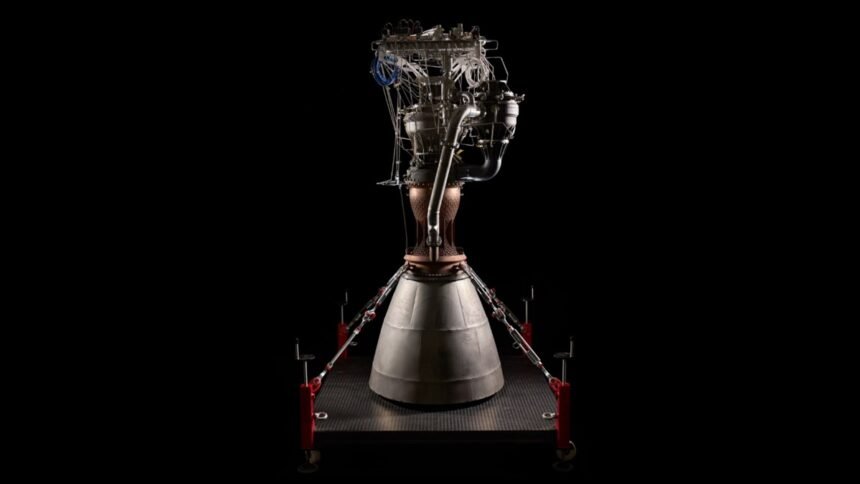
On 7 August 2026, a Bengaluru startup pulled the cover off what may be the most ambitious rocket engine ever built in India. EVEREST, from the two-year-old Astrobase Space Technologies, is an 800 kN full-flow staged combustion (FFSC) engine running on liquid oxygen and methane — the same fiendishly complex engine cycle that powers SpaceX’s Raptor, and one of the hardest problems in rocket propulsion. If it works as designed, India would become only the fourth country to build one. There is a catch the headlines sometimes skip: EVEREST has not been hot-fired yet. What was unveiled is a fully built, fully integrated engine awaiting its trial by fire.
Why full-flow staged combustion is the hard problem
Most rocket engines waste a little propellant: they burn a small amount just to spin the turbopumps, then dump the exhaust overboard. A full-flow staged combustion engine pushes all of the fuel and all of the oxidiser through separate preburners first, using the hot gas to drive the turbines before everything flows into the main combustion chamber. Nothing is thrown away, the turbines run cooler, pressures can go higher, and the engine can be reused many times. The price: you must handle superheated, oxygen-rich gas that wants to eat through metal, at pressures that punish any design flaw. Only the Soviet Union, the United States and China have ever tested an FFSC engine; only SpaceX’s Raptor has actually flown one.
EVEREST is an 80-tonne-class engine — 800 kilonewtons of thrust, roughly eight times the power of the upper-stage engines on ISRO’s workhorse launchers. It is designed for a specific impulse around 340 seconds, a 50–110% throttle range for precise landing control, and — per the company — more than a hundred flights per engine. Its core components were additively manufactured on what the company describes as India’s largest industrial metal 3D printer, inside a 46,000 sq ft Bengaluru factory — additive manufacturing at a scale Thrustworks also bets on for its ANYA engine.
Unveiled, not yet fired
This is the distinction the coverage must keep straight. The August unveiling — attended by IN-SPACe’s Rajeev Jyoti, Indian Space Association DG Lt Gen A.K. Bhatt and astronaut Shubhanshu Shukla — showed a complete, integrated engine. But the full-engine hot-fire, the test that proves the design survives real combustion, is still ahead, expected in the coming months. What Astrobase has demonstrated so far: a successful sub-scale hot-fire on the first attempt in September 2025, and high-speed turbopump trials in January 2026. Those are genuine milestones — but they are not the same as lighting the full 800 kN engine.
EVEREST is India’s first privately built full-flow staged combustion engine — unveiled in August 2026, with its full-scale hot-fire still to come.
The company behind the engine
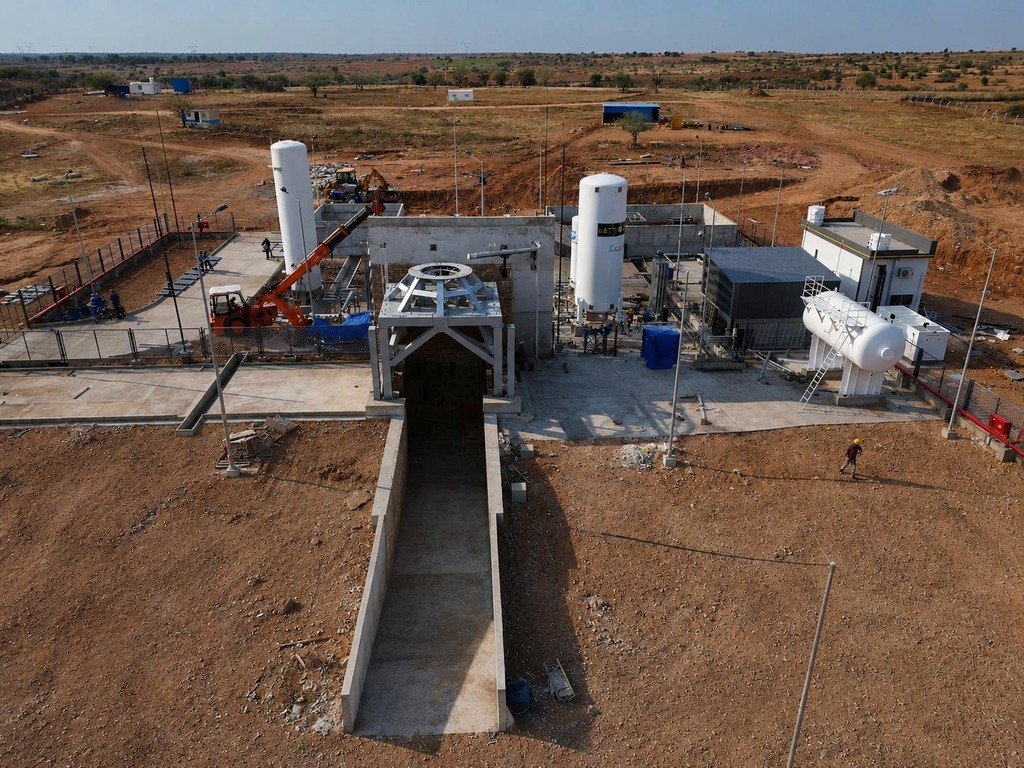
Astrobase was founded in 2024 by Devakumar Thammisetty, a former ISRO propulsion scientist, and Neeraj Khandelwal, co-founder of crypto exchange CoinDCX — an unusual pairing of deep propulsion expertise and startup capital. The company is developing a 21.5-acre test site near Anantapur in Andhra Pradesh, built for high-thrust engine testing, and says its infrastructure is designed to eventually produce up to fifty engines a year. It is a recipient of IN-SPACe’s Technology Adoption Fund, announced in June 2026.
The company’s framing is bold: India the fourth country after Russia, the US and China to build an FFSC engine, and Astrobase the fourth commercial company globally to attempt one. Those are company claims, repeated across the launch coverage, and worth attributing as such. The stated roadmap: full-engine hot-fire, then vehicle integration, with a first orbital launch targeted for the end of 2028 and a partly reusable rocket flying seven EVEREST engines.
What success would mean
If EVEREST fires and flies, it changes India’s launch economics. A reusable, high-efficiency 800 kN engine is the building block of medium and heavy-lift reusable rockets — the class of vehicle India currently lacks. The company’s aspirational talk of $300-per-kg launch costs by the early 2030s should be read as exactly that — aspirational. But even the attempt signals something real: private Indian capital is now funding propulsion at the frontier, not just small launchers and satellites. SpaceFields is attacking the same frontier from the solid-propellant side.
Key takeaway
EVEREST is a bet placed before the cards are dealt: a fully built FFSC engine that has not yet faced its hot-fire. That honesty matters more than hype — if the engine lights and holds together, Astrobase will have done what only SpaceX has done commercially. Until then, it is the most interesting engine in India that hasn’t fired yet.
What is a full-flow staged combustion engine?
A rocket engine cycle in which all of the fuel and all of the oxidiser pass through preburners to drive the turbopumps before entering the main combustion chamber. Nothing is wasted, turbines run cooler, and the engine can be deeply reused — but handling hot oxygen-rich gas makes it extremely difficult to engineer.
Has EVEREST been tested?
Partially. Astrobase completed a sub-scale hot-fire in September 2025 and turbopump trials in January 2026. But the full 800 kN engine unveiled in August 2026 has not yet been hot-fired — that test is expected in the coming months.
Who founded Astrobase Space?
Devakumar Thammisetty, a former ISRO propulsion scientist, and Neeraj Khandelwal, co-founder of crypto exchange CoinDCX. The company was founded in 2024 and is based in Bengaluru.
What is EVEREST’s roadmap?
Full-engine hot-fire testing, then vehicle integration, with a first orbital launch targeted for the end of 2028. The company plans a partly reusable rocket powered by seven EVEREST engines, and says its Anantapur facility is designed for up to fifty engines a year.
More Read

Sources & further reading
- Astrobase Space official website — The company’s official site with programme details
- Astrobase develops India’s first privately-built 800 kN FFSC engine — Unveiling report with engine specifications
- Astrobase’s EVEREST engine: chasing rocket science’s hardest problem — Technical deep-dive, notes the engine hasn’t hot-fired yet
- Interesting Engineering: Meet Astrobase’s EVEREST — Video explainer on the FFSC architecture