


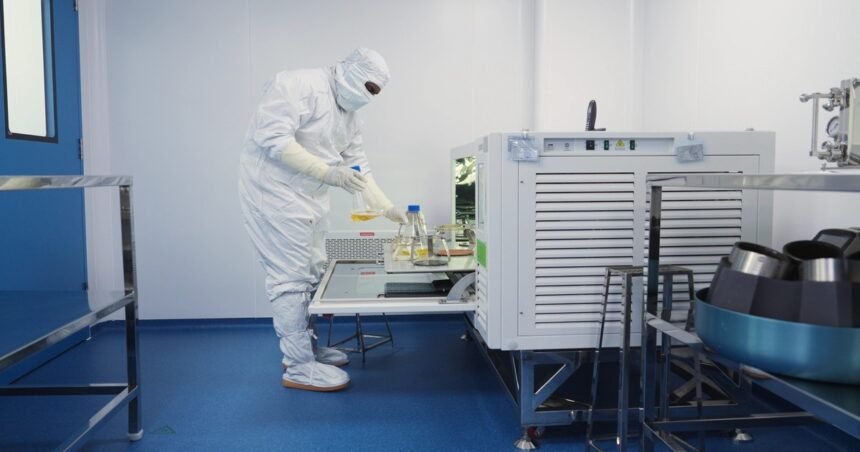
Most cancer medicines are made for thousands of people at once. The medicine PopVax is building in Hyderabad is made for one person, and one person only — designed from the genetic code of that patient’s own tumour, manufactured in a facility built for exactly that job, and delivered in weeks, not years. On 30 October 2026, the Hyderabad biotechnology company unveiled the RNA Foundry, an integrated research, development and manufacturing facility for personalised cancer vaccines, built in collaboration with Stochastic Sciences.
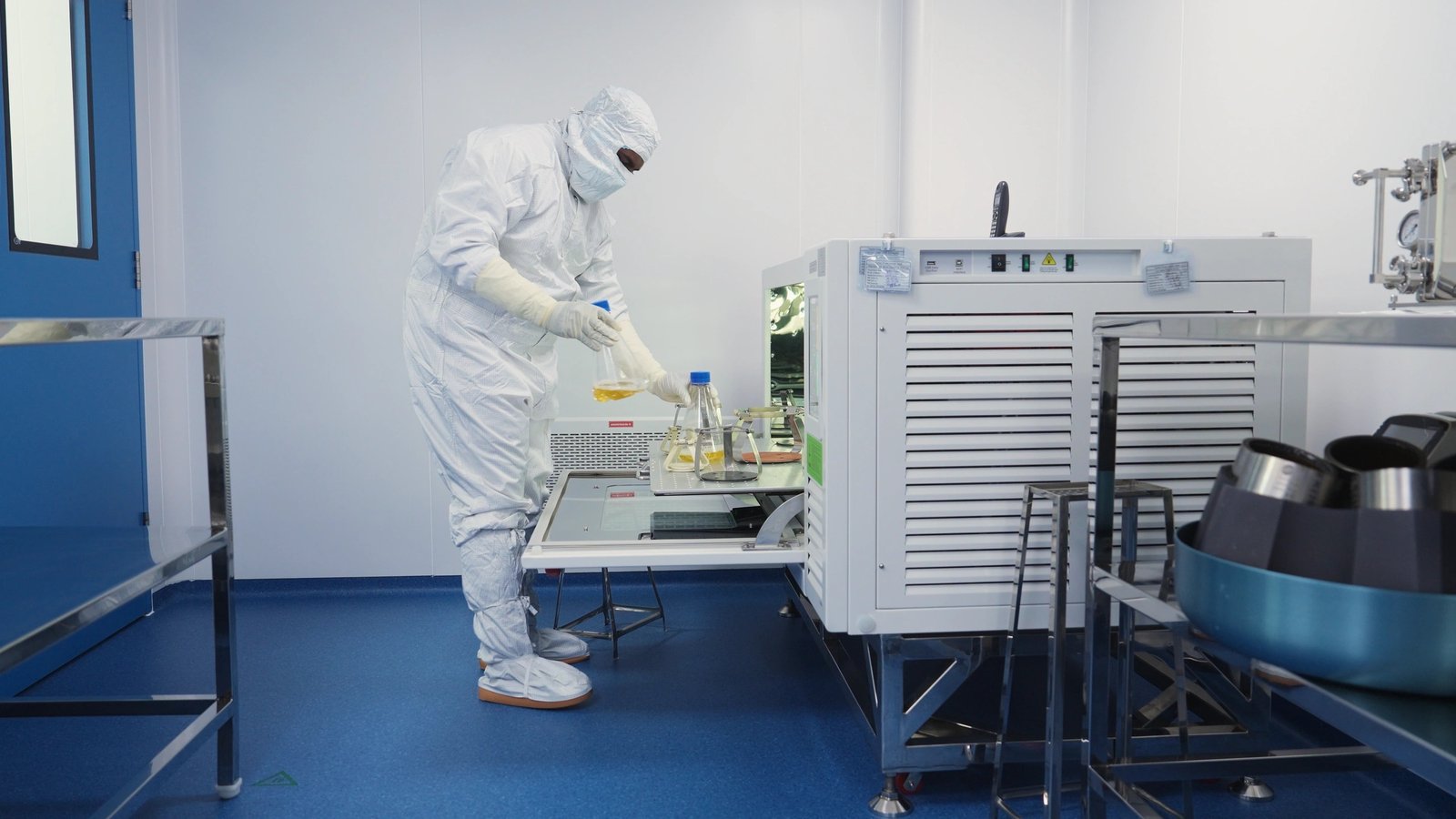
Inside the RNA Foundry: an operator loading flasks into a shaker. (Image: PopVax / RNA Foundry)
A factory for vaccines made one at a time
PopVax, founded in late 2021 by Soham Sankaran, is a clinical-stage biotechnology company built around a single idea: that India should design original RNA medicines, not just manufacture other people’s. The company says its Hyderabad facility is its answer to the hardest part of that idea — making RNA medicines to a high standard of quality, at speed, for individual patients. The RNA Foundry is a GMP-capable facility, designed to meet global Good Manufacturing Practice standards, and the company says it can run around the clock to produce personalised RNA vaccines.
The ambition is deliberately large. The company says the Foundry has the capacity to make more than 100 personalised cancer vaccines over the next 12 months, and it is inviting patients and their doctors to send cancer type, stage and tumour sequencing details so a vaccine can be designed case by case. Biocon executive chairperson Kiran Mazumdar-Shaw congratulated Sankaran on the launch, calling it a cutting-edge endeavour — a fitting welcome, given that her team developed India’s first novel cancer therapies two decades ago.
How a tumour becomes a vaccine
The process starts where every patient’s story is different: the tumour itself. The team sequences the genetic material of a patient’s tumour to find its mutations, then uses machine learning to pick out neoantigens — the abnormal proteins, or fragments of proteins, that a cancer cell produces and a healthy cell does not. Those neoantigens are the targets. PopVax then designs an mRNA sequence carrying the instructions for the body to produce those selected antigens, so the immune system learns to recognise and attack cells carrying them.
More Read

That design work is the company’s home ground. PopVax says it combines AI-powered protein design with molecular biology, using frontier AI models together with open-source tools that predict how a protein fragment will be presented to the immune system and how strongly it will trigger a response. Once a sequence is agreed, the Foundry produces it in ISO 7/8 cleanrooms, encapsulates it in the company’s lipid nanoparticle formulation, fills it into vials, and runs a full battery of quality-control tests — from RNA identity by sequencing to sterility testing — before shipping it with manufacturing records and a certificate of analysis.
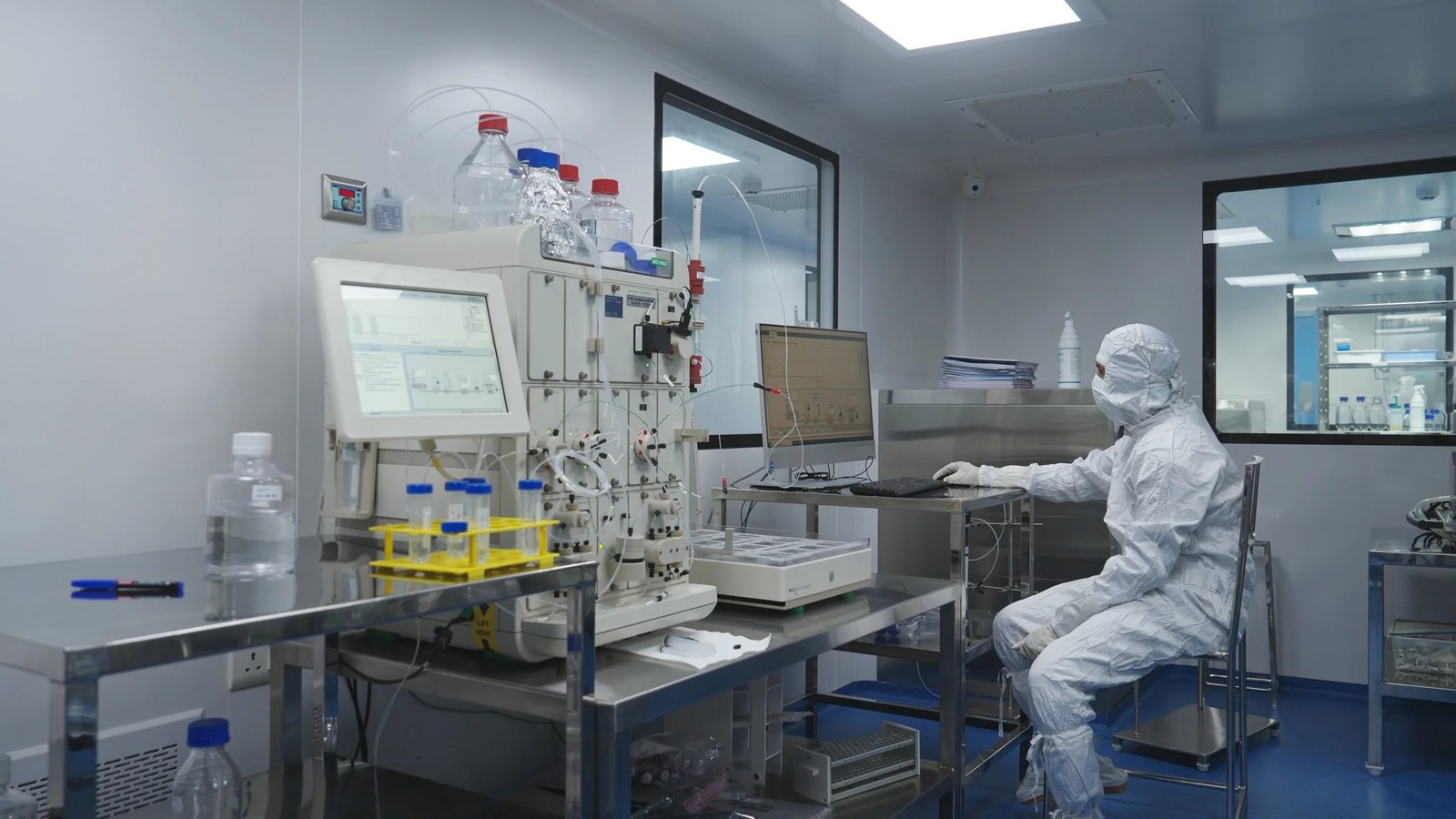
Quality in every vial: an operator running a chromatography system in a Foundry cleanroom. (Image: PopVax / RNA Foundry)
Built on a platform already in the clinic
The personalised cancer programme does not start from scratch. It runs on the same mRNA and lipid nanoparticle platform, and the same manufacturing and quality-control protocols, that PopVax used for its broadly protective COVID-19 vaccine candidate, PVX-001 — a candidate the company says was developed and manufactured at the RNA Foundry and entered a Phase I clinical trial in Australia on 31 August 2026.
The formulation itself solves one of mRNA medicine’s most practical problems: cold storage. PopVax says its proprietary lipid nanoparticle formulation, built around its own ionizable lipid PVXL-150, stays stable for more than nine months in an ordinary refrigerator at 2–8 °C. That fridge-stable design, the company says, makes transport and storage straightforward — a decisive advantage for patients far from specialist cold-chain infrastructure.
The platform behind it is genuinely full-stack. Since late 2021, PopVax says it has built a machine-learning feedback loop for AI-powered protein design, a novel mRNA architecture for immunogen display, its own ionizable lipids and formulations, and in-house fast-turnaround GMP production — a team of more than 100 people across computational design, immunology, nucleic-acid delivery, analytical development, GMP production, quality and regulatory work. Its first programme, an open-source broadly protective COVID-19 vaccine, was funded with $20 million from Vitalik Buterin’s Balvi and the Gates Foundation, and the company says it has secured a further $6 million from the US Biomedical Advanced Research and Development Authority (BARDA), Renaissance Philanthropy and the Gates Foundation for its technology platform and its influenza, hepatitis C, tuberculosis, strep A and HPV vaccines.
Why personalised, and why now
PopVax is focusing first on hard-to-treat solid tumours such as liver cancer and pancreatic cancer, which the company says kill more than 80% of patients within five years of diagnosis. For those patients, a vaccine designed around their own tumour offers something standard treatments cannot: an immune response aimed precisely at their cancer, designed to minimise damage to healthy cells, and delivered as an additional treatment alongside existing cancer therapies.
The timing, the company says, is no accident. Encouraging results from personalised mRNA vaccines combined with immune checkpoint inhibitors against melanoma, and from similar approaches against pancreatic cancer, suggest RNA vaccines may become an important part of cancer care across tumour types in the coming years. PopVax’s bet is that the factory to make them — fast, to a GMP standard, and in India — should exist now, so patients do not have to wait for approvals and infrastructure to catch up with the science.
That is the spirit of the RNA Foundry: a Hyderabad facility turning a patient’s tumour sequence into a vaccine in eight to ten weeks, at a typical project cost of around $300,000, according to the Foundry. It is personalised medicine built as Indian engineering — designed in Hyderabad, manufactured in Hyderabad, and offered to patients and doctors anywhere in the world.
Keep reading: Hours, Not Days: Inside BioCipher Labs, the Bengaluru Startup Decoding Infections With AI · A Robot That Fits a 2×2-Foot Corner: Inside Articulus Surgical’s Pulsar · More Chemicals, Materials & Life Sciences stories
Like stories like this? Add Exceptional Technology as a preferred source on Google to see more of our reporting in your search results and Discover feed.







