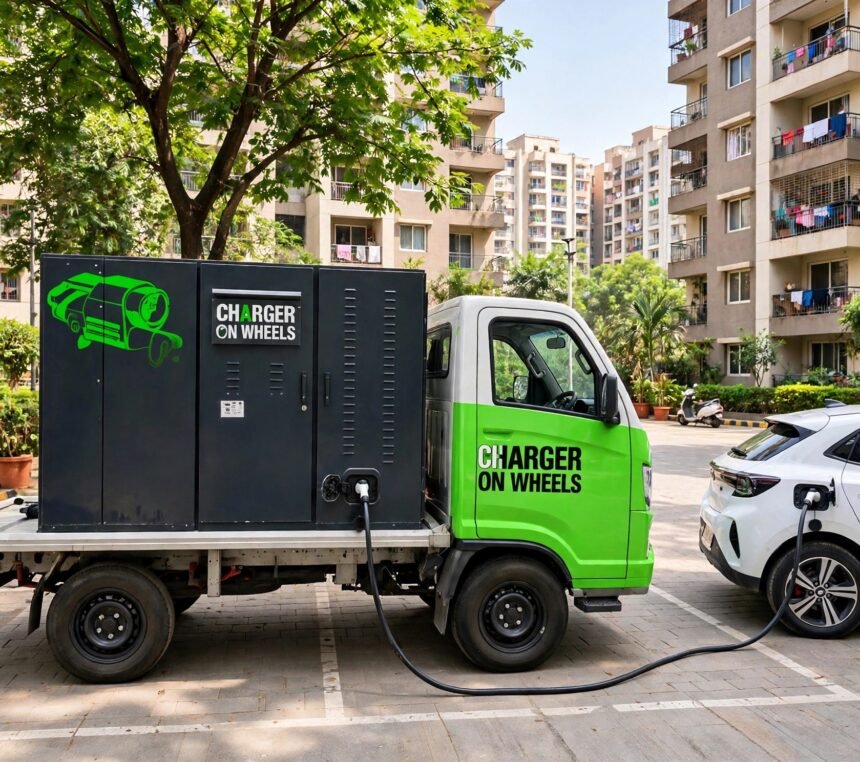
For an electric car owner in a Gurugram apartment complex, the charger has always been the hardest part of owning the car. The building will not allow a private charger in the basement, trenching and transformer upgrades take months and lakhs of rupees, and the nearest public fast charger is a drive away — often busy, sometimes out of order. Charger on Wheels, a Gurugram startup founded in 2024 by Anil Kumar, looked at that everyday frustration and flipped the problem around. If the car cannot go to the charger, the charger will come to the car.
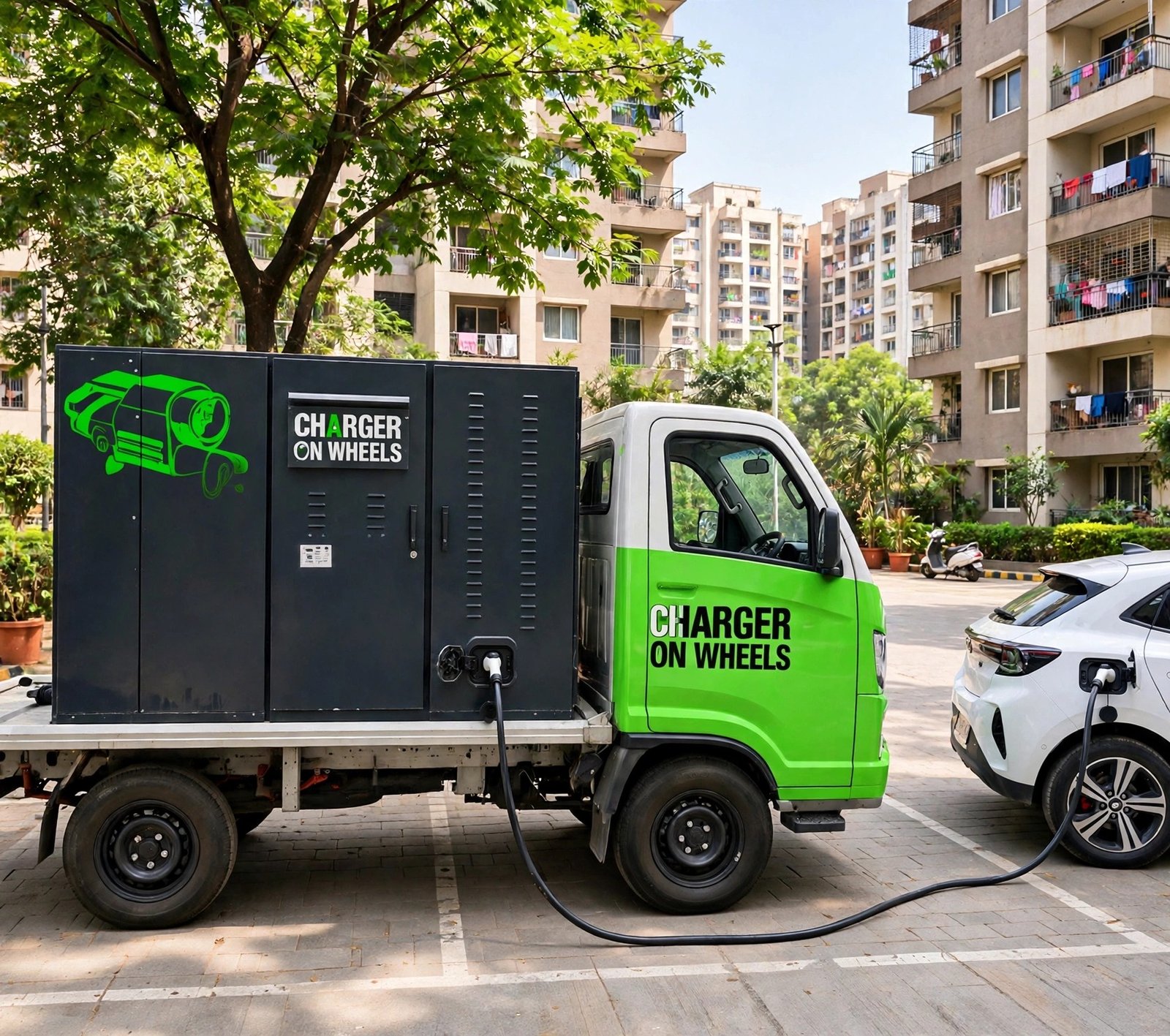
A power bank on wheels
The unit at the heart of the service is a mobile DC fast charger with a battery energy storage system on board — a self-powered charging station that travels in a truck. The company’s first-generation unit pairs a 78 kWh battery with a 60 kW DC fast charger and a single CCS2 gun. Its second generation, built in-house and rolling out since September 2026, carries a 92 kWh battery with a 60 kW DC fast charger and dual CCS2 guns, so two electric cars can charge at the same time, with IP54 water resistance, AI integration and real-time energy and performance analysis.
Booking runs through the company’s app. Pick a slot, and a trained operator drives the unit to the vehicle — home, office or depot — and plugs in. The charging is paced by the car’s own battery management system, tapering automatically as the battery nears 80%, and the company says a session delivers up to 200 km of range in roughly 30 minutes. There is no trenching, no transformer upgrade and no new switchgear: the building never has to be rewired, and the charger leaves when the session ends.
The network, in numbers
Charger on Wheels has been running in Gurugram since January 2026, and the early numbers show a service finding its users fast. The company says it operates three mobile charging units serving more than 280 active customers, handling around 70 charging sessions a day — roughly 23 to 24 sessions per unit, every day. It recorded revenue of &rupee;1.1 crore in FY26 and is targeting &rupee;30–35 crore in FY27, with a published uptime of 99.0%.
The idea lands in a market full of chargers that sit idle. India’s public charging network has grown sixfold since 2022, from around 5,000 stations to over 29,000 by 2025 and 67,657 by August 2026, according to Rubix Data Sciences figures cited by Energetica India — yet utilisation across the network runs at just 1 to 5 percent, because most owners charge where their cars already are: a 2023 Tata Motors study found 93 percent of its EV owners charge at home or in the office. Charger on Wheels builds its whole model on that habit, putting the charger where the cars spend their time instead of asking the cars to come to the charger.
Hyderabad next
The next stop is Hyderabad. In November 2026 the company announced its launch in the city through a collaboration with Aparna Constructions and Estates, bringing doorstep charging to the developer’s residential projects, and began physical incubation at T-Works, Telangana’s prototyping and hardware innovation centre. It has already demonstrated its mobile charging unit to the management of the Indian School of Business at the T-Works facility and showcased the solution at the Indian Green Building Council’s Hyderabad office. Bengaluru, Mumbai and Pune follow, and the company says it aims to deploy more than 70 mobile charging units by March 2027, reaching five cities in 2026, 25 by 2027 and 100 by 2028, with five countries over the next five years.
More Read

The backing behind the build-out is industrial. Exicom Tele-Systems, the listed Indian EV charging and critical-power manufacturer, supports the company’s battery and energy-storage technology, and Charger on Wheels works with real estate developer M3M and is onboarding Bird Automotive, the BMW and MINI dealership group, to put charging within reach of new EV buyers. The service runs on an Energy-as-a-Service model, with subscription plans that cover households, residential communities, fleets and dealerships — and the company is exploring solar power and intelligent energy management to make the mobile network cleaner still.
The bet is a simple one: charging stops being a place you drive to and becomes a service that arrives. If a battery on wheels can bring a fast charger to every parking bay in the country, the hardest part of owning an electric car quietly disappears — and that is the future Charger on Wheels is driving toward, one doorstep at a time.
Keep reading: The Charger That Comes to You: Inside Hopcharge, the Gurugram Startup Bringing Fast EV Charging to Your Doorstep · One Lakh Scooters and Counting: Inside BGauss, the Mumbai EV Maker Quietly Riding Into India’s Top 10 · More Automotive & Mobility stories
Like stories like this? Add Exceptional Technology as a preferred source on Google to see more of our reporting in your search results and Discover feed.