Every season, weeds steal an estimated $11 billion worth of crops from Indian farmers. That is the figure from the ICAR-Directorate of Weed Research in Jabalpur, which tracks losses across ten major crops — and it does not count the labour. Weed management eats up 20 to 25 per cent of total cultivation costs, the institute reports, because the two available options are hiring crews to pull weeds by hand or spraying chemicals that poison the soil and the sprayer alike.
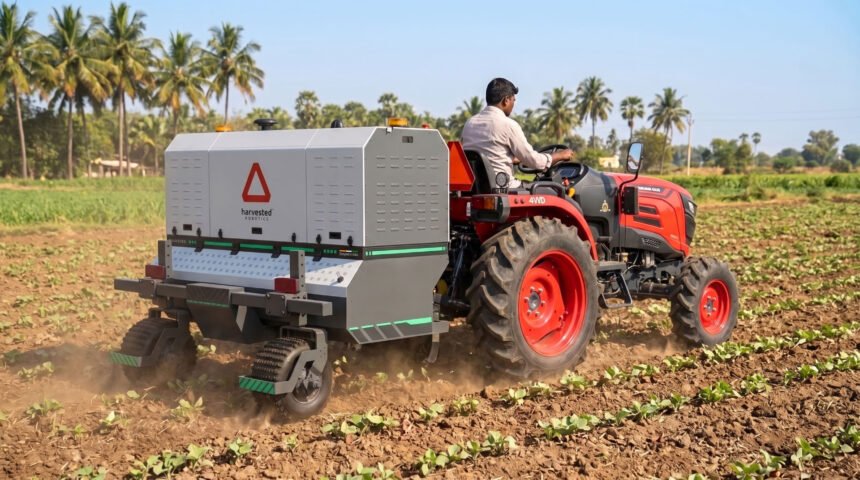
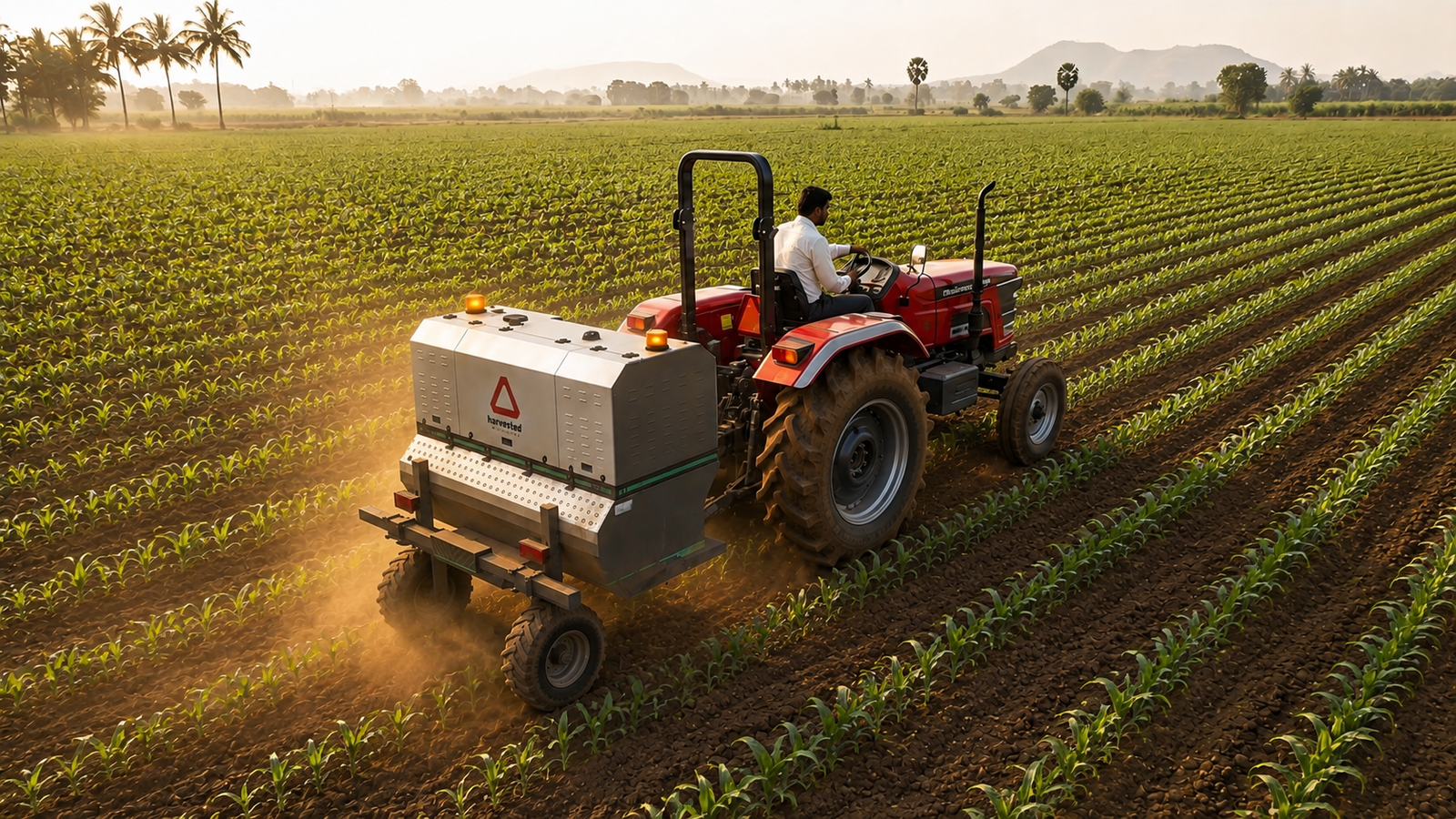
In Hyderabad, two twenty-something engineers decided there was a third option: a tractor-mounted robot that sees every plant, spares the crop, and burns the weed with a laser. Their company, Harvested Robotics, calls the machine RAKSHAK — and says it is India’s first AI-powered laser-weeding robot.
See the weed, know the difference, eliminate it
RAKSHAK bolts onto the tractor a farmer already owns — the three-point linkage, drawing power from the tractor’s power take-off shaft — and turns an ordinary pass through the field into a precision weeding operation. Cameras scan every plant in the row in real time, and an onboard computer running computer-vision models decides, in milliseconds, which one is the weed. Then the lasers fire.
The company says the machine can carry up to four Class 4 lasers, and that it scans, detects and burns each weed in under 0.5 seconds — around 80 to 100 weeds a minute — with a targeting precision of about 5 mm. The detection models run on an onboard computer, so the machine needs no internet connection, and built-in lighting lets it work at any time of day. Detection models are retrained crop by crop, and the company’s roadmap targets 1–2 mm precision for the production version.
The pitch is not just the laser. It is that the laser is the only weeding tool that is precise, instant, residue-free and repeatable — no consumable, no resistance, no waiting period before harvest. Nothing is sprayed, nothing is dug up, and the crop is untouched: the beam fires only after the model has confirmed the target is a weed, and its short range and tight focus keep the standing crop and the soil around it intact.
Built for Indian fields, priced for Indian farms
Laser weeders exist abroad, most visibly in the United States — but the company says those machines cost a million dollars, use carbon-dioxide laser technology, and are enormous and maintenance-heavy. RAKSHAK’s design argument is that it is built around the way Indian crops are actually planted: tight row spacing, small tractors, and fields where farmers cannot afford to treat the whole field when one weed at a time will do.
More Read
The engineering is largely home-grown. Harvested Robotics says it designed the electronic boards, microcontrollers, robotic arm and laser cooling system in-house, and the machine is assembled in Hyderabad. The lasers — blue lasers, the company says, which penetrate chlorophyll faster than invisible alternatives — and the motors are imported. The company has applied for a patent on the system.
The vision stack is being trained the hard way. The team has collected more than 300,000 field images from a single crop using a mapping device it developed itself, gathering RGB as well as near-infrared imagery. Every pass through a partner farm feeds more data back into the models — the company is effectively building an Indian agri dataset while it builds the machine.
The founders and the money
Rahul Arepaka and George Mathew studied computer science at Mahindra University in Hyderabad and founded Harvested Robotics in 2023, starting in their college incubator. Arepaka had already built agricultural robots for competitions, including the World Robotics Olympiad, and done contract work with mechanical-weeder manufacturers before concluding that mechanical weeders could not remove weeds close to the crop.
The company began with a Rs 10 lakh equity-free grant from the Kerala Startup Mission in 2024, then raised Rs 5 crore in a pre-seed round in 2025 led by Arali Ventures, with angel participation from Mahindra Group chairman Anand Mahindra and Country Delight co-founder Chakradhar Gade. The startup was named to YourStory’s Tech30 cohort of 2026.
Caveats, honestly stated
RAKSHAK is in beta testing — the company is currently trialling it on cauliflower at its R&D farm in Hyderabad, with potatoes next — and Harvested Robotics is pre-revenue with no paying customers yet. Arepaka says the machine is two versions away from production, with enterprise pilots targeted by the end of the year and production preparation by August 2027. Timelines in hardware slip; treat the dates as the company’s plan, not a guarantee.
The headline performance figures — 80 to 100 weeds a minute, over 90 per cent detection accuracy, 5 mm precision, the “most affordable in the world” characterisation — are the company’s own, reported by press that visited its farm. The laser and motor supply chain is not yet Indian. And an expected price of Rs 7–8 lakh, aimed at tractor-owning farmers with around five acres of row crops, still puts the machine out of reach for the smallest farmers — which is presumably why the company reports a waitlist of 200 to 300 farmers already sizing it up.
Still: two college engineers building a vision-guided laser robot for Indian agriculture, assembling it in Hyderabad, training its AI on Indian fields and pricing it at a fraction of the American equivalent — that is exceptional engineering pointed at a problem worth $11 billion a year, and exactly what this site exists to showcase.