In a crowded government hospital outpatient ward, a doctor sees patient after patient, hour after hour. The consultation happens in Hindi, Marathi, Kannada or Telugu — and when the patient walks out, almost none of what was said makes it into a health record. The next doctor starts from zero. Now a Bengaluru health AI company is changing that, one conversation at a time: EkaCare has been selected by the National Health Authority to build an AI voice scribe for doctors across India’s public health system, a system that listens to the consultation and writes the clinical note itself.
The selection, announced on 11 November 2026, makes EkaCare the technology partner for the National Health Authority’s Ambient AI-enabled Voice Scribe under the Ayushman Bharat Digital Mission. The solution will run on National Health Authority infrastructure powered by Amazon Web Services, and it is designed to turn millions of everyday consultations into structured, searchable digital health records.
A scribe for every consultation
Millions of consultations take place every day in India’s public health facilities, and much of what is discussed never reaches a health record. The Voice Scribe listens to each consultation as it happens and prepares a structured clinical note, so doctors can focus on their patients rather than on typing.
Each note covers complaints, history, medications, vitals, lab findings, diagnosis and plan, following speciality-specific templates and produced in FHIR, the standard used across the Ayushman Bharat Digital Mission. The doctor stays in control: every note is reviewed, edited if needed and approved by a verified doctor before it is saved and linked to the patient’s ABHA health ID. Doctors using the Voice Scribe’s own screen sign in through the Healthcare Professionals Registry.
Public hospitals can adopt the Voice Scribe inside their existing software through an embedded mode that plugs into their Hospital Management Information System, or use it through its own screen or through APIs built on the open MedScribe Alliance standard for medical scribes. And it is secure by design: the Voice Scribe is designed to run entirely within the National Health Authority’s own airgapped secure environment, so public health facilities keep complete control over data sovereignty.
Built in India, for the way India speaks
The Voice Scribe is powered by two technologies that EkaCare built in India, for Indian clinical settings.
More Read

The first is Parrotlet-A 2.5 Pro, EkaCare’s open-weight speech model for Indian healthcare voices. Its weights are publicly available on AIKosh and Hugging Face, and in a public benchmark of 6,550 real Indian consultations, the company says it had the lowest error rate of all the models tested in each of the five benchmarked languages. The Voice Scribe supports more than 15 Indian languages, including conversations that mix languages, and its speech model has been benchmarked on major Indian languages such as Indian English, Hindi, Marathi, Kannada and Telugu.
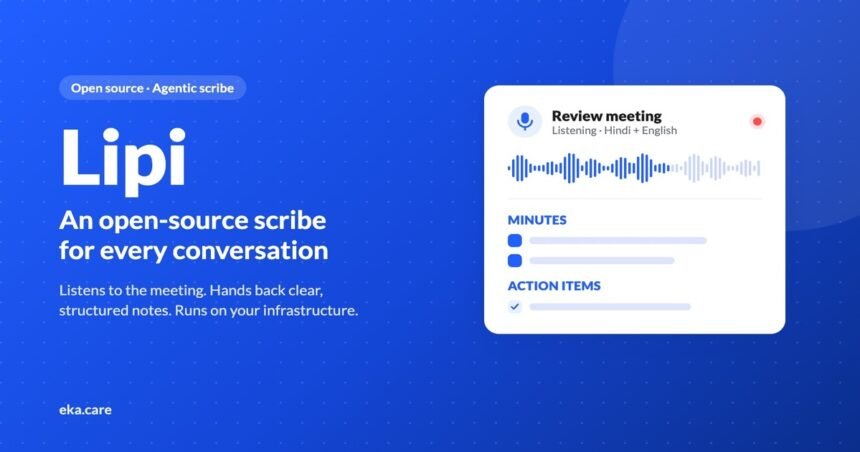
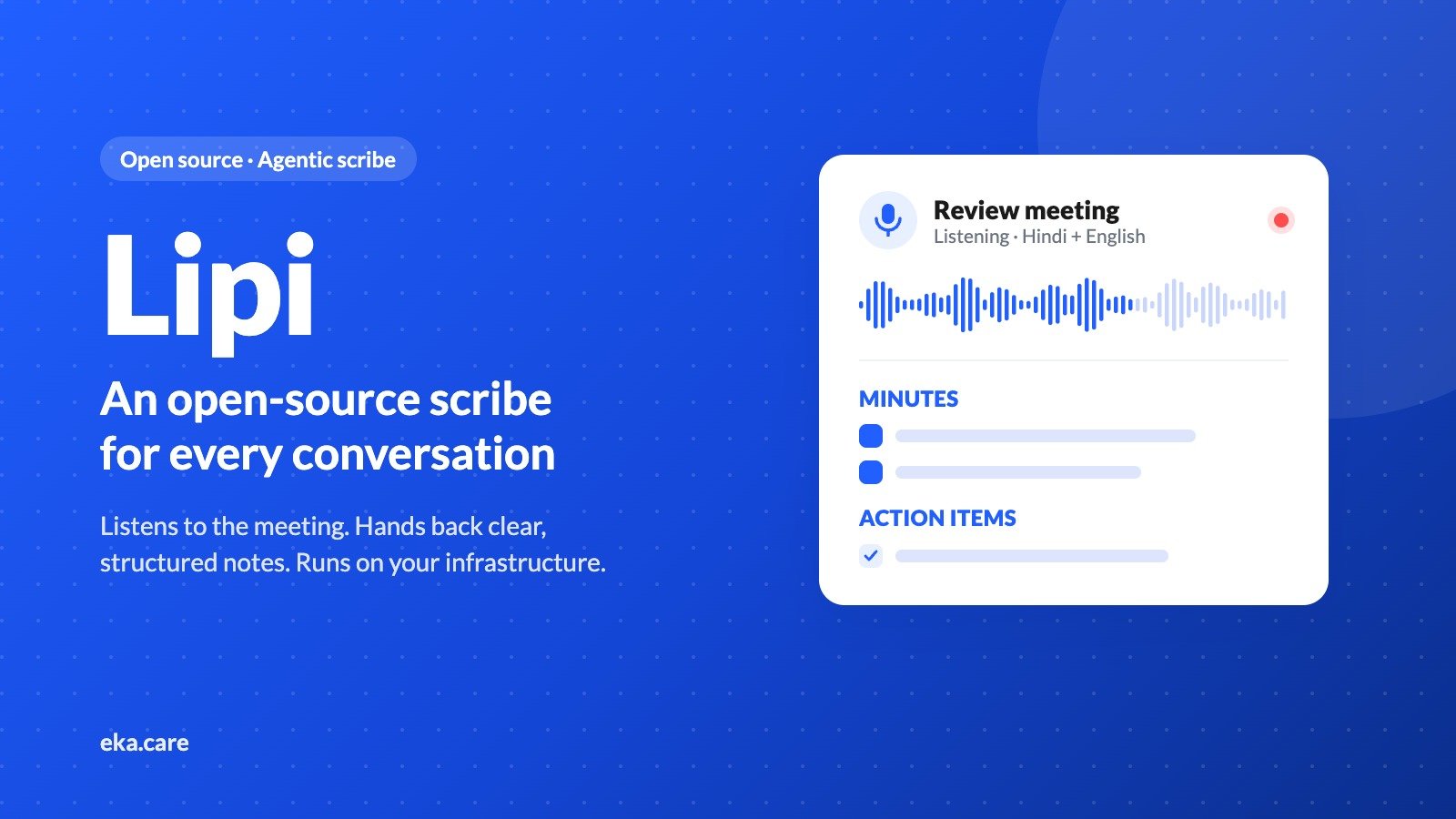
The second is Lipi, formerly known as Vaarta — EkaCare’s open-source agentic harness, which turns conversations, from meetings to medical consultations, into structured records. The electronic medical record inside the Voice Scribe is built on Lipi, and because Lipi is open source, developers, hospitals and researchers can use it, adapt it and contribute to its development. EkaCare publicly open-sourced Lipi on 11 November 2026, the same day the National Health Authority selection was announced.
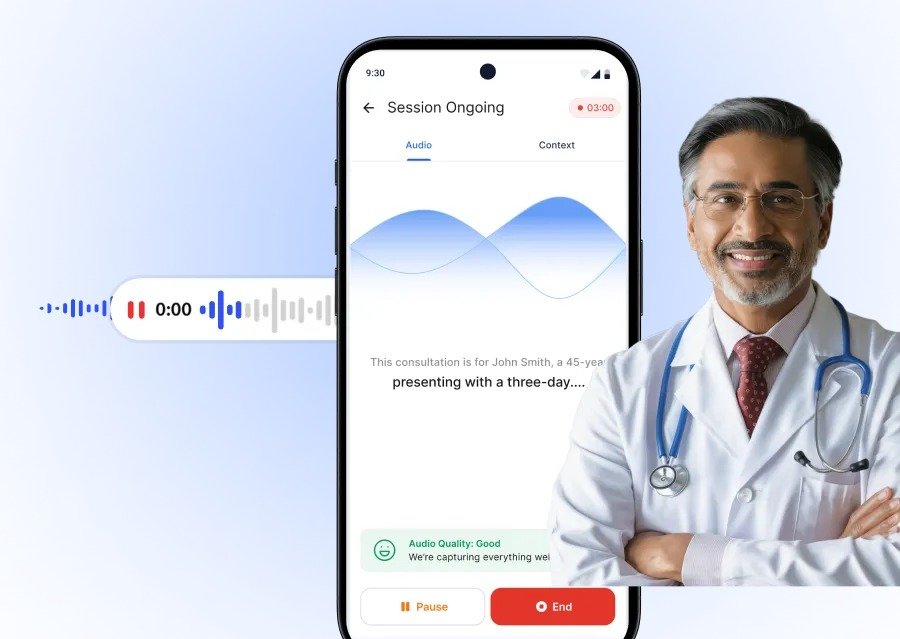
“Doctors should be able to give their full attention to the patient, not to a keyboard,” said Bhaskar Chaudhary, Chief Product Officer at EkaCare. “With the Voice Scribe, a doctor can speak with the patient in the language they are comfortable in, and a structured clinical note is ready for review when the consultation ends.”
From a thousand doctors to a national system
EkaCare was selected through the National Health Authority’s Expression of Interest process for open-source ambient AI voice-to-text solutions for digital health record creation, which included a demonstration before the authority’s Evaluation Committee. The technology was also demonstrated at the authority’s National Review Meeting with States and Union Territories, held in Kolkata on 5 and 6 November 2026, where founder and chief executive Vikalp Sahni and Neha Jagadeesh, vice-president of AI engineering, presented the company’s speech recognition model and agentic harness.
The Voice Scribe builds on the technology behind EkaScribe, EkaCare’s ambient medical scribe, which the company says more than 1,000 doctors already use in private practice. EkaScribe is India’s first AI medical scribe, the company says, purpose-built for India’s crowded, noisy outpatient departments, where it turns free-flowing conversations into structured medical records and prescriptions.
The company behind it
EkaCare was founded in December 2020 by Vikalp Sahni, Deepak Tuli and Abhishek Begerhotta, with a vision to build the technology backbone for a health profile for every Indian. Sahni, the former chief technology officer and co-founder of travel platform Goibibo, had built the hackathon project that became Aarogya Setu, and saw first-hand how embryonic India’s digital health journey still was.
The company raised $4.5 million in a seed round led by 3one4Capital in 2021, followed by a $15 million Series A led by Hummingbird Ventures in 2022, with participation from Mirae Asset, Verlinvest, Aditya Birla Ventures, Binny Bansal and Rohit MA. Today the nearly 100-member Bengaluru team’s platform serves almost 65,000 doctors and about 18 million users, the company says, and its app — available in 12 languages — was the first private platform approved by the Ayushman Bharat Digital Mission to facilitate the creation of ABHA health IDs. Its technology is already integrated into apps including Samsung Health and Medanta, and the company has also released KARMA-OpenMedEvalKit, an open-source framework for evaluating clinical AI models in India.
Why it matters
India’s public health system runs on conversations — millions of them, every day, in languages and accents that global AI was never trained to understand. Until now, most of those conversations vanished the moment the patient left the room, leaving behind paper slips and memory. EkaCare’s Voice Scribe captures them as structured, interoperable records that follow the patient, inform the next doctor and feed a national digital health system. It is Indian AI doing what it was built for: listening to India, in India’s own languages, and giving doctors their time back.
Keep reading: The App That Knows Which Door to Knock On: Inside Froncort.AI’s AI-NETRA · Sewage In, Garden Water Out: Inside Tellus Habitat, the Bengaluru Startup Recycling India’s Wastewater · More Chemicals, Materials & Life Sciences stories
Like stories like this? Add Exceptional Technology as a preferred source on Google to see more of our reporting in your search results and Discover feed.